The lossless mode is great (but more limited than PNG), the lossy mode sucks though. Like it only supports a quarter of the colour resolution compared to formats like JPEG.
Also being a video format, it’s not actually tuned to store still images, it likes to blur/smear things.
There are many valid criticisms one can make of webp; perhaps discussing the pros and cons. Rather than using those you instead went after it’s name not being linguistically accurate.
I use webp a lot, it’s smaller than PNG for lossless images like screenshots and smaller than JPG for lossy while working for both. All the image editors and image viewers I use support it, so it’s not inconvenient for me in any way.
Also Portable Network Graphics, as the name suggests, is a network image format, not a digital image format. Just having a laugh : )
I think you are talking about website hosting, which has nothing to do with my offline images. I have nothing to do with websites.
But if you are talking about using it for publishing, some time ago I published a mobile app that shows an offline map for some mountain trails. All the map tiles were originally PNG and took 900MB, but I got them to 50MB as WebP tiles. That’s quite a reduction, nobody would download a 900MB app!


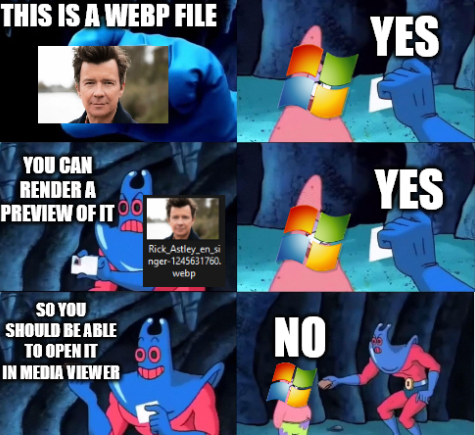
Irfanview is the answer.
I don’t even know what the question was tbh, but I’m still right.
Irfanview is always the answer!
not allowing webp is the answer.
webp, as the name suggests, is a web image format. not a digital image format.
webp is a fucking cancer and deserves to be put in the same place betamax and 8-tracks were left to rot.
Why is it bad? Like what should I use instead on my website for images and icons?
webp is fine for web publishing.
I have a problem with websites that use middleware that makes webp masquerade as jpg or png. so when you go to save it locally, it’s a surprise webp.
not only that, webp is a standard that google made and pushed into the web consortium. I explicitly hate anything Google forces on the Internet.
The lossless mode is great (but more limited than PNG), the lossy mode sucks though. Like it only supports a quarter of the colour resolution compared to formats like JPEG.
Also being a video format, it’s not actually tuned to store still images, it likes to blur/smear things.
There are many valid criticisms one can make of webp; perhaps discussing the pros and cons. Rather than using those you instead went after it’s name not being linguistically accurate.
A bold strategy cotton.
I use webp a lot, it’s smaller than PNG for lossless images like screenshots and smaller than JPG for lossy while working for both. All the image editors and image viewers I use support it, so it’s not inconvenient for me in any way.
Also Portable Network Graphics, as the name suggests, is a network image format, not a digital image format. Just having a laugh : )
why does the size of images matter when the compiled JS bloat is 60x what it should be?
if you’re properly using content caching load times shouldn’t be a problem at all, thus negating challenges to image file sizes.
and if you’re using webp for HQ images you’re better off using png or even jpg.
I think you are talking about website hosting, which has nothing to do with my offline images. I have nothing to do with websites.
But if you are talking about using it for publishing, some time ago I published a mobile app that shows an offline map for some mountain trails. All the map tiles were originally PNG and took 900MB, but I got them to 50MB as WebP tiles. That’s quite a reduction, nobody would download a 900MB app!
Unless the question was do you use faststone 😉