- cross-posted to:
- AntiMeme@sopuli.xyz
- cross-posted to:
- AntiMeme@sopuli.xyz
You must log in or register to comment.
And then he was yeeted out of the window
Don’t even have to invest. In my area, a 100% renewable supplier was about 30% more per KWH, all of that extra overhead was paid to keep old unprofitable coal plants online. That’s capitalist efficiency for you.
Maybe it would also be much cheaper if “your” houses were a bit smaller and had proper insulation…
I think it would cost trillions of dollars to rebuild all houses to be smaller. Imagine the carbon footprint of that endeavor.
I wish!! Unfortunately, I didn’t build my house.
Have you considered inventing a time machine, going back in time, becoming a general contractor, and then building your house but smaller? Smh, people won’t go the slightest bit out of their way to make things better these days.
Not sure if you’re referring to USA, but the energy code in the US is quite strict. Since the 80s insulation has been required and in the last 20 years the code has tightened to be quite strict. Homes in Latin America have none, no energy code, and European housing stock predates these requirements. Doesn’t mean US homes don’t consume a ton of energy but they are probably way better insulated than average.
Both Europe and US are big enough to have a huge variety in building codes for different climates in different states/countries.
Hilariously my 1200 sq foot 125 year old home is much less energy efficient than my in-laws 3000 sq foot 3 year old home due to the greatly improved insulation and sealing practices in modern structures. On the other hand my house is so drafty I don’t have to worry about things like mold growth due to improper vapor barriers nor the air becoming too stale due to insufficient circulation
Its not all about insulation though. A terrace has much less exterior wall than a row of spread out detached homes. Some still insulate the party wall. but more for sound reasons. But the main advantage of terraces , fossil fuel-wise, is that the medium-density is more likely to give you a walkable grocery + other stuff and a somewhat useful bus service or other public transport.
Though modern suburbs here can be pretty sparse too with more detached homes.
The UK is leading the western world in renewables in many ways, yet our bills are some of the most expensive.
How many nuclear plants?
The UK isn’t leading they way. They’re dragged kicking and screaming because they no longer have access to cheap Russian fuel. They’ve made it into the 45% bracket, which is good but not exceptional.
Sweden, Finland and Denmark had the highest RES (Renewable energy source) shares among Member States in 2024 due to strong hydro industries (Sweden and Finland), wind power and wide use of solid biofuels for district heating. All of which are driven by public investment and administration.
UK drop off in carbon emissions over the last 40 years has largely been the result of deindustrialization and exporting of manufacturing abroad. They still consume a great deal of carbon per capita. They just do it by purchasing finished goods from overseas.
Of late, they’ve also been rebuilding their old dirty energy economy to power AI datacenters.
Also to add to what you wrote, another reason is that their North Sea oil reserves became pretty much depleted in the last decade or two with gas following it, which has pushed gas prices higher and hence pushed people to user more electricity (gas prices in Britain were famously low) and along with exporting all industry to places like China and Bangladesh that has naturally brought down Britain’s direct CO2 emissions.
Yet another reason is that the Crown makes money from licensing space for offshore wind farms since they’re the ones who officially own the seabed around Britain.
I used to live as an immigrant in Britain and, still today, it still never ceases to amaze me how so many of them keep falling for the “Britain is leading…” bullshit they’re constantly fed by the media and politicians over there, not just in this but in pretty much everything (Brexit didn’t happen in a vacuum).
Even my shitty shit country - Portugal - has long been beating Britain in this (as it’s a much poorer country, badly managed and with lots of problems) purelly because even in the time of Salazar (the Fascist dictator) there was a lot of investment in Hydro-generation, which continued after the Revolution in 74 and expanded into Wind-generation (actual in-shore wind, because unlike in Britain the NIMBYs don’t have the power to just push it to be the much more expensive offshore kind) and later Solar, so whilst Britain was mismanaging their North Sea reserves and burning oil and gas like there’s no tomorrow (part of the reason why Norway has a massive sovereign fund and the UK does not - the Norwegians didn’t just burn it like crazy and wasted the money of whatever was sold) my country was already generating a lot of its power from hydro and it just became more so since.
Shitty shit Portugal is now in the 75%+ bracket on renewables.
The idea that Britain is leading anybody in renewables adoption is hilariously wrong.
Removed by mod
We’d spend money up front to build the green energy generation. Distribution costs don’t go down, and tend to increase over time. It would take a while to realize any savings on the consumer bills?

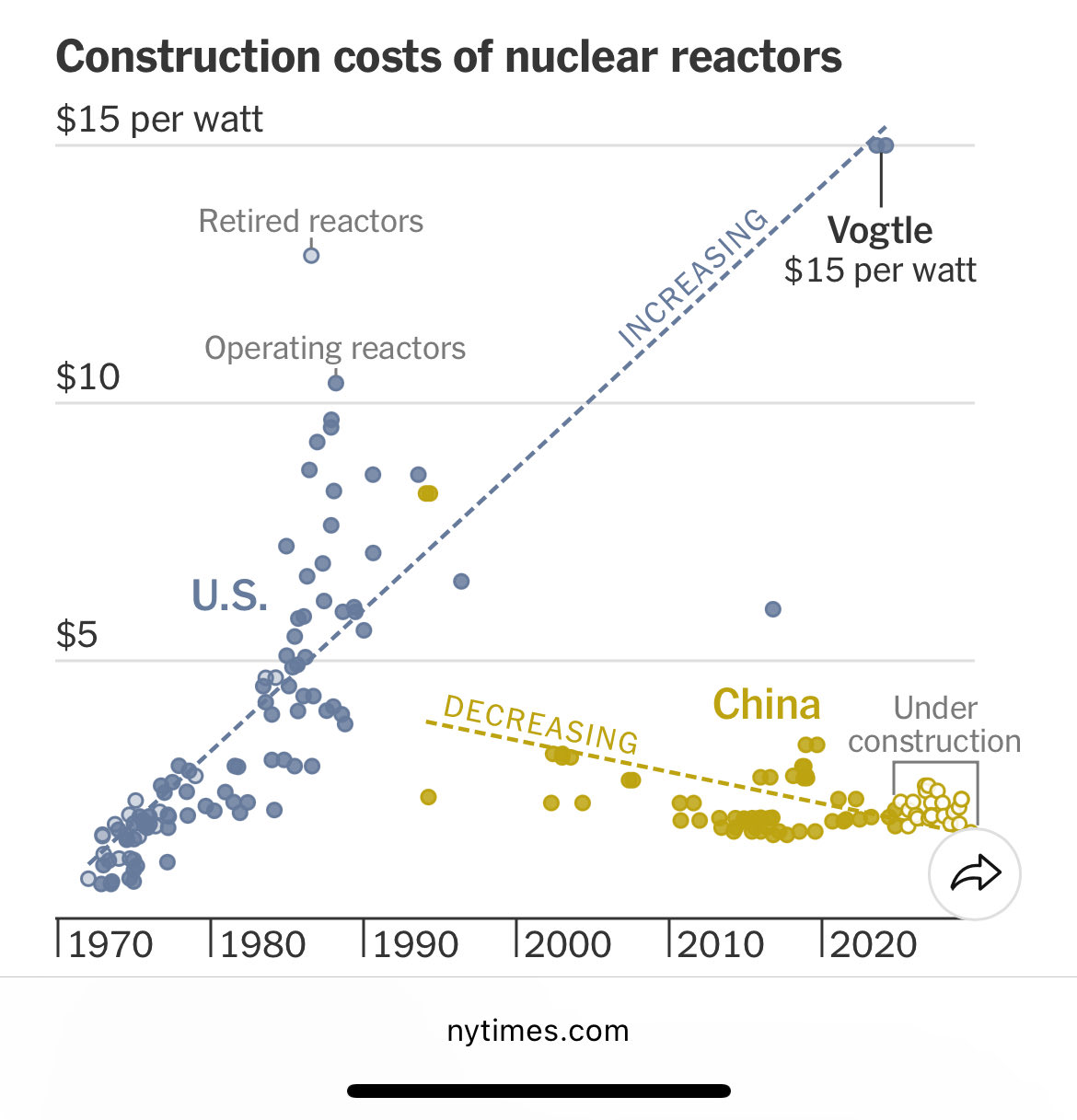
Reminder for anyone looking at this graph that nuclear is driven high by western incompetence, and nuclear prices actually continuously drop in places with competent governments like China
It depends how you do it. I invested in green energy with a heat pump and spend fuck all compared to some people I know in heating. With a home battery I could cut my energy down to about £300 a year. Dont even need solar for that.
Imagine the savings to society with the energy independence from green energy
- shut down most of the continent wide natural gas distribution infrastructure
- shut down most of the continent wide gasoline distribution infrastructure
- cut way back on the military when we no longer have to protect oil kingdoms
There were recently a couple of bad gas leaks locally and it was an interesting reminder that there’s these natural gas lines laid crisscrossing the northern US that are just explosions waiting to happen. There’s been some nasty ones too
The unavoidable conclusion in today’s world is that we need to be phasing out natural gas. It can’t be cleanly turned off and back on, it’s wildly dangerous if it leaks out due to poor install/maintaince or natural disasters, it can explode if someone happens to drill into a gas line (I know a guy who did internet installs and at the time he joked about how “yeah you just drill holes into folks homes to poke the cables through and hope you don’t hear hissing after drilling”) during a house fire it just feeds more extremely potent fuel into the fire until turned off. About the only benefit is when it’s extremely cold out, such as when the destabilizing polar vortex whips through, natural gas is probably the most energy efficient option to keep homes and businesses inhabitable
Plus methane is a much stronger greenhouse gas than CO2, even with the shorter lifetime. We seem entirely unable to reduce methane leaks or even measure them against natural gas usage.
But from a consumer perspective.
- where I live, electricity is much more expensive than natural gas, maybe double the cost per unit of energy
- and I pay even more for 75% renewables
- I just got a heat pump installed for my addition. So far temps have gotten just a bit under freezing and it has no problems keeping up
But that adds up to a reality where the cost threshold is mid-40°F’s. While it may be an argument in favor of solar, I don’t have enough unshaded roof to generate more than half my usage
I know your intentions are good, but this reads as a rather damning list of why a bunch of people are going to fight tooth and nail to keep the status quo.
This is an absolute fact: the government refuses to invest in green energy because it produces too much energy and they’d have to give out power for free.
Yes. All of my problems are the government’s fault.
Well that’s a rediculous mischaracterization. All my problems are capitalism and how it influences the government’s fault.
If only the government would government me out of this!
This is really a huge oversimplification of a complex and nuanced topic. But the main thing worth mentioning is that your utility bills, in all likelihood, are already insanely cheap if you compare what you get to any other time in history. Like, keeping your home temperature at a perfectly pleasant temperature 24 hours per day probably costs you only a couple hours of labor each month. Compare this to gathering sticks in the forest and lighting a fire inside a mud hut - which, btw, also gives you lung cancer faster than cigarettes.
Should the government invest more in renewables? Yes, obviously. They should also fund the infrastructure necessary to make renewables work at scale, and research to improve renewable generation, transmission, and storage tech in order to close the gap between what is practical now and what we need to achieve. And while they are at it, they should introduce improved pricing schemes to head off increased wasteful usage. But will any of this actually have a direct impact on consumer pricing…? Probably not, since almost all utilities are already state owned or else heavily regulated. The cost of electricity is determined more by committee and political maneuvering than the actual price of, say, coal or solar on a day to day basis. The actual mechanism of paying for power to be generated and delivered to your house on demand is a combination of the price you pay per kwh, property taxes, government revenue in general, debt taken on by the government or utility, investments made in the past, etc. If you actually want a cheaper price per kwh, the solution is simply petitioning whatever regulatory body is in charge to lower it.
Of course, the problem with lower prices is that they encourage wasteful usage. If electricity becomes free, then aunt Ethel will start blasting the AC while leaving the windows open, because she likes to be comfortable while listening to the birds chirp. Without appropriate pricing schemes, people and companies will use up as much additional renewable capacity as is built as soon as you finish building it.
My heating bills runs close to $800 a month in the Winter. That is more than a few hours of labor.
heating bills runs close to $800 a month
You are spending WAY too much per month on heat. Upgrade the insulation in your home and seal air leaks.
Also, do not use resistive heat. It is the most expensive heating solution by a wide margin.
Trust me, I have been eyeing a heat pump for awhile now.
The house is close to 4k square feet, but I do have 10 people living there so it is being well utilized. I also live in Alaska so we get entire months of sub 20 temperatures.
It is still hard to deal with when you get that fuel bill.
Hence why I said “in all likelihood”. There are always exceptions to the rule. Apparently you are one of them.
The average for the whole US during the winter is just under $1,000. That is around $250 a month. This is also not a “few” hours.
Central air can easily run +$200 a month during the summer.
I will admit I have a big house that is heated with diesel. My bill would be half that if I had a heat pump.
Considering most Americans were living paycheck to paycheck before this recent bout of inflation, I don’t think most have any extra money to play around with anymore. It is time for tough decisions like keeping the house warm or eating things other than ramen.
Nuclear is also a good option. It has the potential to scale up to our generation needs faster than green energy, and it can still be environmentally clean when any byproduct is handled responsibly.
Do I trust my government (USA) to enforce proper procedure and handling? Not really… but I do think we’re less likely to have a nuclear accident in the present day. Modern designs have many more fail safes. And I think it’d still be much cleaner than burning fossil fuels.
I think they need to coexist, though. I think a goal in the far-future should be a decentralized grid with renewable energy sources integrated wherever they can be.
Basically the one nation I would have most trusted to handle nuclear safely, Japan, couldn’t even do it. The issue these days is not that the plants themselves are unsafe, it’s that we live on a active and changing planet, and accidents can and will always happen because of so-called acts of God. The problem is that nuclear, when it goes bad, tends to go mega ultra bad in ways that are very environmentally destructive and heinously expensive to clean up. So even if there is only 1/10000 the accident rate at nuclear plants that there are at other power plants, the consequences can be a million times worse.
Why is your model for nuclear Japan? China is the world’s forefront of nuclear energy research and development, keeps expanding its capabilities, and has a clean record with no accidents.
Regardless, you’re overestimating the damage that nuclear has done in comparison with other energy sources. You could have one Chernobyl per year and you wouldn’t come close to the death toll coal or oil have worldwide. Regarding Fukushima for example, since you brought up Japan: some recent studies suggest that more people have died as a consequence of the upending of their lived by the evacuation of the whole region, than would have died according to realistic statistical models of radiation damage to humans. The main problem is that fossil fuel lobbies have successfully made people completely intolerant of radiation damage while they happily live in cities breathing in NO2 and particulate matter without one complaint.
Yeah one really nice thing about nuclear is it’s very easy to safely hide all the waste away for 20-60 years and pretend it’ll never leak or cause issues for anyone in the future, but then you get a https://en.wikipedia.org/wiki/Hanford_Site
Wow, an energy source which sometimes has increased cancer rates in its vicinity due to pollution? Thank golly all other energy sources don’t have such problems!
thorium is nuclear too… (and doesnt seem to have the same runaway problems!)
Love me some Thorium! It doesn’t address every natural-disaster type of concern as far as radiation leaks and environmental contamination, but is absolutely the better choice over Plutonium/Uranium in terms of meltdowns and nuclear waste.
Would you feel better about nuclear if we expanded these rebreeder reactors I’ve heard of (uses spent nuclear waate) to the point there is no spent fuel sitting around?
yeah if we could not stick shit in the ground that remains deadly for thousands of years, with containment solutions designed to last 20-60 years, that would be great. But we just keep pretending this stuff is cleaner than it is because we’ve learned how contain the waste safely for about a single human lifespan. But just read about the slow-motion disaster that are the US nuclear superfund sites and you’ll see that you can put off the consequences of this waste for so many decades before it comes back around. And there is no waste-free nuclear tech at this point, just less wasteful.
Humans would never cheap out on health and safety, or reduce regulatory red tape just to try to bring costs (and maybe, though less likely, prices) down. Unheard of.
Also you can vastly reduce the amount of battery capacity needed by having pilotable sources of energy like nuclear, hydro, geothermy and such
Except nuclear is not very pilotable. More than Solar or Wind. But can’t really be turned off either
Sure hydro is a lot more pilotable, or better yet, batteries.
But actually, turning it off 100% is probably the least important property of pilotable plants : you almost never need that. What does matter, however, is that those plants can be engineered to generally follow the daily demand curve and France’s plants can do that at the rate of about 1% per minute.
Bold of you to assume the government cares about you at all.
If “our” means on the US, you may have to take a look at your electricity monopolies for it to make any difference.
The US has some of the cheapest energy in the civilized world. I’m not sure what to draw from that fact, but it is clear our energy system works pretty well for the end-user.
For a counterpoint, check out Germany’s expensive as fuck energy.
You have some of the world’s cheapest electricity wholesale. You also have a huge variance in prices to end-user, with the people that complain on the internet being among the most expensive in the world… because, of course, people that get cheaper prices don’t complain.
Also, yes, electricity in Germany is expensive as fuck.
It’s also one of the oldest and poorly maintained for much of the country. As the data centers keep going up it’s making it harder and harder to meet customers energy needs.
Taking away (partially or completely) reliance upon carbon or nuclear energy will reduce costs and help save the planet. Like my solar set up, it costs less to run my home and workshop in summer than it does in winter.
Fuck your government, cover your roof in panels and enjoy. Simple as
because of nationalism, i cannot.
In FL, even if your home fully self sustains on solar and batteries, by law you still have to pay the power company $36 a month to be connected to the grid you don’t want to be a part of.
I left FL… over a year ago.
Here’s the other kicker… a huge chunk of Republican campaign funding comes from the power companies. FL residents are essentially being forced to fund the campaigns of people that seek to rule over them, not represent them.
Brother the only way it’s cheaper to source your own panels is if you buy them outright. Less than 50% of Americans have a savings account let alone 10k in disposable income.
If you take out a loan for the panels the payments equal what your electric bill would be and by the time you pay off the panels it’s time to replace them.
So you paid the same amount you thought you were going to pay, your bill didn’t increase that whole time, your carbon footprint was lower and you didn’t give any money to the ratfuckers? Where is the downside?
It’s not lower. Most electric bills are lower in the winter. You’d pay more in the winter months.
I had a whole thing about my setup here, but it was more than I want to share. Short version, panels are cheaper, easier to deal with, and longer lasting than you think. Most manufacturers guarantee 80% capacity after 30 years, area covered is more important than max output, there’s no need to buy the whole thing at once, 3-5k no more than 1200 at a time over a few years can get a lot of people all they need
No they wouldn’t. Final consumer cost is based on what people WILL pay not what they WANT to pay. At the end of the day the overarching goal of capitalism is for 99% of the population to spend 100% of their earnings. You can’t funnel all wealth to the 1% if the 99% are holding on to it.
So you’re telling me if I found a way reach all my fellow power company customers we could strike and lower our power rates?
Many states have very regulated utility prices: you may need just a half dozen buddies and get appointed to the oversight board that approves rates
This guy politics.
In the short term, yes. The money you’ve saved is now considered “disposable income” and will be absorbed by the next person in line.
If a paycheck could make you wealthy, no one would give you a paycheck. A retirement account CAN make you wealthy but only after the machine has squeezed 40+ years out of you. But one way or another that money is leaving your hands and flowing back into the system.
This is sounding like you’re trying to do a socialism over here.
Sounds like you don’t understand what socialism is
Yes. It’s like big telecom. When people install panels at home, power companies start inventing additional fees. If communities start looking for local grids, companies start lobbying to outlaw this.
The main problem with that is the large power consumption by industry. This is ensuring continued profits for the company and thereby weakens your influence, similar to hiring scabs.
Yes. BUT there are certain ways a government can help its citizens (and itself in most cases) by allowing them to be self sufficient that has nothing to do with electric companies or monopolies at all. The subsidies for solar panels were a great example of this. Depending on your personal needs, you could generate enough power to take yourself off the grid, and the government invested in your panels by way of those subsidies. In many cases the extra electricity from the panels that you don’t use can go back into a grid to be used by someone else. Theoretically helping you and the government. There are, of course some issues with the system but speaking from experience it can absolutely work and work wonderfully.
Unfortunately Trump (of course) has killed these subsidies so that will not be a thing as of new years 2026.
Ok, sure. There are theoretical and convoluted ways to disconnect from the electric grid. You’re still buying solar panels. Your out of pocket costs don’t change. The river of money still flows into and out of your life. It’s called currency for a reason. The whole system is designed to stop you from keeping your money.
The dark secret about money is that it only works when there’s isn’t enough for everyone. Despite what politicians want you to believe, you are SUPPOSED to live paycheck to paycheck- at least under a western capitalist economy. This is why poor people are both the most valuable citizens, and easiest to control. It’s slavery with more steps.
In a free market, people will pay less for the same service if they can.
Capitalistic utility monopolies are a scam.