Kierunkowy74@piefed.social to Linguistics Humor@sh.itjust.worksEnglish · 3 months agoThe illusion of free choicemedia.piefed.socialimagemessage-square9fedilinkarrow-up169arrow-down12
arrow-up167arrow-down1imageThe illusion of free choicemedia.piefed.socialKierunkowy74@piefed.social to Linguistics Humor@sh.itjust.worksEnglish · 3 months agomessage-square9fedilink
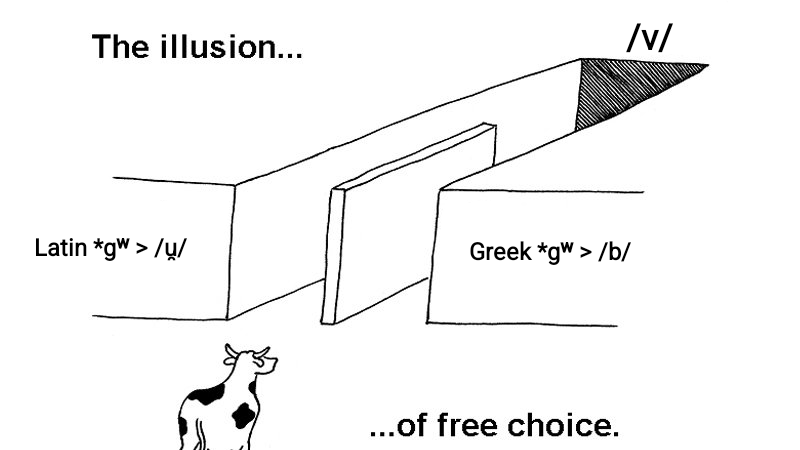
minus-squarefunkless_eck@sh.itjust.workslinkfedilinkEnglisharrow-up2·3 months agoat a casual glance, it looks like a significant difference is that the Latin ellided from a palatal consonant and the Greek from a bilabial to end up at the same phoneme.
minus-squareLvxferre [he/him]@mander.xyzMlinkfedilinkEnglisharrow-up2·3 months agoLatin [w] is labiovelar, just like [gʷ]; no palatal in this case. The difference is mostly order of operations: Latin - lenition, then loss of the velar articulation: [gʷ]→[w]→[β] Greek - loss of the velar articulation, then lenition: [gʷ]→[b]→[β] then [β] evolving into [v] in both.
minus-squarefunkless_eck@sh.itjust.workslinkfedilinkEnglisharrow-up2·3 months agoapologies I meant velar, my brain short circuited over “soft palate”.


at a casual glance, it looks like a significant difference is that the Latin ellided from a palatal consonant and the Greek from a bilabial to end up at the same phoneme.
Latin [w] is labiovelar, just like [gʷ]; no palatal in this case. The difference is mostly order of operations:
then [β] evolving into [v] in both.
apologies I meant velar, my brain short circuited over “soft palate”.