You’re just as wrong either way. If you’re talking about the general public, then your demanding the people change their views to line up with those of a politician, rather than the other way around. Not only is that antithetical the the very idea of democracy, it’s also just impractical. Isn’t it much easier to get one person to change their views instead of millions? Why are you focusing on the millions then?
It’s because you’re looking at things from entirely the wrong framework - one that has internalized the supposed “superiority” of the ruling class and asks nothing from them, instead trying to discipline the public to serve the elites unquestioningly and unconditionally. Your worldview is completely upside down.
No, it’s simply that I understand that voting is a method of selecting leaders from the pool of candidates, based on the limitations of the system used. If there are flaws with that system, and FPTP is very flawed, the election is not the place to change it. Working to change the voting method, removing the electoral college, all of those need to happen before the election. Once the election is held, you’re bound by the system used. Presuming you have elections that aren’t rigged or ignored, anyways.
You change the laws on how the vote is done. This is a legislative or constitutional process, depending on the jurisdiction (state, county, country, etc.)
And if the elections are corrupt, then the corruption needs to be dealt with, or things will continue to devolve.
Note that neither of those are the results of an election (assuming your constitution doesn’t have referendums that can affect this).
You change the laws on how the vote is done. This is a legislative or constitutional process, depending on the jurisdiction (state, county, country, etc.)
So, you’re saying you change the laws through elected officials, through elections. And yet, somehow, elections are “not the place” for election reform. Make it make sense.


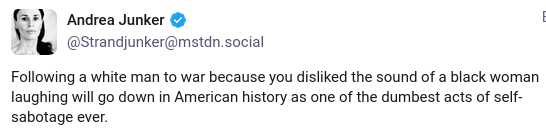
Because one of those is a public figure who’s supposed to be representing the will of the people and the other is just some random person.
Assuming I was using you in the singular. After that, the public is on the same level as a public figure, in my opinion.
You’re just as wrong either way. If you’re talking about the general public, then your demanding the people change their views to line up with those of a politician, rather than the other way around. Not only is that antithetical the the very idea of democracy, it’s also just impractical. Isn’t it much easier to get one person to change their views instead of millions? Why are you focusing on the millions then?
It’s because you’re looking at things from entirely the wrong framework - one that has internalized the supposed “superiority” of the ruling class and asks nothing from them, instead trying to discipline the public to serve the elites unquestioningly and unconditionally. Your worldview is completely upside down.
No, it’s simply that I understand that voting is a method of selecting leaders from the pool of candidates, based on the limitations of the system used. If there are flaws with that system, and FPTP is very flawed, the election is not the place to change it. Working to change the voting method, removing the electoral college, all of those need to happen before the election. Once the election is held, you’re bound by the system used. Presuming you have elections that aren’t rigged or ignored, anyways.
Then what is the place to change it?
And what if they are?
You change the laws on how the vote is done. This is a legislative or constitutional process, depending on the jurisdiction (state, county, country, etc.)
And if the elections are corrupt, then the corruption needs to be dealt with, or things will continue to devolve.
Note that neither of those are the results of an election (assuming your constitution doesn’t have referendums that can affect this).
So, you’re saying you change the laws through elected officials, through elections. And yet, somehow, elections are “not the place” for election reform. Make it make sense.