

Introduction
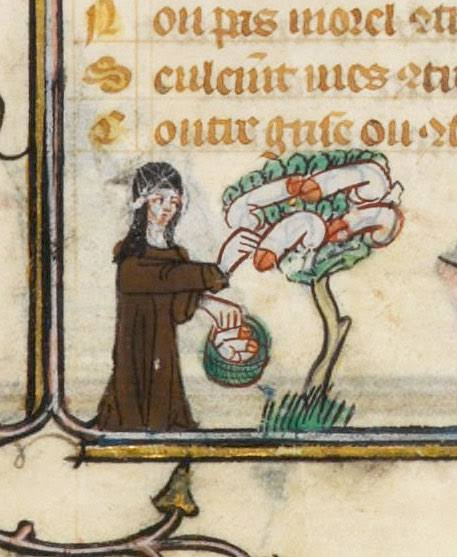
Among the strangest images preserved in medieval manuscripts is the famous “penis tree” illustration, showing a woman harvesting phallic objects growing from a tree. The image comes from copies of the medieval French poem Roman de la Rose, one of the most influential literary works of the Middle Ages.
To modern viewers the drawing looks bizarre, crude, or even surreal. But within the context of medieval literature and manuscript art, it actually reflects a mixture of satire, symbolism, and commentary on love and sexuality that was common in the late Middle Ages.
⸻
The Book It Comes From
The illustration appears in illuminated copies of the Roman de la Rose, a long allegorical poem about love and courtship.
The poem was written in two stages: • Around 1230 by Guillaume de Lorris • Expanded around 1275 by Jean de Meun
The first section focuses on the idealized idea of romantic love. The narrator dreams of entering a garden where he attempts to win a symbolic rose representing the woman he desires.
When Jean de Meun continued the poem decades later, the tone changed dramatically. His section became far more satirical and cynical, criticizing social norms, courtly romance, and even marriage itself.
By the 14th and 15th centuries the Roman de la Rose had become one of the most widely read books in Europe, copied and illustrated hundreds of times by scribes.
⸻
The Strange World of Medieval Marginalia
The bizarre illustration of the penis tree is not part of the main narrative scene. Instead it appears in the margins of the manuscript, a place where artists often inserted strange or humorous drawings.
These marginal illustrations are known as medieval marginalia.
Artists sometimes filled the margins with images that had little direct connection to the text, including: • rabbits fighting knights • monkeys playing musical instruments • hybrid animals and monsters • crude jokes or sexual imagery
These drawings allowed scribes and illustrators to add humor, satire, or social commentary to otherwise serious manuscripts.
⸻
What the Image Shows
In the famous scene: • A tree grows with phallic-shaped fruit hanging from its branches. • A woman reaches up and pulls the objects from the tree. • A basket below collects the “harvest.”
While the image looks absurd, medieval scholars generally interpret it as a satirical metaphor about sexuality and relationships.
The phallic fruit represents male sexuality, while the woman gathering them may symbolize female choice in selecting lovers.
In other interpretations, the image mocks the idea of romantic love by reducing courtship to something as simple as picking fruit from a tree.
⸻
Connection to the Themes of the Poem
The Roman de la Rose deals extensively with themes of: • desire • temptation • seduction • gender roles • the politics of relationships
Jean de Meun’s continuation of the poem in particular often takes a mocking tone toward romantic idealism.
Because of this, many of the illustrations created by medieval artists visually reflect the poem’s discussions about sexuality and human behavior.
The penis tree image fits perfectly into that satirical atmosphere.
⸻
Where the Image Survives
One of the most famous surviving versions of this illustration is preserved in manuscripts held by the Bibliothèque nationale de France, which contains several medieval copies of the Roman de la Rose.
These manuscripts date primarily from the 14th century, a period when manuscript illumination had become highly sophisticated and artists were increasingly playful with marginal imagery.
⸻
Why Medieval Artists Used Sexual Humor
Although it may seem surprising today, sexual humor was not uncommon in medieval art.
Several reasons explain this: 1. Satire of social norms Medieval writers often mocked courtly love and the unrealistic expectations placed on relationships. 2. Moral commentary Some images were intended to warn about lust or temptation. 3. Entertainment Marginal drawings often served as visual jokes for readers.
Because manuscripts were luxury objects owned by nobles or wealthy patrons, the artists who created them sometimes had considerable freedom in the margins.
⸻
A Window Into Medieval Humor
Today the penis tree image is frequently shared online because of how strange it appears to modern viewers.
However, within its original context it reflects something deeper: the playful, sometimes crude sense of humor that existed alongside serious literature in the Middle Ages.
Rather than random obscenity, the image is part of a long tradition of medieval satire connected to one of the most famous literary works of the time.
In other words, even in the 1300s, scribes and artists were perfectly capable of inserting a strange visual joke into the margins of a book.