Introduction
In the early months of World War II, the United States was on high alert following the devastating Attack on Pearl Harbor. Fear of additional attacks along the Pacific coast was widespread, especially in major cities such as Los Angeles.
On the night of February 24–25, 1942, that fear erupted into chaos when air defenses across Los Angeles fired more than a thousand anti-aircraft shells into the sky at unidentified objects.
Although the incident is widely known today as the Battle of Los Angeles, the U.S. military actually referred to it at the time as the “Great Los Angeles Air Raid.” The distinction is subtle but important: while the term “battle” suggests two sides fighting, in this case only American defenses were firing.
No enemy aircraft were ever confirmed.
⸻
Fear Along the Pacific Coast
In the weeks after Pearl Harbor, the entire Pacific coastline was bracing for further Japanese attacks. Military leaders believed cities such as Los Angeles, San Diego, and San Francisco were potential targets because of their shipyards, aircraft factories, and naval installations.
The tension intensified when a Japanese submarine shelled an oil refinery near Ellwood, California, on February 23, 1942—just one day before the Los Angeles incident.
This attack heightened fears that a larger strike might follow.
Air raid sirens, blackout drills, and radar monitoring became routine across the region as the military prepared for the possibility of enemy aircraft appearing over American cities.
⸻
Radar Contact and the Citywide Blackout
Shortly after midnight on February 25, radar stations reported unidentified objects approaching the California coast from the Pacific Ocean.
Initial radar readings suggested the objects were approximately 120 miles offshore and moving toward Los Angeles.
In response, the military ordered a complete blackout across the city. Streetlights were turned off, homes went dark, and air raid sirens sounded across the region.
Residents were instructed to take cover while anti-aircraft units prepared to engage possible enemy aircraft.
⸻
Anti-Aircraft Fire Over Los Angeles
At approximately 3:16 a.m., searchlights began sweeping across the night sky. Soon after, anti-aircraft batteries from the United States Army Coast Artillery Corps opened fire.
For nearly an hour, artillery units fired roughly 1,400 shells into the air. Explosions lit up the sky as searchlights converged on objects that observers believed were aircraft.
Many witnesses reported seeing glowing lights or shapes moving slowly above the city, while others described clusters of lights hovering over the coastline.
However, none of the supposed targets were visibly destroyed.
Fragments from the exploding shells rained down across parts of the city.
⸻
The Famous Newspaper Photograph
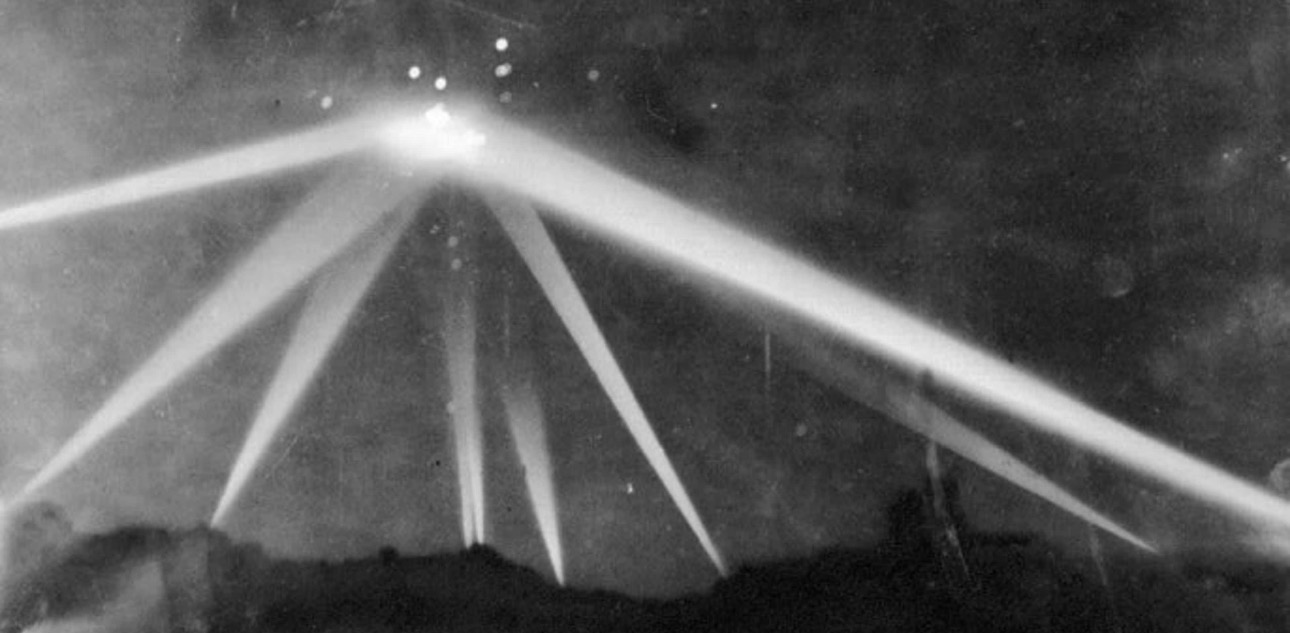
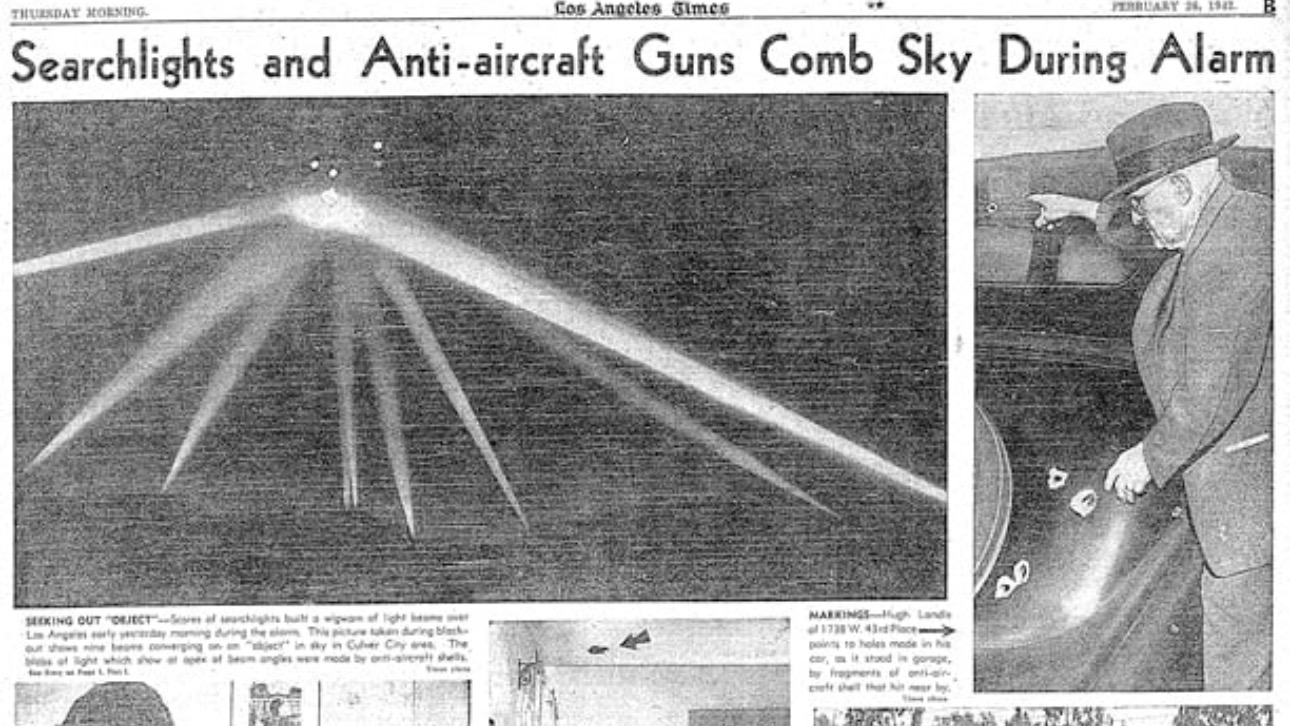
The following morning, newspapers published dramatic images of the night’s events. One photograph from the Los Angeles Times became especially famous. It showed multiple searchlight beams converging on a bright object surrounded by anti-aircraft bursts.
For decades, the image was cited by UFO researchers as evidence of a solid craft caught in the beams.
However, historians later noted that the newspaper image had been heavily retouched, which was a common practice at the time to enhance contrast for printing. The original negative shows a much less distinct scene, with searchlights illuminating smoke from exploding shells rather than a clearly defined object.
This discovery helped reinforce the theory that the lights were simply illuminated smoke clouds rather than an aircraft.
⸻
Conflicting Government Explanations
In the days following the incident, government officials struggled to explain what had happened.
There was even disagreement among high-ranking leaders.
Frank Knox publicly described the event as a false alarm, stating that no enemy aircraft had been present.
However, Henry L. Stimson suggested that unidentified aircraft might have been involved.
This public disagreement between top officials contributed to decades of speculation and conspiracy theories about a possible cover-up.
⸻
Post-War Evidence
After the war ended, American intelligence gained access to Japanese military records.
These records confirmed that Japan had not launched an air attack on Los Angeles that night. Although Japanese submarines had operated along the California coast—including the submarine responsible for the Ellwood shelling—there was no evidence that aircraft had been launched toward Los Angeles.
This discovery further supported the conclusion that the incident was likely caused by misidentification rather than an actual attack.
⸻
Damage and Casualties
Although the city itself was never attacked, the anti-aircraft barrage caused several casualties and property damage.
Falling shell fragments damaged buildings and vehicles across the region. At least five civilian deaths were reported during the incident, mostly caused by heart attacks or accidents triggered by the panic and blackout conditions.
The event demonstrated how dangerous defensive actions themselves could become during periods of extreme wartime anxiety.
⸻
The Most Likely Explanation
Today, most historians believe the event resulted from a combination of several factors.
A meteorological weather balloon may have triggered the initial radar and visual sightings. Once anti-aircraft units began firing, the explosions created clouds of smoke that hung in the air.
Searchlights shining through this smoke produced shifting shapes and shadows that appeared to move across the sky. Nervous gunners interpreted these illuminated clouds as enemy aircraft.
Combined with the tension caused by the recent Ellwood submarine attack, the result was a classic example of wartime misinterpretation escalating into a full defensive response.
⸻
Legacy of the Incident
The so-called Battle of Los Angeles remains one of the strangest events of the American home front during World War II. It highlights how fear, uncertainty, and limited information can quickly lead to dramatic responses during wartime.
Over time the incident became deeply embedded in UFO lore, especially because of the famous photograph and the lack of a single clear explanation in the days immediately following the event.
Even today, the story continues to appear in books, documentaries, and television programs exploring unexplained aerial phenomena.
⸻
Conclusion
The Great Los Angeles Air Raid of 1942 stands as a remarkable example of how wartime anxiety can transform ambiguous events into historic moments.
While modern research strongly suggests the incident resulted from misidentified objects, illuminated smoke, and heightened military alertness, the dramatic images and conflicting official statements ensured that the event would remain part of both military history and UFO legend for decades to come.