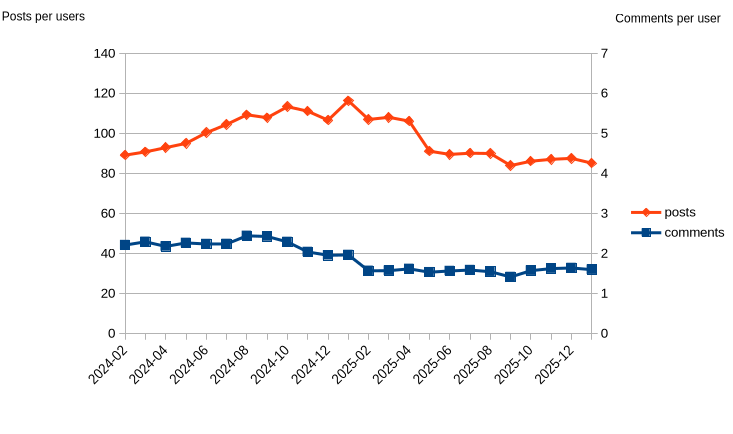
We can see a globally slowly downward trend, probably not good but I’m definitely not equipped to analyze that

Sur le microblogging: @rakoo@blah.rako.space
Sur le web: https://www.rako.space
Sur xmpp: rako@conversations.im
Sur deltachat: https://i.delta.chat/#F2EACE10C8C69DE92EE5B72B308C75A6FA0B3479&i=AXCOWs9ZS0ZlgudzJAm8ERqz&s=WZ2khNFSyDdAW-N3yjqQTnTK&a=phj2so4ey%40nine.testrun.org&n=Invite (si vous n’êtes pas du spam je vous ajouterai à mon vrai compte)
We can see a globally slowly downward trend, probably not good but I’m definitely not equipped to analyze that
Then again if it’s some guy in his corner doing stuff on his own, is it really a community ?

Neither nostr nor simplex make “community building” a thing. The most important defining point is the ability to have communal intermediaries. All protocols can do a forwarding bot, starting with the good old mailing-list, but anything more complicated than that is rare. In nostr that would be running a full relay (which is just out of the question if you’re not technical). Simplex isn’t much better. Both are built for individualistic purposes, so it’s not really surprising.
ActivityPub isn’t perfect but it has Groups, with some people working on making them controllable. XMPP has highly configurable pubsub. Those are proper foundations for billions of people building billions of communities
I’ve been thinking about that a lot and plan to build something I’m more interested in:
Hopefully a design like this should empower users and communities by letting them focus on the social aspect of building the group, nurturing it, instead of the technical parts that constrain users into artificial uses
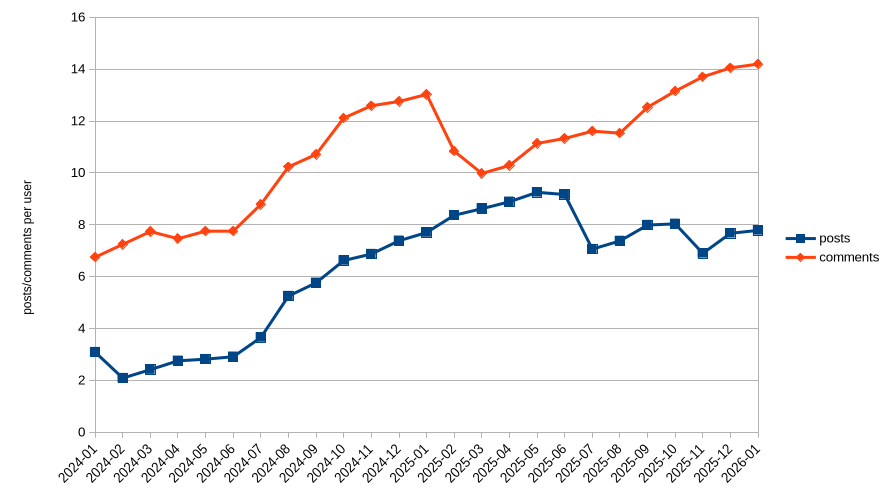
No, I’m taking the data as it exists on the API …