This was a problem, which is nowadays accounted for.
Fossils many times are more than bones and we get actual imprints of their whole tail or other parts of them
So one of the biggest leaps they have made in reconstruction over the last few decades is matching similar bone structure that supports soft tissue. It doesn’t work for all soft tissue, but if the beavers tail bones have bumps or other features that hint at supporting extra soft tissue there is a chance.
All the stuff birds have, like inflatable neck sacks and feathers that move with muscles are examples of things we absolutely wouldn’t get with fossils that are even better than a beaver tail.
I always appreciate an enthusiastic and educational response to situations like this.
Well, now I want to see an artist’s rendition of a T. rex doing this:

The Prehistoric Planet documentary series does it with sauropods, it’s pretty sick.
i’m also a big fan of carnotaurus’ tiny piddly arms being brightly colored on the inside and them waving them around like mad
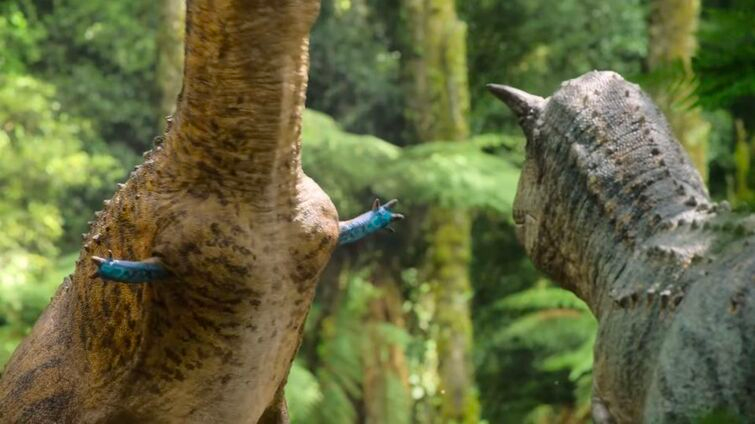
The idea of non-avian dinosaurs with the diverse features and behaviors birds have is very fun to me, and I hope fictitious depictions of birdsaurs becomes as common as classic dinosaurs’s.
I want to see a T. Rex do this.
Also, in 40 million years, you can match the beaver fossils to the bones of their still living descendants and find similar features.
I mean… you can see the processes (bony protrusions on the vertebrae) are long and flat and only transverse (sticking out the sides, not up/down) so… it would be pretty obvious it was a flat tail? Sure maybe they might not get that it wasn’t fuzzy without any fossils if it, and maybe they make it slightly less round, but they’re scientists not idiots. Yeah some has come a long way and some older models sucked sure but it ain’t like we are vibe coding their appearance.
It’s only obvious because you already know what a beaver looks like.
I mean, no?
You can see no vertical protrusions of the vertebrae so there’s going to be A: vertical movement as muscles can best attach to pull up/down. And B: a likely flat structural rail with how wide the horizontal protrusions are. C: nothing sharp or heavily weighted at the end so likely not a huge weaponised tail like a thagomizer. So… you’ve got a probably flat tail, than can slam down on stuff.
Now figuring out WHY it was like that would require being able to find fossils around rivers and being able to tell those rivers had dams or something cuz idk how they would figure out exactly how they use their tails but… yeah you can figure the general shape fine based on vertebrae anatomy which leads to (possible)muscle anatomy. Some bones don’t function the way they look and can throw stuff off. Someone else already mentioned stuff like air sacks in birds and such that would really throw off anatomy based on bone and assumed muscular structure from where bones could have attached muscles.
Pretty much. You can factually tell that a lot of something was going on with all of those delicious muscle hooks on such a small frame, but a flat paddle mightn’t be their first thought. Really depends on who sees it first, but they’d eventually get at least close. Just give it a few years of screaming. Yes, both external and internal.
Vibe coded lion:

I’ve just watched the new movie and damn it’s so stupid compared to the original ones.
Do beavers enjoy… Uppies??
Seems so.

This is some real RFK level science here.
It’s sneaking up on creationist levels of ‘science’, like where they argue recreations of Australopithecus are just ‘imagination’ and present their own version of Lucy as as a quadriped, completely ignoring the overwhelming evidence from her skeleton that she could not have walked that way (and also ignoring that we have hundreds of other specimens of her species).
It really seems that lots of people’s conception of these fields is based on very outdated concepts, either unaware or ignoring all the evidence and advancements of the past 50 years or so.
i saw someone draw a hippo based solely on the skeletal remains. they looked nothing alike.
Sure but also there are some fossils that DO have skin, and some even have preserved organs. And some have feathers, which is a pretty good indicator that there wasn’t some large feature we’re missing.
No doubt we are wrong on lots of counts, but I think we have good evidence for a lot of it as well.
What a marvellous time for paleobootyology.
One thing I wouldn’t mind AI to do, train a model with standardised data like this, and have it match the reconstruction. After that it can use common and less common reconstructions. After that try to map as much info from a dinosaur fossil to said standardised data structure and generate possible reconstruction for said dinosaur
Oh. I like this idea. This is the kind of thing AI would be good for.
All dinosaurs had beaver tails, got it!
That is one cute beaver pic on the left. PM more of your beavers.
Dinosaurs were probably chonky birbs.
Now I want to see some pics of dinosaurs with beaver tails