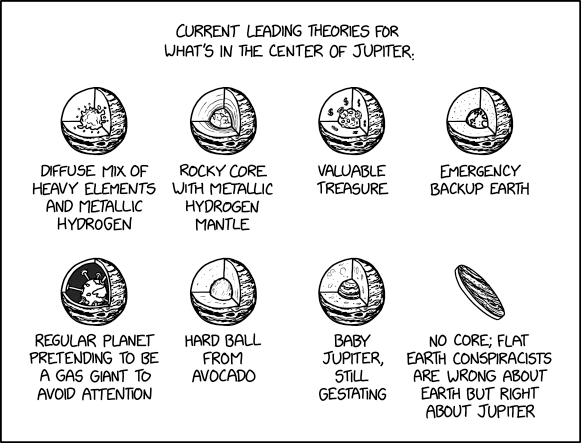
Jupiter is slightly smaller and flatter than scientists thought for decades, a new study finds.
Researchers used radio data from the Juno spacecraft to refine measurements of the solar system’s largest planet. Although the differences between the current and previous measurements are small, they are improving models of Jupiter’s interior and of other gas giants like it outside the solar system, the team reported Feb. 2 in the journal Nature Astronomy.
That’s really interesting, I wonder how many other planets might be bigger or smaller than scientists originally thought. It would cool to know if any are in the future, with all the advances in science and technology I’m sure we could know very soon into the near future, maybe a few years from now.
deleted by creator
I fucking knew it. Everyone knows that the Earth is round, but I just knew that Jupiter was flat!
Removed by mod
I think this is important. Many science history textbooks highlight that the ancients got the measures right by 5% off or that the modern era scientists got the quantity of oxidation (phlogistic) off by 5%. So it’s important to note that we are actually advancing in Science and that we are finding new horizons, not just repeating what the ancients or modern era scientists did.
Sure, but it’s not “textbooks need to be updated” important.
I think it could be, but the implication is at issue. It’s not like we need to update text books to say Jupiter isn’t the biggest planet anymore. It’s that we need to update the new versions to show how our improved measuring has allowed us to refine our knowledge.