As a side note, one of the reasons why cold white LED light bulbs are a thing is because they’re a bit more efficient than warmer light colors.
The reason is because they all just have 2 kinds of light emiting diode (LED) junctions inside - red and blue - plus a phosphorus layer on top that smooths those two perfect lightwave color peaks in the wavelength domain into a broader light spectrum, and the blue is more efficient than the red, so lamps with a higher proportion of blue emitters to red emitters - and which hence emit more light towards the blue end of the spectrum (i.e. a colder white) - will emit more light for the same power consuption than those with more red emitters and hence whose light is more towards the red side of the spectrum (i.e. a warmer white).
EDIT: So it turns out part of this which I learned 10 years ago is outdated. The efficiency thing is true but when I went looking for how phosphors (the layer between the LED emitters and the outside, which absorbs the single wavelength light from the LEDs and emits light with different wavelengths) prompted by the points made by another poster, from places like this it turns out that red LED emitters aren’t at all used anymore, only UV and blue (whose light the phosphor then converts into light with different spectrum distributions depending on the material of the phosphor). If you search for it a number of recent scientific papers pop up around various such materials.
plus a phosphorus layer on top that smooths those two perfect lightwave color peaks in the wavelength domain into a broader light spectrum
The phosphor absorbs some of the blue and downconverts it to green and red. Some of the blue is let through for us to see. The mixture of R, G and B looks like white to us (but not necessarily to other animals with different cones in their eyes).
2 kinds of light emiting diode (LED) junctions inside - red and blue
I’ve never seen a red LED die inside a white LED. I’ve only ever seen blue dies on their own.
Technically UV-pumped white LEDs exist, but they’re rare and I’ve never seen one. They’re less efficient and require a third phosphor (to make the blue).
You can remove the yellowish looking phosphors on the LED with a small pick to reveal the blue die underneath. Fun fact: some high-power “red” LEDs are actually blue leds + phosphors, not that it’s a particularly good choice but it’s a thing: https://halestrom.net/darksleep/blog/018_led_cob_cutting/
It seemed odd the lower frequency diodes would be less efficient so I did a quick bit of reading and it seems like red light is efficient, but red and blue light aren’t as effectively picked up by the human eye as green and because each light has a different operating voltage there are some consequences.
From what I read the things that makes white lights more effiecient is they only use blue diodes which probably means less circuitry is needed to operate than two sets of alternating diodes and there’s less difficulties going from higher frequency (aka higher energy) to low via filters. Hence efficient green light, blue light and red light at a single voltage.
From what I read last time I properly looked into this (so, almost a decade ago when I was considering setting up a business importing LED lamps), the blue light emitting diode junction simply uses less power to emit the same amount of light.
Electrically speaking it’s no bigger or lesser a problem in terms of circuitry to have just blue diodes or blue + red diodes in there since they’re bundled in blocks of diodes in series (and then multiple blocks are in parallel) and the only thing that differs between those two kinds of junctions from a circuit point of view is the drop voltage of one kind of diode being different from that of the other (diode junctions done with different dopants have different drop voltages), something you take into account in the design stage when deciding how many LED diodes you use per block or what DC voltage will your 110v/220V AC input be converted to to feed those LED strings.
More specifically for LED light bulbs, the messy stuff in terms of electronics is the circuitry that converts the 220v/110v AC input into a lower voltage DC suitable for the LEDs whilst limiting the current (as diodes’ only ability to “limit” current is them burning out from overheating due to too much current), not the actual LEDs.
But I’ll put it even simpler: if the problem was indeed simplicity as you believe, then LED bulbs with only red LEDs would also be very common as they’re simpler than blue+red ones.
You can’t easily use a filter to turn red light into blue. Imo if you needed to light a room for a camera or something not the human eye, red seems like it would be effective for that, but given the filter situation and the eye being best at detecting green light it doesn’t make sense to use red as the base color for indoor bulbs.
From what I read, red LEDs were most efficient at 1.8v and blue more near 4v. Maybe its trivial to do second voltage line but the filter situation is probably the limiting factor here.
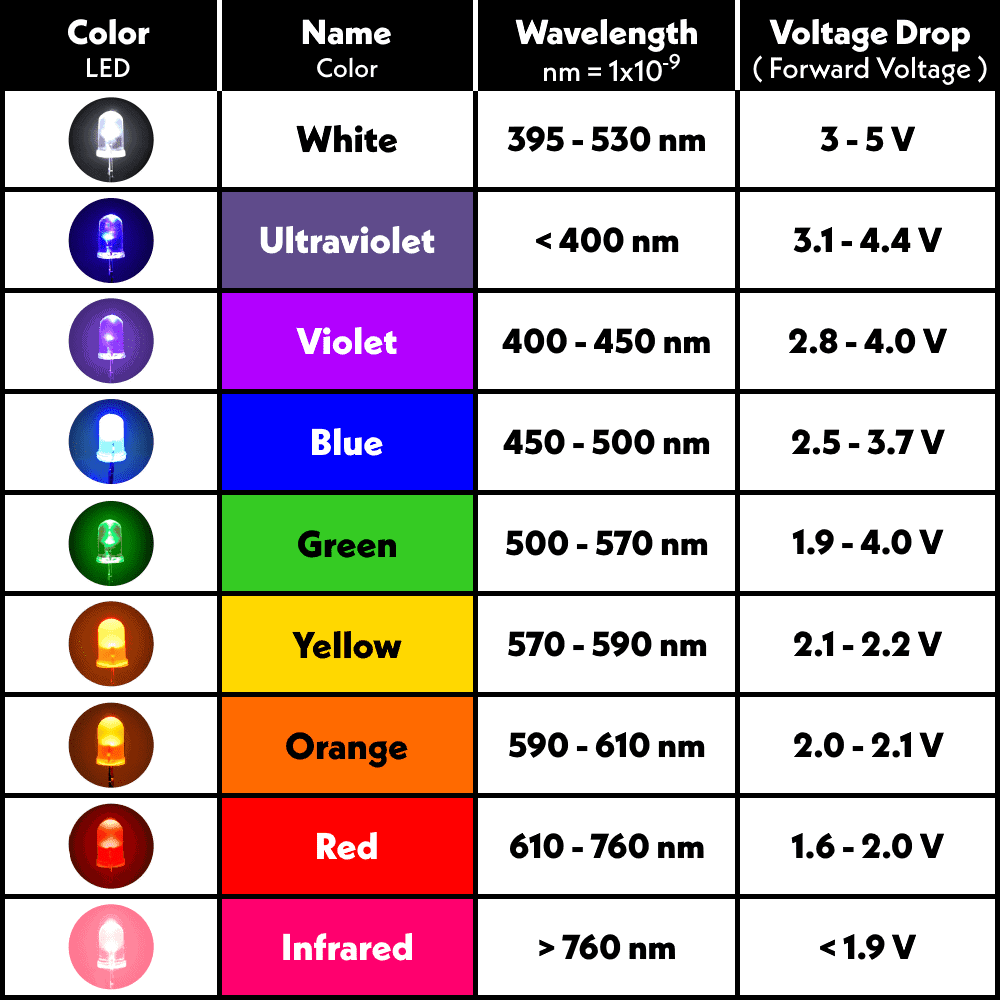
Here are the LED drop voltages for reference.
LEDs aren’t just more efficient at those voltages, those are literally the difference in voltage between one side of the LED and the other side when in operation - if you feed it less than that the LED will simply not work. (Note that these drop voltages are not actually an absolute value but rather a very steep curve relative to current, but for simplification we can treat those as absolute ON/OFF voltage values).
Also the phosphor doesn’t filter light - rather it absorbs light and re-emits it in different wavelengths, the process being such that the emitted light covers a range of wavelengths even if the input light has a single wavelength as is the case for LEDs - so it’s not at all light manipulation by filtering and mixing light sources.
That said I went looking at how phosphor is used in LEDs nowadays and judging from this they don’t use red LEDs emitters at all nowadays, only blue and UV ones, and then chose a phosphor (which can be any substance, not just Phosphorous) whose emission range is towards the desired light range.
I’ve corrected my original post.
The phosphorous coating here is serving to reduce the amount of blue light as an absorptive filter. Its just also doing other stuff. Idk if there’s a proper term for what its doing in whole, but your explanation is otherwise in line with what I’ve read.
That’s not even close to reality.
Read the material linked or just google it yourself.
your explanation is otherwise in line with what I’ve read.
That’s not even close to reality
That’s a bit incoherent.
Fwiw, I did read the article you linked. That’s one of the articles I looked at originally.
I’m just saying its innapropriate to say its “not a filter” because the coating is doing more than partially filtering a wavelength of light; Its a categorical error.
The coating’s primary engineering function is not a filter, so maybe its frustrating to hear it described as one but it is absolutely incorrect to say its not a filter because one of things its literally doing is filtering out a % of the blue light emitted by the diode.
There’s practically no chance this knowledge will ever benefit me, but I’m happy to learn something new regardless. Thanks for sharing!
I love my smart lights for this. I can change them at my whim. By default they’re brighter and whiter during the day, slowly moving dimmer and yellow after sunset. Or I can make them whatever other color but I do that pretty rarely.
It’s also fully offline and no WiFi used. But it seems almost everything you see in the stores are WiFi bulbs you have to get an app for, where one day they might go bankrupt and suddenly your lights dont work. Or the internet goes out. Yuck.
You can’t just sell me on your smart lights and not name the brand/model
Brand/model isn’t important.
You’ll need a HomeAsstant controller. You can buy one premade or you can look up tutorials and make your own with a raspberry pi or old laptop or PC. Then you’ll need a ZigBee controller, this is a radio that will talk to your smart lights and other accessories.
You then get ZigBee compatible lights. Phillips Hue is the top of the line but so stupidily expensive I’d never recommend it. Innr makes good ones at half the cost. ThirdReality makes decent ones too for even cheaper.
You’ll probably also want some ZigBee switches to have physical controls for your lights instead of just by phone. They make models that replace your actual light switches. Or, if you rent like me and can’t modify that, you can get battery powered ones that stick on the wall. Battery life is like a year or more so not too bad.
That’ll do it. You can also use HomeAssistant now that you’ve got it. It’s a home automation software that’s open source and locally controlled. You can hook up much more than your lights. Smart plugs, your TV, 3D printer, fans, cameras, tons of sensors, your thermostat, robovac, etc. Then make automations that connect them. For example my living room ZigBee switch, one press up toggles the main lights. Double press for the lamp. Hold down and it turns off all lights and the TV. Some lights like my closet light are controlled by a door sensor instead of a switch, so they come on automatically. Some people prefer motion sensors so all lights are automatic. Turn off stuff automatically when you leave, etc.
cooler light is more popular in places where it gets hot: Middle East, South East Asia countries prefer using cooler tones because it gives feeling of freshness and cooleness
3500 to 5k. My brain hates all others.
Feel like youre playing both sides
3500k is warm 5000k is daylight
Nobody is buying higher K for their home
I love my daylight bulbs
Feel like this is a very US thing. Here in Brazil we just don’t use the white light if we can’t. Same thing with overhead lighting, we love it here but seems like the US guys just don’t go for it
I don’t mind a daylight bulb for overhead lights, but they have to be supplemented with warmer lights elsewhere around the room
Am I the only one who doesn’t replace light bulbs based on color temperature? I usually keep around whatever is already in the rental unit/whatever spares the last tenants left around, because I usually move every year anyway.
In the rare chance I get a choice, I usually choose daylight though.
Most people I know who do care.
Change all of the bulbs when they move in. Throw the old bulbs in a box.
Put the old bulbs back when you move out.
Use the new bulbs at the next apartment.
Some of them also have smart bulbs and those are way too expensive to give away.
I don’t go out of my way to replace light bulbs with all these smartbulbs that have day/night cycles.
That being said, if they go out, I normally pick a smartbulb because the price difference isn’t that much for all it offers in return.
I’ve been working remotely from 3 to 10 PM and the gradual change in color temperature both from the smartbulb and my screen really helps me take it easy as my shift is ending.
I definitely have four different temperatures in my tiny studio. I imagine that would set a sort of person on edge.
We don’t know Celsius. How do you expect us to know Kelvin?
There’s a solution here you’re not seeing… RGB lights. Setting the hue on the fly to match what I need has been pretty neat. Pure white for work, natural white for relaxing, red only for venting in the summer since insects can’t see it, green and blue strobe for dance nights, the only limit is your imagination. Living in the future has at least a few perks to go with all the downsides.
wait insects can’t see red? does that extend to spiders? i keep all my windows and doors closed all the time even when its sweating hot because i’m terrified of being invaded by insects and spiders
Though IME, the light quality of a real white LED is better than the mix of an RGB led. Also interesting: the cooler the LED is the higher the quality of the light.
Not doubting you, but how do you define the quality of the light?
There’s various metrics, like CQS, CRI or newer versions of it.
It’s basically about how close the wavelength spectrum is compared to a black-body radiator given a color temperature (e.g. an incandescent lamp or the sun).
Most “RGB” lights also have 2 white ones of different CCT for a more natural white.
Yes, and blending in between, including RGB, can enhance the quality of light as well to estimate a natural light source.
Most of them are so expensive, though.
No, Philips, I am not spending $50 on a single bulb, that is madness.
My sisters can’t decide which ones she wants to use, so every room has a different lighting hue. Most rooms have different bulbs for each lamp, so hot and cold are right next to eachothert
I have a somewhat basic home automation, and my lights are programmed to be cooler during daylight hours (where necessary, desk lamp, corridor, etc), and they become warmer at night. The reverse happens early morning in winter, where I wake up while still dark.
Your piss colored light feels like I am living in the 80s and we haven’t invented halogen bulb yet.
deleted by creator
2700k ambient indirect, and 4000k direct overhead with 4 times the illumination when we need to see something. One or the other, the ambient ones are synced to power off automatically
Modern society is telling me I need to take melatonin.
I tell modern society I make my own melatonin, and sleep perfectly fine because my lights are warm in the evening.WoHo, míster not addicted to your phone who doesn’t watch it in bed.
We can’t all be like you.
I’m fully addicted to my phone, but, if I try to watch it in bed… I’ll be laying on it in 20 minutes. Don’t know what it is, I hit the bed, I pass the fuck out. pretty sure it could be on fire and i’d just die there.
Jokes aside, swtiching to a eink reader helped my sleep so much it’s not funny
I can’t help you with your addiction, I can only offer warm glow.