Businessmen don’t get to write off their living expenses either, but feasibly you could start a business and become a contractor for your employer so you could write off things like footwear, home office square footage, and a standard deduction per mil driven between two work locations.
Best part is the (Canadian?) IRS? CRA will never audit you unless they have the staff and they can get more out of you than the cost of the audit (roughly 20k minimum).
In Australia employees who work from home can either calculate all your actual work from home expenses and deduct that, or use the standard fixed rate (which varies by year, but last financial year was 70 c per hour) which includes utilities and stationary/consumables. With the fixed rate you can still additionally deduct depreciating assets like computers and furniture (proportional to how often they are actually used for work).
If you work from home in the US you can deduct for a dedicated home office. I did it but it didn’t save me a penny tax wise. Not sure if my office is to small or my income to low.
The problem is that in the US, most tax deductions are concurrent with the standard deduction. So even if (for example) you donate $10k to a charity, the fact that it’s tax deductible is meaningless unless your total deductions are more than $16,100 (or more if married or head of household). It’s yet another way that tax deductions favor the rich - past a certain tax bracket, it makes sense to donate to a charity (that you control) to lower your taxes; for random Joe Peasant, it’s completely pointless.
I know a guy who started a business just to throw parties for his friends. He’d take a cover charge at the door and buy booze tax free and make sure to never turn a profit.
Got by with a banquet license which is like $8 for the night.
I knew a retired carpet cleaner who occasionally did that. He wasn’t wealthy by any means but if he was going to owe more than 3k in Taxes it was always better for him to spend it on a “business trip”.


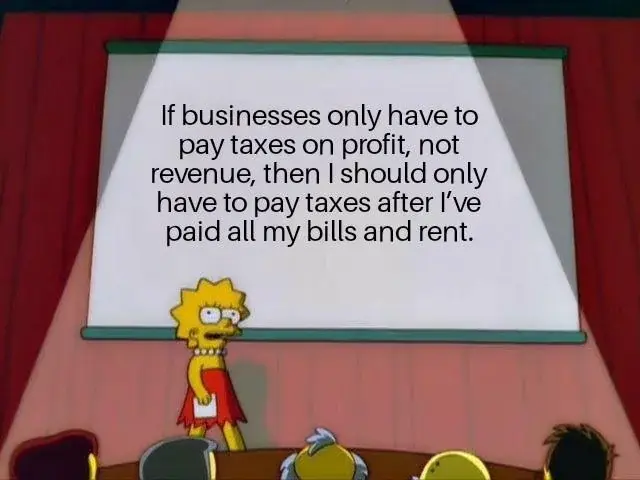
Businessmen don’t get to write off their living expenses either, but feasibly you could start a business and become a contractor for your employer so you could write off things like footwear, home office square footage, and a standard deduction per mil driven between two work locations.
Best part is the
(Canadian?) IRS?CRA will never audit you unless they have the staff and they can get more out of you than the cost of the audit (roughly 20k minimum).In the US that’s usually a bad deal because you lose employer-sponsored healthcare.
Can you not do that as an employee in Canada?
In Australia employees who work from home can either calculate all your actual work from home expenses and deduct that, or use the standard fixed rate (which varies by year, but last financial year was 70 c per hour) which includes utilities and stationary/consumables. With the fixed rate you can still additionally deduct depreciating assets like computers and furniture (proportional to how often they are actually used for work).
If you work from home in the US you can deduct for a dedicated home office. I did it but it didn’t save me a penny tax wise. Not sure if my office is to small or my income to low.
https://www.irs.gov/businesses/small-businesses-self-employed/simplified-option-for-home-office-deduction
The problem is that in the US, most tax deductions are concurrent with the standard deduction. So even if (for example) you donate $10k to a charity, the fact that it’s tax deductible is meaningless unless your total deductions are more than $16,100 (or more if married or head of household). It’s yet another way that tax deductions favor the rich - past a certain tax bracket, it makes sense to donate to a charity (that you control) to lower your taxes; for random Joe Peasant, it’s completely pointless.
tbh I’m not sure, I’ve never attempted it in Canada. Works that way in the US.
I believe you can deduct up to 30% of your rental costs, depending on square footage dedicated to office space in Canada.
I know a guy who started a business just to throw parties for his friends. He’d take a cover charge at the door and buy booze tax free and make sure to never turn a profit.
Got by with a banquet license which is like $8 for the night.
I knew a retired carpet cleaner who occasionally did that. He wasn’t wealthy by any means but if he was going to owe more than 3k in Taxes it was always better for him to spend it on a “business trip”.