

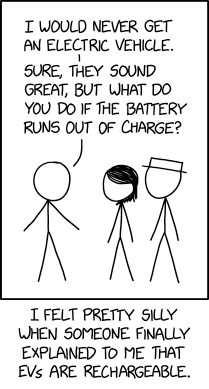
Title text:
Now that I’ve finally gotten an electric vehicle, I’m never going back to an acoustic one.
Transcript:
Transcript will show once it’s been added to explainxkcd.com
Source: https://xkcd.com/3214/
Title text:
Now that I’ve finally gotten an electric vehicle, I’m never going back to an acoustic one.
Transcript:
Transcript will show once it’s been added to explainxkcd.com
Source: https://xkcd.com/3214/
EVs as they are now, are only useful for rich people, for two reasons.
Electric cars are essentially disposable, where they are expected to be destroyed or “recycled” instead of repaired.
Ofc rich people buy new cars every few years anyway, so it’s not an issue for them.
A gasoline car can be fueled in 30 seconds + 2 minutes to pay, and there’s usually a line at most service stations. Even if there’s mass adoption and all gas stations were converted into EV chargers, even if it only takes 10 minutes to charge an EV, that is 12 minutes per person, it would still amplify the queue to the point where it would be impossible to get anything charged.
Ofc rich people can just charge in their backyard or garage at night, so not an issue for them either.
I’m not saying that EVs are bad, but there has to be serious investment in infrastructure and batteries need to be cheaper and cheaply REPLACEABLE in order for the poor to be able to adopt EVs
Real world studies are showing they last about an average of 12-15 years on average, and every manufacturer has a warranty for at least 8 years, with many up to 10.
The typical passenger gas station pump flows at 7.9 gallons per minute. For most passenger cars and trucks, with tanks between 15 and 35 gallons, that’s about 2-5 minutes of pumping.
A typical level 3 charger will take a battery from 10% to 80% in about 25 minutes. And chargers can be in places where gasoline pumps can’t be, like ordinary parking lots and garages. So the dual purpose parking where you can charge the car while you shop at the grocery store or work out at the gym or sleep overnight at home is just a completely different paradigm from what we’re used to.
The average car lasts about 12 years, by the way. EVs last basically as long as ICE vehicles. Which also makes sense, because it doesn’t have to mix the fluids that lubricate and cool with combustion residue and foul up the engine that way.
So your data is out of date, and those fears that were commonly cited in 2015 have pretty much proven to be false for the technology that was around in 2015. Now, in 2026, there’s been even more advances in managing battery/charging health and chemistry, with more of an infrastructure for maintenance, repair, and charging.
And that’s a problem for ppl who buy 20 year old cars.
Yes, you are right, I take back my “converting gas pumps into EV chargers”, that situation can be solved by having more charge points in other places, unfortunately, as things are know, I know from an EV drive himself that it’s almost impossible to find a free charger at least where I live.
I guess that greatly depends on where you live, since you said “gallons” before I’m assuming US, at least here few people I know can afford a 12 years old car.
that’s the average, some will last longer than that
So if you’re in a country where it’s economically feasible to continue maintaining cars beyond 15 years, why wouldn’t you think that the much cheaper electric cars wouldn’t dominate the market even more?
Compared to the U.S.'s low adoption rates, EVs sell at higher rates in certain rich countries like Norway and Denmark, middle income countries like China and Turkiye, and poor countries like Estonia and Nepal. The cheapest EVs, globally, are cheaper than the cheapest ICE vehicles.
The cost of maintaining a car to last 20 years can be applied to EVs and ICE cars alike. I suspect that EVs will be easier to maintain to those ages. In the U.S., that doesn’t really happen in large part because our labor and parts network is expensive enough that buying new is comparably cheaper than repairing, past the 15 year mark, for most vehicles. EVs don’t actually change the equation any.
So how are mechanics going to solve the battery problem? Maybe replace dead batteries with used but still somewhat working batteries? But then after 20 years all batteries for that same model will be dead.
Or are you trying to say that poor people will be able to buy newer cars than they do now, because rich people will dump them sooner?
Why not replace them with new batteries?
Also, you’re not engaging with the fact that the typical ICE car lasts an average of 12 years. If there’s a batch of survivors that lasts much longer than average and are accessible to the people of your country, what makes you think the same won’t be true of EVs when they get old enough?
I will be honest, it’s not like I’m doubting your data, but that number is hard to swallow, a 12 year old car is basically new. Even if people in America throw away new cars just because they need some minor repair that doesn’t mean the car can’t survive 20 years more with proper maintenance.
Batteries are about 30% of the price of a full car, which is a lot, but significantly less than 100%. You definitely have an incentive to replace them instead of the full car.
To replace most of them, you need to unscrew the 4 big bolts that hold it, remove the dead one, put a new one in and rescrew the 4 big bolts. This is made difficult by the 700kg that the batteries weigh, but is doable if you have the equipment to lift and move heavy things.
Your issue is Tesla. Tesla has an absurd and dangerous battery design to make their models as flat as possible. I will not list the reasons why Tesla should not be used as a reference
I am not sure why you are stating that only the rich can charge at home, it is much cheaper than charging at a station. Fast chargers do sometimes have a queue issue, but it’s not as bad as it would be at a gas station with three lanes. They’re not converting gas stations to charging stations, they’re adding chargers to parkings that can charge dozens of car in parallel. And you won’t use them often because it’s so pricey.
Most manufactures offer 8 or 10 year warranties. Batteries are expected to last the life of the car (10-20 years). This is similar to the expected lifespan of the engine, because it’s designed that way rather than being a fundamental limitation of the technology, same as contemporary car engine lifespans.
All cars are expected to be recycled when major components are damaged or worn out.
Charging in your driveway works fine, and you might be overstating the percentage of people who live in apartments and also have a car. Maybe true in your locality but not mine.
Replaceable batteries make the car cost more, not less, same as engineering in easily swappable engines (some tanks have this, no cars do). The big thing you’re not getting is that POOR PEOPLE DON’T BUY NEW CARS. The only thing required for adoption of EVs by poor people is a healthy supply of used EVs.
But that’s the problem, because the manufacturer always expects the car to last less than what it really does, poor people buy cars long after their “expected lifetime” has passed, (that is, when the previously owner considers the car to be too unreliable him), that’s when the person who is scrapping by, buys the unreliable car because it’s the only he can afford, now, repairing an old car as it keeps breaking down is expensive, but it’s still doable and much cheaper than buying a new car. But if the batteries are dead and the price of batteries cost as much as they seem to cost, then there’s no way to fix the car.
Also I’m septic if an electric car battery can last 20 years at all, there isn’t any good data on it, but if it uses the same technology as laptops Lithin-ion I don’t see it lasting much more than 10. From my experience Lithin-ion don’t lose capacity in a linear fashion, it’s more like a cliff, one day the laptop lasts an our, next day lasts 10 minutes.
You see, that’s the problem, it’s “Reduce, Reuse, and Recycle”, recycling should be the last option when the object really is at it’s limit and can’t function (and be fixed no more), if things are build to be durable then there’s no need to recycle them.
Would be fun to test how long I could set a power cord down from my apartment window into the driveway without it being stolen or vandalized. Or maybe the police would find some law to fine me for that.
Yes, but the lifetime of the car will be much longer, so when you equate the price of the vehicle to it’s useful lifetime it actually becomes cheaper.
Yes, and that’s exactly what I’m saying, if poor people don’t buy new cars, and there are no old electric cars in the market because their batteries expired and the cars got recycled instead of repaired.
That’s what you’re saying but it’s not born out by what’s being seen with used EVs (other than the early Leafs). Used cars are perfectly usable after 10 years. The main problem with the used market is that there just weren’t that many EVs on the road 10 years ago, less than 1% of the market.
Most people live in apartments or rent. Plug in hybrids sound more feasible for now until the infrastructure is better. I know I can’t afford a charger and upgrade to my house to get an electric car. I’m intrigue by the Hyundai ionic5 n, but where do I park it to charge? I’ve driven many electric cars and even the low power ones feel nice to drive because of the torque. The audi etron and Hyundai ionics are awesome.
What we need is a magazine/renting system (e.g. drive battery empty, replace it at a charging station)
Afaik some e-roller in asian countries already have this for the small motorcycles.
Now make it motorized/automated/easy to do and boom: New gas station.