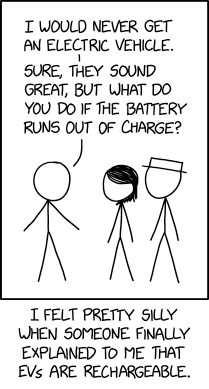
Title text:
Now that I’ve finally gotten an electric vehicle, I’m never going back to an acoustic one.
Transcript:
Transcript will show once it’s been added to explainxkcd.com
Source: https://xkcd.com/3214/
You must log in or register to comment.
I can kinda get the range anxiety comments though - it sucks having to keep daisy chaining extension leeds to go further.
Well if you run out of power it is easier to get someone to bring a container of gas than to get a truck filled with batteries to come and charge you for 30 min. The US has LOTS of large, rural areas with very poor EV support. Half the time the EV lots near me have some sort of problem and are shut off. They make more sense for dense, urban areas where you do lots of short trips and have access to high speed chargers.
Gonna get blasted for this, given the overall sentiment here in the comments towards EVs, but EVs are going to be used to monitor people everywhere they go and have killswitches, and other shit I’d not wanna deal with.
You say they’re going to, but EVs already exist and are pretty damn popular, especially hybrids. What makes you think that EVs are going to monitor people beyond what regular license plate tracking already does? What kind of killswitch? This sounds like fearmongering.
Them being electric/having digital components lets companies monitor your vehicles the same way they do monitor your online presence.
You can look up the killswitch thing, it’s planned in Europe iirc. It’s being sold as being introduced so as to “reduce drunk driving”, but obviously once that’s in place it can be used to manufacture car accidents and the sort.
Any time someone says these “technological advancements” are anything but innocuous, they get rammed as “fear-mongering”.
Every car you’ve ever seen on the road is electric and has digital components. Electric vehicles just use a direct drive motor powered by a battery instead of powered by gas combustion. Your 2026 lifted F250 is just as digital as your 2012 used Nissan Leaf.
The killswitches in question would apply to all new vehicles, not just electric ones. The US version of the law makes no provisions for remote shutdown, only for something akin to a passive breathalyzer. “Obviously once that’s in place it can be used to manufacture car accidents” your brain is conspiracy poisoned and you’re listening to talking points from the likes of Ron Desantis. Please take a break from the internet and go enjoy your local park.
That’s a fallacious argument. It’s like saying using a laptop made in 2026 is the exact same as using a laptop made in 2010 for privacy standards. News flash, it ain’t.
The killswitches in question wouldn’t apply to all new vehicles, or well, they would just be EVs, because they’re planning to ban regular vehicles.
They said when cable tv started that it would be ad free, it was for a while. Then you’d own your media, now it is all streaming. Then you’d have your own software, now it is going to subscription based more and more. Why would you think the current state of tech is the way it will always be? Car companies are already going towards data gathering though it isn’t limited to EVs. It is much easier to control every aspect of your vehicle though with an EV.
had a regular 110 plug adapter and extension cord. plug in anywhere but takes longer than charge station. never used it in 20,000 miles. about same as a gasser. hit 1/4 tank stop and fill up. imagine the switch from horses to gas was hard to figure out for a while.
These are the vehicles to have in the Apocalypse. Carry your own solar panels and charge it. No need to get fuel since gasoline only stays fresh for 6 months.
i had this idea only i planned to retire on the beach and eat fish. turned out to be no fun after a week camping in a jeep. Apocalypse in the basement. i wonder if there’s a siren like tornados
Personally I’d go with an electric bike since it needs significantly less time to charge given the same number of solar cells.
deleted by creator
deleted by creator
EV’s are probably best for an actually realistic scenario where energy infrastructure is destroyed or there is a mass fuel shortage, both things that happen all the time around the world in times of crisis.
But as far as actually apocalyptic scenarios it’s hard to beat a bicycle which doesn’t require a global supply chain to maintain.
Well… there are things like tires, tubes and components that would be hard to create.
But you need to supply and maintain the chain
au contraire my finely dressed friend:

deleted by creator
Bringing trucks of volatile explosive substance into every corner of the vast empty space, storing it somehow, maintaining the infrastructure for safe distribution: normal, cool, easy, makes sense.
Having a working outlet attached to a cable that already transmits electricity: unrealistic magical technology that just cannot possibly exist.Gasoline is not a “volatile explosive”. Movies make people think that shooting a gas tank will make it detonate.
Gasoline is not a “volatile explosive”. However, it is a volatile, explosive substance. That’s like the main reason it is in use. People forget how volatile and how explosive it is, because they handle it often, and because they know that you can shoot a gas tank and it wouldn’t immediately detonate most of the times, only some time.
Typically, you just get a tow to an EV charger (or even a residential outlet) and charge there.
I keep a spare charger and extension cord in the frunk when traveling a long distance. I can literally pull up to any place with an outlet and charge in an emergency. By the time a tow truck would show up, or by the time it would take to walk to the nearest gas station and walk back, the car would probably get enough charge to make it to a fast charger.
A word of caution to anyone charging an EV on an extension cord… You need to fucking watch it the whole time, and check the temp of your outlet and cord. Mine got uncomfortably warm, but not hot enough to burn. If the cord gets too hot to hold, then you need to stop, and get a better (usually thicker) extension cord.
Imagine having a gas station at home in your garage (assuming you own a house). Every time you’re home and your car is sitting in the garage (which is most of the time for most people), the “gas station” is slowly feeding “gas” into your car. You never even have to go to a real gas station, except on long trips (200+ miles).
I plug my EV in at home on the weekends. It charges overnight. Monday, I drive it to work (30 miles) and if there’s a charger available there, I charge it up for free. Over the 8 hours I work, the car charges up enough to refill both the trip to work plus enough for the trip home. If all I’m doing is to/from work, I don’t even have to plug in at home on weekdays.
I barely pay for fuel at all. I never have to stand at a gas pump in the freezing cold.
If I’m ever running low on charge (rare) I can find a charging station OR use the emergency plug-in charger & extension cord I keep in my frunk at any available outlet anywhere in the country. I’ve never had to use it, but I have it.
For me, an EV was the best option. I’ll never go back to an IC car.
Agree. And torque. You want torque? OK. It’ll give you torque. It doesn’t care what speed it’s doing, it’s got torque.
That and regen braking, which is the ducks nuts.
While the current state of our charging infrastructure is dismal, for sure ……
There are high speed charging trucks for just this purpose, or presumably a tow to a charger
In an emergency, you should be able to charge at any electrical outlet. It will cost you time, but if the goal is just enough charge to get you to a supercharger, then it may not be too bad
There is one aspect of charging that is much better in rural areas: the opportunity to charge from home. I never use a local high speed charger, those are only for trips. Charging at home is cheaper and much more convenient than going to the gas station for local driving, but many urban people won’t be able to do that
Plugable hybrids are a good compromise, when people remember to actually plug them in and run on electric when they don’t need to travel long distances.
I’d rather not have to deal with a petrol/diesel engine than go long distances, but saying that is a bit of a non issue to go a long distance in an EV in Europe.
That’s called privilege.
They also have the worst of both worlds shoved together
They’d be the best compromise for me. I usually drive short distances in the city, but maybe once or twice a year I want to do the 800km journey back to my home city in the next province. Train travel isn’t an option.
I have a similar situation and I just rent a car for those twice a year trips 🤷 Still cheaper than paying for gas
Literally impossible, given you have to pay for the gas of those rentals plus however long you keep them until you get back.
I pay 0€ for gas all year long, electricity is currently 0,0187€/kWh
The money I save from that equation easily pays for a rental twice a year.
You’d be paying even less with a plug-in electric hybrid.
How? Mind you that gasoline is 2€/litre here and electricity costs next to nothing.
They also have the best of both worlds shoved together, when used in an ideal general case situation. Zero emissions for urban use, emissions limited only on the very occasional when needed, and even then if it has enough stops to call EVs viable, you are going to get a significant reduction in emissions if you plug along the way.
Range extender hybrids are the goat
The combustion engine can always run at optimal rpm for torque and the drivetrain is 100% electric
A LOT simpler to construct too, it’s basically an EV with a built in generator
I only drive acoustic cars. They sound even better
Every once in a while I want the sound effects for my EV. Some of the most iconic “muscle” cars are just sound effect so it’s the same thing.
- if a mustang is all sound effect, my EV should be able to sound d the same
- if a Subaru has fake shift points with its CVT to help the car bros feel more comfortable, why can’t my EV
I want to come up to a red light in my EV and out-rev the corvette next to me
MachE has a sound effect. Frankly, it’s kinda sad.
I want to be able to choose my own noise (being fully aware why that is a bad idea more broadly). Can you imagine driving through the grocery store parking lot making a TIE fighter sound?
I want Gregorian chants or Baroque mandolin music.
Solid choice.
The problem is I do think it’s a good idea (but retro “space invaders” sounds). There’s a good argument that cars moving walking speed near a pedestrian’s ought to make enough noise to ensure the pedestrians are aware of them. I’d rather be annoyed by the noisy eenvironment than run over
Once it’s intentional to do this then yes, why not pick your own?
To be clear, I do think they should make noise, yes please. Totally agreed. When they’re moving slowly enough that people can get out of the way (and the tire noise is a little less significant), they should be making an artificial sound.
Also, Space Invaders sounds would be an amazing choice; along the same lines, the Pac-Man “wakka-wakka-wakka” would be awesome, especially if you have a yellow car. Come to think of it, the Fozzie Bear “wokka wokka!” would be hilarious, too.
I just think allowing people to choose a sound that’s automatically blasted at loud volume from their car at any given time is something we’ve already had a lot of experience with, given that stereo systems have been standard on cars for decades now; and we can be certain that people can’t be trusted with it–especially when they themselves can’t hear it. There are absolutely people who will use that power to broadcast ads, or their own recorded voice shouting obscenities, or a high-pitched screech sound that harms people’s hearing.
Or, even worse, they’ll change the sound to silence or something super quiet. Maybe to be malicious, but probably more so just because they find it annoying in some niche situation (like in their garage or whatever).
Allowing people to choose from a certain subset of options, or having some sort of onboard algorithm try to detect whether the sound is an appropriate volume (and replacing it with a substitute if needed) might be a good compromise.
Too true
If you sing-a-long in them you get better milage.
The only real question is: does it go “wooo wooo!” ?
You toss it out and get a new one of course!
“It said E for end, so I threw it out” - Patrick Star
I’m hesitant to get an electric vehicle because I don’t currently have anywhere to charge near my condo. My condo parking spot isn’t near a building, so it would probably be a pain to charge from there. I’d be interested if my office had some charging stations.
Until then, I’m quite happy with my old Prius. It goes, stops, and steers as needed, no complaints. Catalytic converter has only been stolen once.
A friend of mine did it. Parked at his condo then went to a supercharger every weekend. It can be done. I’m not that dedicated but some people are.
Unfortunately charging at work may not be the answer if there are not enough. My office has 8 chargers, so I can charge for free. However there are more than 8 people who want to use them. In theory we can share so 16 cars get half a day each but it can be tough to get a turn.
Chargers, both high speed and destination, really need to scale a lot for this to become convenient and reliable. It’s unfortunate that this also has become political and attempts to improve this have been blocked
Being able to charge at home is a game changer, and I live on the east coast where superchargers are commonly available but sometimes it’s easy to get discouraged at this infrastructure being so delayed
It’s a valid argument if you don’t live near good charging infrastructure. I have an EV in an area with ample charging. But when we went to visit my in-laws who live in a more rural area, it was a big challenge. The only chargers around were so slow that it would take 24+ hours to charge the car. And if you run out, you can’t get someone to bring a can of gas.
In an urban area, I love the reduced maintenance and not getting gas. On a road trip with kids, I don’t love killing half an hour in a grocery store with my kids amassing armloads of candy faster than I can put it back.
EVs are great, but we can’t automatically dismiss any complaint a hesitant person has.
24hour charge that’s like charging at under 3kw, that’s the rate at which a standard electrical outlet can charge in the UK, that’s the same power as my kettle. The V2L function on my EV can kick out more power than that.
In Canada, a level one charger is 1.4kw
My Tesla trip planner did something I never would have thought of but it works. It planned for at most 20 minutes at superchargers. It meant I never had to wait long at the cost of my next leg of the trip being a bit shorter. But I imagine it does optimize overall trip time, not just individual charging time. Remember batteries can’t charge linearly: there’s always a curve and charging always slows down as it gets full. Charging to 80% or similar takes advantage of the steep part of the curve to save you time
My biggest charging delay on trips is my own fault, always looking for a supercharger rather than destination chargers
- I’ve always given up pretty fast trying to find hotels with chargers
- when visiting family I never asked to plug in because I wasn’t sure whether they would make a big deal about it
I have had some issues with my electric car in rural areas between FL and GA and I will say the charging infrastructure has gotten much better in the past year in that area. Especially since most cars can also use the Tesla chargers too if you need to.
I’m sure charging stations exist, but I’ve only ever seen one with my own eyes once (Brazil, major city)
That’s something I’ve noticed in the US as well; gas stations are all over creation, easily visible, they have giant signs along interstates. I’m familiar with several long stretches of major highways and interstates, I could not take you to a charging station off the top of my head, nor do I think I could find one by highway signage like I can a gas station. I’m sure they exist but they haven’t called my attention to themselves.
As far as I can tell, car chargers are all over the place but often hidden away in the back of parking lots. And a lot of chargers require you to make an account or download an app.
Drove home today from the countryside in Finland. A station every 30km at least.
Gas costs ~2€/litre.
In South Africa, I have seen plenty in the big cities, but nothing on the countryside.
Meanwhile in Europe I take off for road trips with my EV that has very mid range, fully trusting there’s gonna be a station when I need one, at first I used to plan the trips around charges but quickly figured out it’s not necessary. If you have a newer model with big range then it’s really a total non-issue. Sucks to hear Brazil isn’t there yet but I’m sure the infrastructure will catch up soon.
EVs as they are now, are only useful for rich people, for two reasons.
- Batteries only last 5 to 10 years max, meanwhile poor people drive cars that are at least 20 years old, since replacing the batteries costs usually as much as the whole car, there wont be any of those new electric cars on the road in 20 years.
Electric cars are essentially disposable, where they are expected to be destroyed or “recycled” instead of repaired.
Ofc rich people buy new cars every few years anyway, so it’s not an issue for them.
- There’s not enough infrastructure for charging electric cars, having to drive extra into a charging station which is usually being used and wait until said charger is free is a too much of an inconvenience for people who already don’t have any free time at hand.
A gasoline car can be fueled in 30 seconds + 2 minutes to pay, and there’s usually a line at most service stations. Even if there’s mass adoption and all gas stations were converted into EV chargers, even if it only takes 10 minutes to charge an EV, that is 12 minutes per person, it would still amplify the queue to the point where it would be impossible to get anything charged.
Ofc rich people can just charge in their backyard or garage at night, so not an issue for them either.
I’m not saying that EVs are bad, but there has to be serious investment in infrastructure and batteries need to be cheaper and cheaply REPLACEABLE in order for the poor to be able to adopt EVs
Batteries only last 5 to 10 years max,
Real world studies are showing they last about an average of 12-15 years on average, and every manufacturer has a warranty for at least 8 years, with many up to 10.
A gasoline car can be fueled in 30 seconds
The typical passenger gas station pump flows at 7.9 gallons per minute. For most passenger cars and trucks, with tanks between 15 and 35 gallons, that’s about 2-5 minutes of pumping.
A typical level 3 charger will take a battery from 10% to 80% in about 25 minutes. And chargers can be in places where gasoline pumps can’t be, like ordinary parking lots and garages. So the dual purpose parking where you can charge the car while you shop at the grocery store or work out at the gym or sleep overnight at home is just a completely different paradigm from what we’re used to.
The average car lasts about 12 years, by the way. EVs last basically as long as ICE vehicles. Which also makes sense, because it doesn’t have to mix the fluids that lubricate and cool with combustion residue and foul up the engine that way.
So your data is out of date, and those fears that were commonly cited in 2015 have pretty much proven to be false for the technology that was around in 2015. Now, in 2026, there’s been even more advances in managing battery/charging health and chemistry, with more of an infrastructure for maintenance, repair, and charging.
Real world studies are showing they last about an average of 12-15 years on average
And that’s a problem for ppl who buy 20 year old cars.
A typical level 3 charger will take a battery from 10% to 80% in about 25 minutes. And chargers can be in places where gasoline pumps can’t be, like ordinary parking lots and garages. So the dual purpose parking where you can charge the car while you shop at the grocery store or work out at the gym or sleep overnight at home is just a completely different paradigm from what we’re used to.
Yes, you are right, I take back my “converting gas pumps into EV chargers”, that situation can be solved by having more charge points in other places, unfortunately, as things are know, I know from an EV drive himself that it’s almost impossible to find a free charger at least where I live.
The average car lasts about 12 years, by the way. EVs last basically as long as ICE vehicles
I guess that greatly depends on where you live, since you said “gallons” before I’m assuming US, at least here few people I know can afford a 12 years old car.
that’s the average, some will last longer than that
So if you’re in a country where it’s economically feasible to continue maintaining cars beyond 15 years, why wouldn’t you think that the much cheaper electric cars wouldn’t dominate the market even more?
Compared to the U.S.'s low adoption rates, EVs sell at higher rates in certain rich countries like Norway and Denmark, middle income countries like China and Turkiye, and poor countries like Estonia and Nepal. The cheapest EVs, globally, are cheaper than the cheapest ICE vehicles.
And that’s a problem for ppl who buy 20 year old cars.
The cost of maintaining a car to last 20 years can be applied to EVs and ICE cars alike. I suspect that EVs will be easier to maintain to those ages. In the U.S., that doesn’t really happen in large part because our labor and parts network is expensive enough that buying new is comparably cheaper than repairing, past the 15 year mark, for most vehicles. EVs don’t actually change the equation any.
So how are mechanics going to solve the battery problem? Maybe replace dead batteries with used but still somewhat working batteries? But then after 20 years all batteries for that same model will be dead.
Or are you trying to say that poor people will be able to buy newer cars than they do now, because rich people will dump them sooner?
Maybe replace dead batteries with used but still somewhat working batteries?
Why not replace them with new batteries?
Also, you’re not engaging with the fact that the typical ICE car lasts an average of 12 years. If there’s a batch of survivors that lasts much longer than average and are accessible to the people of your country, what makes you think the same won’t be true of EVs when they get old enough?
Also, you’re not engaging with the fact that the typical ICE car lasts an average of 12 years.
I will be honest, it’s not like I’m doubting your data, but that number is hard to swallow, a 12 year old car is basically new. Even if people in America throw away new cars just because they need some minor repair that doesn’t mean the car can’t survive 20 years more with proper maintenance.
Batteries are about 30% of the price of a full car, which is a lot, but significantly less than 100%. You definitely have an incentive to replace them instead of the full car.
To replace most of them, you need to unscrew the 4 big bolts that hold it, remove the dead one, put a new one in and rescrew the 4 big bolts. This is made difficult by the 700kg that the batteries weigh, but is doable if you have the equipment to lift and move heavy things.
Your issue is Tesla. Tesla has an absurd and dangerous battery design to make their models as flat as possible. I will not list the reasons why Tesla should not be used as a reference
I am not sure why you are stating that only the rich can charge at home, it is much cheaper than charging at a station. Fast chargers do sometimes have a queue issue, but it’s not as bad as it would be at a gas station with three lanes. They’re not converting gas stations to charging stations, they’re adding chargers to parkings that can charge dozens of car in parallel. And you won’t use them often because it’s so pricey.
Batteries only last 5 to 10 years max
Most manufactures offer 8 or 10 year warranties. Batteries are expected to last the life of the car (10-20 years). This is similar to the expected lifespan of the engine, because it’s designed that way rather than being a fundamental limitation of the technology, same as contemporary car engine lifespans.
Electric cars are essentially disposable
All cars are expected to be recycled when major components are damaged or worn out.
Ofc rich people can just charge in their backyard or garage at night, so not an issue for them either.
Charging in your driveway works fine, and you might be overstating the percentage of people who live in apartments and also have a car. Maybe true in your locality but not mine.
I’m not saying that EVs are bad, but there has to be serious investment in infrastructure and batteries need to be cheaper and cheaply REPLACEABLE in order for the poor to be able to adopt EVs
Replaceable batteries make the car cost more, not less, same as engineering in easily swappable engines (some tanks have this, no cars do). The big thing you’re not getting is that POOR PEOPLE DON’T BUY NEW CARS. The only thing required for adoption of EVs by poor people is a healthy supply of used EVs.
Batteries are expected to last the life of the car (10-20 years)
But that’s the problem, because the manufacturer always expects the car to last less than what it really does, poor people buy cars long after their “expected lifetime” has passed, (that is, when the previously owner considers the car to be too unreliable him), that’s when the person who is scrapping by, buys the unreliable car because it’s the only he can afford, now, repairing an old car as it keeps breaking down is expensive, but it’s still doable and much cheaper than buying a new car. But if the batteries are dead and the price of batteries cost as much as they seem to cost, then there’s no way to fix the car.
Also I’m septic if an electric car battery can last 20 years at all, there isn’t any good data on it, but if it uses the same technology as laptops Lithin-ion I don’t see it lasting much more than 10. From my experience Lithin-ion don’t lose capacity in a linear fashion, it’s more like a cliff, one day the laptop lasts an our, next day lasts 10 minutes.
All cars are expected to be recycled when major components are damaged or worn out.
You see, that’s the problem, it’s “Reduce, Reuse, and Recycle”, recycling should be the last option when the object really is at it’s limit and can’t function (and be fixed no more), if things are build to be durable then there’s no need to recycle them.
Charging in your driveway works fine
Would be fun to test how long I could set a power cord down from my apartment window into the driveway without it being stolen or vandalized. Or maybe the police would find some law to fine me for that.
Replaceable batteries make the car cost more, not less, same as engineering in easily swappable engines
Yes, but the lifetime of the car will be much longer, so when you equate the price of the vehicle to it’s useful lifetime it actually becomes cheaper.
The big thing you’re not getting is that POOR PEOPLE DON’T BUY NEW CARS
Yes, and that’s exactly what I’m saying, if poor people don’t buy new cars, and there are no old electric cars in the market because their batteries expired and the cars got recycled instead of repaired.
That’s what you’re saying but it’s not born out by what’s being seen with used EVs (other than the early Leafs). Used cars are perfectly usable after 10 years. The main problem with the used market is that there just weren’t that many EVs on the road 10 years ago, less than 1% of the market.
Most people live in apartments or rent. Plug in hybrids sound more feasible for now until the infrastructure is better. I know I can’t afford a charger and upgrade to my house to get an electric car. I’m intrigue by the Hyundai ionic5 n, but where do I park it to charge? I’ve driven many electric cars and even the low power ones feel nice to drive because of the torque. The audi etron and Hyundai ionics are awesome.
What we need is a magazine/renting system (e.g. drive battery empty, replace it at a charging station)
Afaik some e-roller in asian countries already have this for the small motorcycles.
Now make it motorized/automated/easy to do and boom: New gas station.
The problem is that what you actually do a roadtrip, (and you’re not charging at home on a normal “commute” day) is sit on your ass and do absolutely nothing for 45 to 90 minutes at a gas station in the middle of fucking nowhere, hoping no hick “jeds” see you hanging out at the Tesla charger and approach you to tell you that “yuu got a perddy mouf”.
You don’t charge EVs from 0 to 100% on roadtrips. It is inefficient.
Charging from 20% to 80% only takes 15-30 min.
You seem to have last looked at EVs in 2015. At 350kW, it takes about 7 minutes to charge.
A lot of EVs are currently advertising charge times of 30 minutes from 15% to 90%. Furthermore:
If theres a line for the charging station, everybody is gonna take 30 minutes, so you could realize you have a 2 hour wait.
If the battery is hot, it can take longer. If you just got off the highway, it could add another 15-30 minutes while the battery cools off.
7 MINUTES?! 7 minutes. To full. FROM EMPTY?!* 7. minutes.*
I don’t believe you. The last video I saw about road tripping with an EV was last year- this one.
Unfortunately that’s a Tesla ad. But I was wrong. Looks like at least some of the 350kW charging cars take about 18 minutes. Slower than getting gas, but not much worse than a pee and sandwich break every two hours or so.
Not to full, you never charge to full on a fast charger… You charge enough to continue with your trip, which, yes, takes about 10-15 minutes in my real-world experience. I’ve also timed my fueling stops in my gas car, and they also take at least 10 minutes if I have to pee, grab some coffee, etc.
So I’m not at all opposed to electric cars, but I’m on the old side and what I’m not “for” is spending time charging enough, planning my next charging stop, rather than “filling up” and “there’s one on any exit, whenever I see fuel is low again”.
Maybe it will reach that point some day, but if I want to go sightseeing or go to somewhere interesting, I don’t want the whole trip being highly stressfull stops of “OK where do we plan to stop next and for how long”.
At that point I’d much rather take a train, and yes I know how insulting that is considering it would be AmTrak here in the united states of late stage capitalism.
You misunderstand. The roadtrip planning, at least in my EV, is all handled by the car itself. I just punch in my destination and go. It figures out where I need to stop to charge, for how long, etc. When I’m stopped charging, the “time remaining until full enough” is prominently displayed in the car itself as well as in the app, and I get notified (in the car and in the app) that my car is ready to continue. All that time I also have a (very accurate) estimate of how much charge I’ll have remaining once I reach the next stop.
There’s no guesswork, the car figures it out on its own, and I can tweak it however I want.
Also, the actual experience refueling is horrible compared to charging: When fueling I have to stand outside in the cold, breathing noxious fumes while being blasted with loud adverts from the machine… Then I get inside to pay, and if I want to grab a snack, coffee or go to the bathroom, I know that I’m not making progress towards my destination during that time so I’m kind of in a hurry.
Charging, you just park, plug, and let the car do its thing. You know you have 10 minutes to kill anyway, so you do the same things knowing that your car is doing something productive in the meantime. The vast majority of the time, the car is done before me anyway. It’s just a lot more relaxing honestly.
But all this is something I do what, at most once a month with my car? Day-to-day is done with home charging, where I get home, plug in, and the car is full the next time I need it. No more stressing about running late but finding out you need to stop to refuel, etc.
All in all, I find my EV experience to be WAY less stressful / annoying than my gas car. Just yesterday, we did a small family trip about 2 hours away with the gas car (the EV doesn’t fit the whole family sadly), and on the way back we found out gas prices had jumped 15¢ / liter during the day, thanks to Trump’s war… With an EV the price stays a lot more stable over time.
So- genuine question here, not baiting. So assuming your 4G/etc (telemetry soaked) connection is working, how often would you wind up stopping to charge “up another X percent” along the way? It sounds like it would be having you stop more often than every few hundred miles?
The home charging scenario is great, near perfect experience FOR SURE, but there are cases where it’s not possible, like renters.
I kinda doubt the genuineness of the question given the comment about telemetry… I’ll be the first to admit that these things are a privacy nightmare, but that’s a problem with ALL modern cars, not just EVs. It just so happens that most EVs are modern cars, but they’re not necessarily worse than your random off-the-shelf 2026 Nissan Rogue.
Still, genuine answer: Haven’t done that many roadtrips where I’ve needed to charge more than once, actually. But my car can easily leave now and go 2-3 hours at highway speed without stopping. Make that 3-4 hours if I set it to charge at 100% the night before (in case of a planned roadtrip), as I usually only charge it to 80% to preserve battery life. Not sure how many miles that is as I’m to lazy to do the conversion, but this is why I use “hours at highway speed” as a metric.
A good resource to look at the various scenarios specific to your situation / area would be ABRP.
Or just… rent a car?
If an EV supports all of my travel/commuting needs except one or two road trips per year, I’d rather just spend $65/day renting an ICE. The idea that you need to solve every problem with one privately-owned vehicle is part of why there’s so many idiots using F-150s for daily commutes.
That’s not unreasonable but I’m in a mood today so Get the heck out of here with your REASONABLE ARGUMENTS! :)
user.user.age = “9000”; Done.