
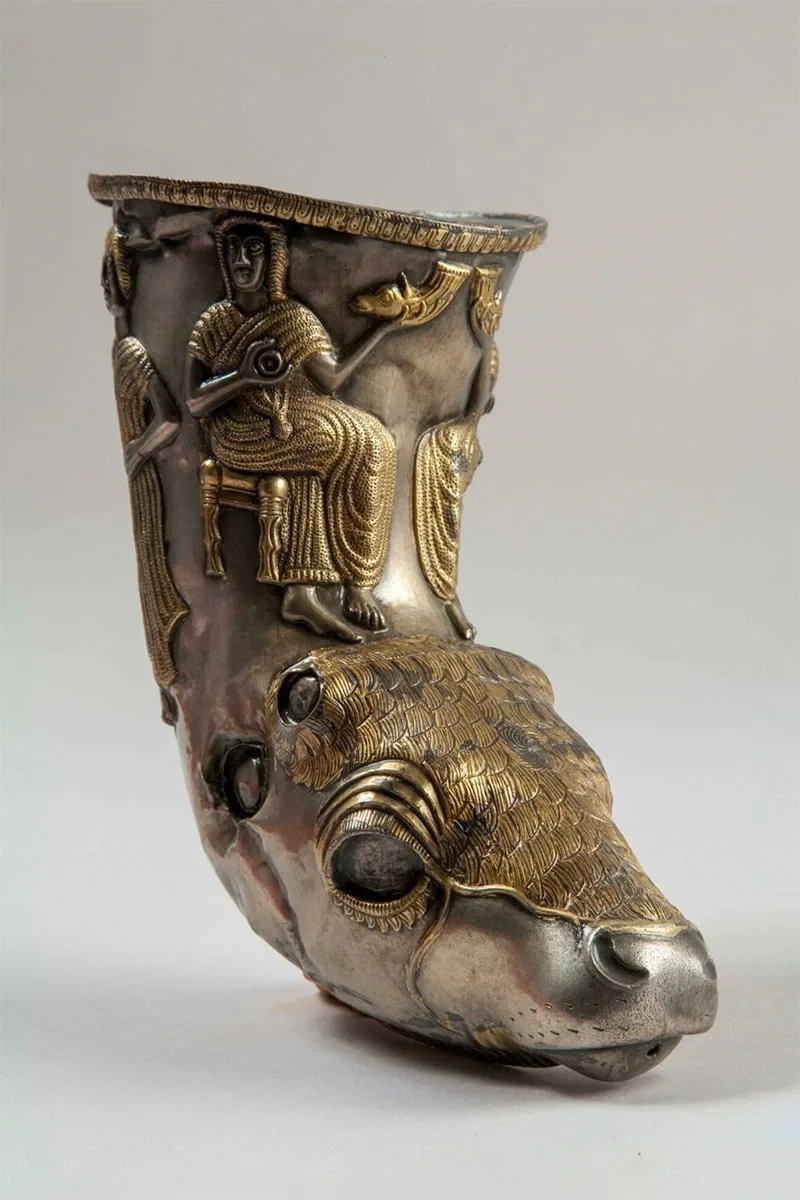
A rhyton is an ancient drinking vessel used mainly in ceremonies, feasts or rituals. It usually has a cone or horn shape and often ends with the head of an animal or mythical creature. Instead of drinking from the top like a normal cup, liquid (such as wine) is poured in from the top and flows out through a small hole at the bottom, often through the animal’s mouth.
The Poroina Mare rhyton was discovered by chance and entered the collection of the former Museum of Antiquities in 1893. It is shaped like a silver horn, partially gilded, ending in a bovine protome, with a cult scene depicting four women represented on the neck of the vessel: two seated on a throne, each holding a rhyton in one hand and a phial in the other, and the other two standing, with one hand raised and a gilded geometric decoration on the rim of the vessel, with a hole under the spout for draining the liquid, the rhyton from Poroina Mare is a local product, made in an indigenous manner, of Thraco-Getic art at the intersection of Greek and Scythian influences, dating from the 4th-3rd centuries BC.
I was gonna say Das boot. But after reading I’ve learned it was Das beer funnel.