I hide all my apps and so my home screen is completely blank, save for the wallpaper. On my Linux machines there are no icons on the desktop (except I added a calendar applet to my laptop, and the icon for my external drive appears when I plug it in). I can breathe. It’s lovely.
I once saw a colleague at a work event who had a home screen completely full of icons that, when more closely inspected, were actually stacks of icons layered on top of one another. I was so anxious just looking at it.
These UIs were useful for getting people used to how to do things on a computer that they used to do in real life. A file cabinet to represent the directory structure, a notepad app that looked like a notepad. A photo gallery app that displays your photos on a virtual film reel. Stuff like that. (See the UI to the original iPhone for a perfect example of this kind of design.)
Once computers became ubiquitous, people eventually started using them more than file cabinets, card catalogs, pen and paper, etc., eliminating the need for UIs that represented their real-world counterparts. Everyone stopped using the old methods to do things, which eventually evolved into the minimalist UIs we have today; using real-world representations was no longer necessary, because people stopped associating computer tasks with their oldschool counterparts.

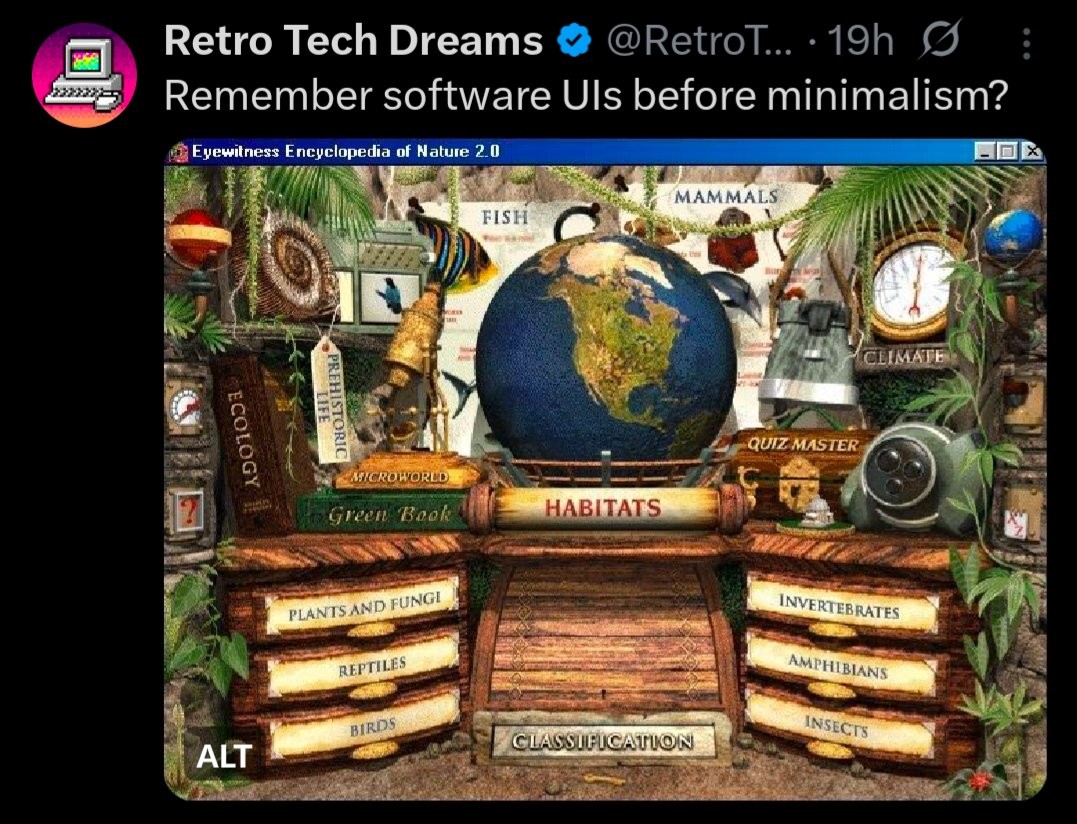
I prefer minimalist ui. This just looks messy.
I hide all my apps and so my home screen is completely blank, save for the wallpaper. On my Linux machines there are no icons on the desktop (except I added a calendar applet to my laptop, and the icon for my external drive appears when I plug it in). I can breathe. It’s lovely.
I once saw a colleague at a work event who had a home screen completely full of icons that, when more closely inspected, were actually stacks of icons layered on top of one another. I was so anxious just looking at it.
You must love Apple Glass. It is so minimalist you can’t even see it half the time.
These UIs were useful for getting people used to how to do things on a computer that they used to do in real life. A file cabinet to represent the directory structure, a notepad app that looked like a notepad. A photo gallery app that displays your photos on a virtual film reel. Stuff like that. (See the UI to the original iPhone for a perfect example of this kind of design.)
Once computers became ubiquitous, people eventually started using them more than file cabinets, card catalogs, pen and paper, etc., eliminating the need for UIs that represented their real-world counterparts. Everyone stopped using the old methods to do things, which eventually evolved into the minimalist UIs we have today; using real-world representations was no longer necessary, because people stopped associating computer tasks with their oldschool counterparts.
deleted by creator