

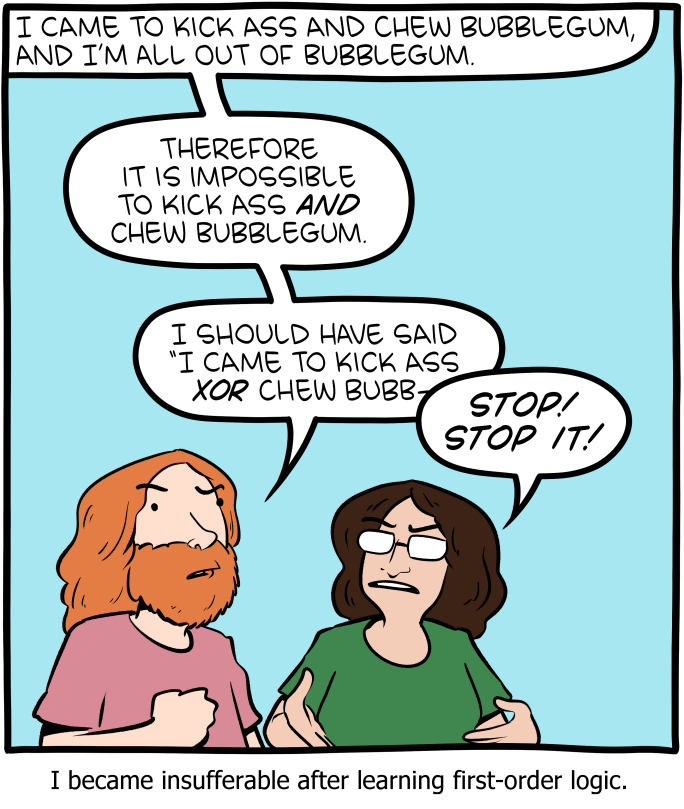
http://www.smbc-comics.com/comic/chew
Alt text
There was a fairly intricate debate on an early version of this posted to bluesky, the contention being over whether OR was sufficient. I think the ORs have it, but XOR is a funnier word, so there.
Bonus panel

In the English language “or” is equivalent to the Boolean “xor”. The English equivalent to the Boolean “or” is “and/or”.
Only sometimes. English is very much not so consistent.
Example: If I’m asked “Do you want fries with that? Or a shake?” It’s perfectly reasonable* for me to respond with “Both please.”
(*Linguistically, not so reasonable for my health.)
Just respond like logic operators expect you to
Yes
Yeah in this instance “yes” would cover both and if you want to answer with either specific then you name them
“fries, thanks, no shake”
“a shake please, yes”
Those all seems clear to me
Edit although if you just answer “yes” the cashier should prolly confirm “both?”, if he’s a pro.
“Either A or B” is a much less confusing xor.
But even logically it is an and. He came to do both, the logic statement won’t comply until he has done both, nowhere there is he saying that he is going to do both at the same time, only that his intention, by the end, is to have done both.
If he fulfills his intentions, he will have chewed bubblegum and kicked ass by the time he leaves, but that’s again up for interpretation because he didn’t specify if he’s capable for either or any kind of timeframe.
…I did take a course on what’s basically advanced logic in 4th year of CS. I believe we proved up until exponentials via logic proofs, based on some basic axioms like 1+1 and number ordering.
It’s fun to logically prove that 2 + 3 = 5 from the basic symbols 1 and +.