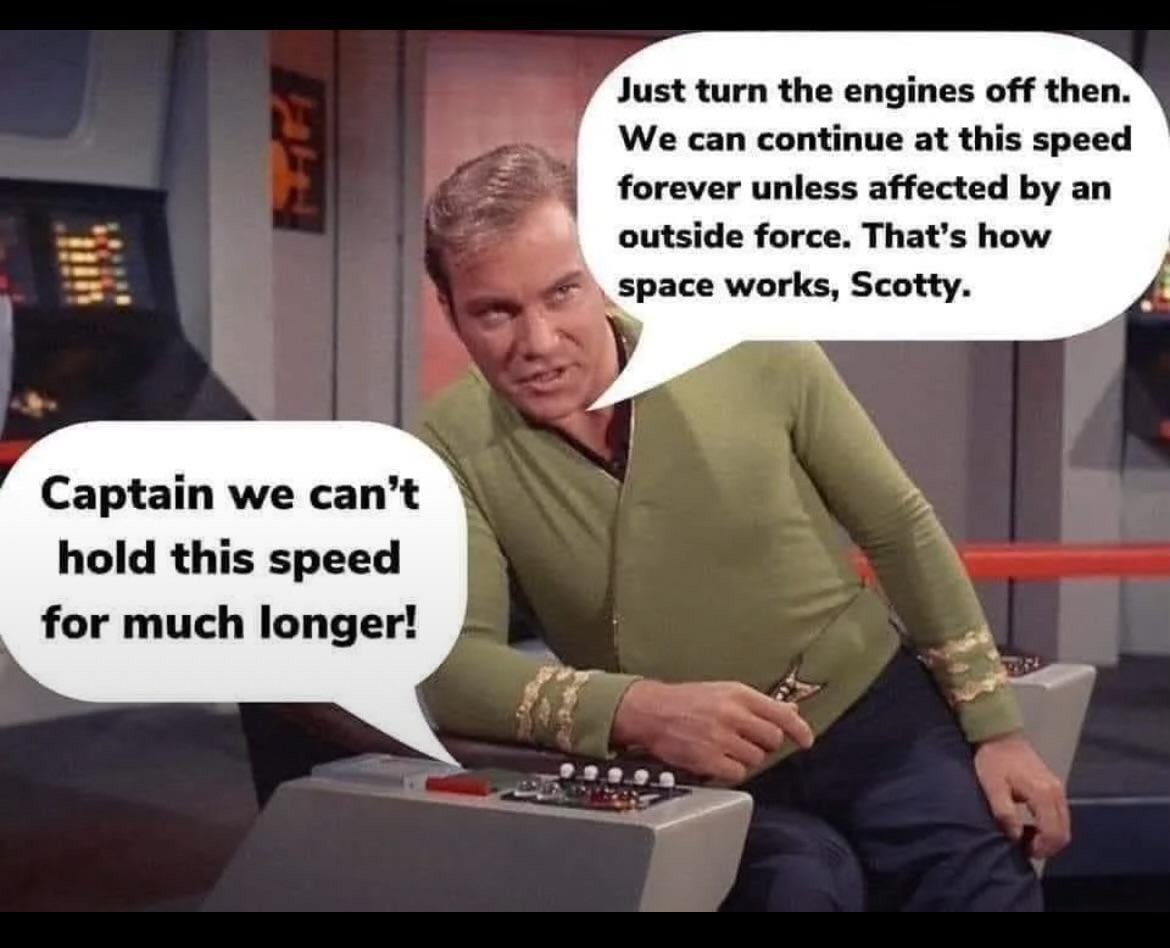

ITT: Angry Trekkies.
In the Trek universe ships do not accelerate to anywhere near relativistic speeds, they create a “warp bubble” that compresses space behind the ship and expands the space in front of the ship, creating a kind of pressure differential/wave (as in ocean waves) in spacetime itself. The ship doesn’t “move” at all at warp. To quote the late, great Cubert Farnsworth: “I understand how the engines work now! It came to me in a dream. The engines don’t move the ship at all. The ship stays where it is and the engines move the universe around it!”
That said, I don’t think I’d want to be moving at any speed through space without a way to slow myself down.
Canonically the impulse engines at least on the Enterprise D can achieve a top speed of 0.25 c. This means that when they’re being “cautious” and moving at one quarter impulse, they’re still moving at an insanely high velocity.
Was talkin about that in another comment thread actually. My headcannon is that’s why you hardly ever see them use full impulse unless it’s a life or death situation. Like you said, even 1/4 impulse is still something like 20 million meters per second.
Edit: If anyone is curious, the fastest man-made object in the universe is currently the Parker Solar Probe, which hit 0.000641C by slingshotting around Venus seven times!
I mean yeah, that’s not how Warp works! Impulse sure but not Warp
What if we blow a tyre captain?
You just turn off the flat tire simulation program, duh!
Love when sci-fi sneaks in a physics lesson 😂 In space, speed isn’t the issue—acceleration is.
This is something that always bothered me when watching some sci-fi space shows. A space walk occurs, but there is only so much thrust that can be used. Once the thrust stops, the person stops.
Thats…not how vacuums work.
What bothers me more is the crappy placement of these dialog bubbles. The order of them makes you read Kirk’s dialog first.
These are Laverne and Shirley speech bubbles, designed to ensure that neither speech bubble can complain about not getting top billing.
It’s not how atmospheres work either
This sort of thing is really common in video games where you’re able to move in zero G.
In the few games that have accurate zero G movement people get really confused. They’ll hold a movement key the entire way to a destination then smack into it because they didn’t realize they’d have to hold the opposite key for an equal amount of time to stop. Or they’ll fly a certain distance like that, then want to make a 90° turn, only to keep careening off in the direction of their initial travel with a slight bend to it.
Play hardspace shipbreaker, it’s qn entire game about manipulating objects and yourself in a zero g environment
I don’t recall ever seeing that with space walks in shows before. But depending on the show, in many there’s typically some form of inertial dampener and/or artificial gravity generator tech (or the equivalent) in the canon that allows for the crew to remain more or less stationary/move around normal and attached to the ground even while accelerating/decelerating and in stable orbit. Given such tech is always kind of handwave-y because such tech isn’t actually feasible with our current understanding of physics, it could be argued that they are the cause of what you describe.
Like if the role of the inertial dampener is to keep your position absolutely stable relative to the ship absent forces acting on you, if the radius of its influence extends outside of the ship to some degree, you might expect them to slow and stop relative to the ship once their thrusters stop. And same with the artificial gravity, if it extends out of the ship some and “downward” is directed towards the ship, you would expect them to be able to walk on the hull and even “fall” towards it.
It’s a different kind of space. They’re going faster than light.
In every ST series, they only ever say that in warp. And nobody has no idea how warp works.
I just know if you go faster than Warp 9 you’re fucked
Well, at minimum, fucking seems to be involved.
The Delta Flyer went above Warp 10.
But that was Voyager, and Voyager frequently is not considered cannon.
Warp 10 was how they got back, wasn’t it?
But it’s also at the end of the Star Trek timeline, so they’re allowed to advance the tech curve a little bit
Warp 10 was how they got back, wasn’t it?
no, warp 10 is how paris and janeway made their lizard babies, left them stranded somewhere and then never talked about them again. worf is parent of the year compared to these two.
Voyager took a Borg transwarp corridor to get back to Earth. Future Admiral Janeway facilitated it.
Yeah, but you get to have sex with the captain, uncaffeinated.
Warp 10. The Enterprise C regularly surpassed 9.5.
Didn’t rikers enterprise go to warp 13?
It did, but it also attacked the klingons from below rather than the standard head on so we know they writers were all high when they wrote that!
Rikers enterprise went to Warp 69
Writers are not physicists, and the TOS Enterprise also had a few minutes above warp 10 at some point. It’s whatever a set of 2-4 writers and 3-5 producers decided that week, and retconning the awkward bits later.
I never was making that claim, just that the person I replied to say going above 10 was dangerous
At some point in the cannon they decided warp 10 is the transwarp limit. They ignored it a couple of times.
they changed that between TOS and TNG.
https://memory-alpha.fandom.com/wiki/Warp_factor#Star_Trek:_The_Original_Series
Sure, but I’m saying that any thought or concern about a canon transwarp limit is at risk of being dashed by the whims of people looking for a plot device.
Oh for sure, warp factors and the limits thereof can be bent to fit a particular story
It’s whatever a set of 2-4 writers and 3-5 producers decided that week, and retconning the awkward bits later.
it is actually not, they had detailed manual for that. star trek was inconsistent or vague about lot of stuff (for example how their economic utopia works), but they usually tried to have their technobabble consistent.
they changed how the warp speed works between TOS and TNG.
https://memory-alpha.fandom.com/wiki/Warp_factor#Star_Trek:_The_Original_Series
(not saying there weren’t exceptions, for example there were some really random numbers flying in the equinox double episode.)
Then tell me what Tom Paris did in the Cochrane shuttlecraft ;)
That’s my point. It’s a standard until it’s not for a convenient plot reason.
TOS:
Warp factor 	speed (c) 	travelled in 24 hours (ly) 	Earth to Alpha Centauri

9 	729 	1.996 	52.07 hours
10 	1000 	2.738 	37.96 hours
11 	1331 	3.644 	28.52 hours
from TNG forward:
9 	1516 	4.15 	25.03 hours
10 	∞ 	∞ 	0
the lizard babies episode, however absurd, is in line with this.
The D. We only saw The C once. That was the ship Tasha went to with Shooter McGavin.
IIRC the in universe reason for the E’s long ass nacelles was to allow it to achieve 9.95. I am pretty sure I remember part of the expanded universe going into experimental refits of the USS Sovereign that allowed it to hit 9.995.
But for some reason they keep dropping out of orbit around planets.
What else were they orbiting?
Stars, crystaline entities,…
Lady streamers at twitchcon
I can only remember occasions where they had atmospheric drag, dropping out of orbit is much more of a Star Wars thing.
But I can believe one of the new shows fucked the entire thing up.
less so in nutrek, old trek usually has some techno-babble included. i wonder if they think the viewers will get bored to death from a pseudo-explanation of how warp works, eventhough they sorta explained it over the franchise as (contracting and expanding space using a subspace field).
transwarp, vortex, slipstream kinda sidesteps the speed of light in our own universe, by interdimensional travel, hence why its faster than warp.
Collapsing the warp field is bad for the same reason why the False Vacuum Collapse is bad.
For the curious, OA has a pretty extensive, physically plausible theoretical writeups on warp bubbles:
https://www.orionsarm.com/eg-article/493f29cc472f0
They’re the STL kind, but still, they do seem to require power.
AFIAIK the impulse drives are sub relativistic in Star Trek, right? Or maybe they aren’t, but that seems.
they just throwin redshirts out the back thats why impulse drives are red
They’re specifically soft when it comes using impulse vs warp for both subliminal and superliminal speeds. It’s whatever the writers needed at the time. It makes sense that they can use warp to go almost any speed, but it’s a whole lot of power to warp space just to cruise around a solar system. I think there was at least one episode of TNG where they went light speed or close to it with impulse, but I may be misremembering, I just remember thinking that’s not how their own science works.
ST doesn’t seem to respect relatively anyway, so I guess it doesn’t matter, heh. The physics are different.
They do and they don’t, again, depends on the writer, but relativity is a really hard concept for the average show watcher. Sci-fi doesn’t really exist without relativistic breaking tech of some sort. ST has warp and subspace communication. They have reasons those break relativity, and they kind of stick to them. Then they have beings like the Q that might as well be gods. And sometimes actual gods in TOS. As a whole, the series is nonsense. But they try to make it less so over time and that just makes it retconned nonsense.
For example, impulse engines can not accelerate a ship to anywhere near the speed of light. But they can accelerate it to enough of a fraction of C that things like time dilation become problematic. No breaking of physics but surprise surprise now your crew is 3 minutes younger than they should be, relative to Earth. Add that up over time and you’d potentially have to start swapping out crew members so that they don’t end up younger than their children when they retire. The Star Trek Voyager Technical Manual lists “full impulse” as 1/4C, or nearly 75,000 kilometers per second, which is probably why you hardly ever see it in use unless it’s a life or death situation.
There’s a writeup from a few years ago by a NASA scientist talking about the Alcubierre drive if you want something that’s closer to Star Trek engines. Although spoiler alert, they conceded that a ship would already need to be moving at SOME sub-luminal speed towards the destination first in order to control direction. Can’t just fire up ye olde warp engines from a standstill like they do in the show, apparently.
https://ntrs.nasa.gov/api/citations/20110015936/downloads/20110015936.pdf
Alcubierre drive
Exactly! This is what OA is using, albiet a modified version that doesn’t violate causality like the original Albecurie. See the original link and: https://www.orionsarm.com/xcms.php?r=oa-faq&topic=FTL+in+OA
Star Trek engines are something between displacement and halo drives, though with the bubble technically being “internal” and the ship following all relatavistic limitations:
A warp bubble is a region of space time enclosed in a fold, or bubble, of highly curved space. By expanding the space time metric behind the bubble and contracting the metric in front, the bubble can be made to move without the use of propellant mass. The vessel can apparently be coupled to the warp bubble(s) in various ways; by containing the bubbles wholly within the ship, as in the Displacement Drive; in front of the ship, coupled by gravity and/or magnetism, as in the Halo Drive; or entirely enclosing the ship, as in the Void Drive.
Note that no warp bubble has ever been observed traveling at super-luminal speeds. It is thought that such faster-than-light travel is impossible with void bubbles, because of dynamical instability of the warp metric at speeds greater than light and a suspected high flux of Hawking radiation that would turn anything inside a faster-than-light void bubble into a plasma of fundamental particles.
In the Displacement drive configuration, void bubble based drive nodes, operating in either the Alcubierre or Natario configuration, are enclosed within one or more magnetic containment vessels aboard the ship. The drive nodes are magnetically linked to the vessel within the containment volumes and react against it as they move, effectively pushing or pulling the ship across space with no ejection of reaction mass.
Only wormholes are “FTL,” with the catch that they have to be created and transported very carefully with respect to their light horizons (lest a configuration creates closed timelike curves and makes them explode)
Okay cool, I didn’t put that together while reading the first post. Although my understanding is that Trek warp drives would fall into the Void Drive category based on these descriptions. The bubble completely encases the ship while at warp and effectively shortens the world line they’re following, at least from the ship’s perspective. In the famous “Neelix almost kills the ship with cheese episode” they create a “static” warp bubble and invert it towards the ship in order to heat up all of the biogel packs on Voyager. Also I looked up the impulse engine thing and they arent relativistic but they are capable of accelerating a ship to 1/4C which is surely enough to cause some time dilation issues.
The void drives in OA are a bit crazy in that they’re almost like little pocket dimensions: sub microscopic, maneuverable, “bigger on the inside” like a Tardis, and requiring further nested void bubbles to enter/exit them without destabilizing. They’re more like something Q would use in their civil war. The description may sound closest to ST’s “ship inside warp bubbles,” but mechanically the displacment/halo drives are closer and their attempt at “more physically consistent” ST warp drives, while void ships are at the absolute edge of what’s possibly plausible in physics, assuming all engineering issues go away.
A giant ship at 1/4c is still quite high, yes… it’s also at the point where, under normal physics, you’d have to worry about things like the exhaust plume vaporizing whatever’s behind it.
Also Q help you if the navigational deflectors wink out for even a microsecond lol. I’m not a physicist but I’m fairly certain that hitting a mote of dust at 1/4C would cause a large enough explosion to wipe out an entire planet, if not an entire solar system.
A 1 gram rock would be “almost nuclear,” yeah, but not planet killing, and most micrometeoroids/cosmic dust is fortunately much smaller than that.
I found a fun calculator trying to research this. An object weighing 1 microgram, travelling at 0.25c, would contain nearly 3 megajoules of kinetic energy. So yeah I guess dust wouldn’t be apocalyptic but that still wouldn’t be fun to bounce into/through.
Scotty knows that conservation of momentum actually doesn’t happen over long distances in an expanding universe. Eventually you’ll stop.
https://www.youtube.com/watch?v=lcjdwSY2AzM
But also you need a warp drive to maintain warp. As soon as you turn it off or damage the nacelles you’re kicked out of the warp bubble. This happened in Into Darkness.
At the speeds they travel literally everything is an external force on them
Maybe it has something to do with active debris absorption 🤔
Not quite. The warp drive doesn’t actually provide any thrust, its purpose is to create the warp bubble and then “squish” the space in front of the starship.
Thus the “warp engines” do actually need to get constantly fed energy in order to work. Feed more energy equals get more squish equals go faster.
It doesn’t the ship through the universe, but the universe around it!
have they reverse the polarity of the shields?
they can’t do that without decoupling heisenberg compensators, duh.
what if they decouple the shields and reverse the polarity of the heisenberg compensators
you would need to realign the nacelles plasma flow, but it might work. how much time do you need for that?
i did it while we were talking. so, two days?
if you want to be real miracle worker, make it one next time.
aye aye sir
o7
It depends. Impulse engine? Sure. Warp? Nope. Also, you need shielding.
What about hyperdrive?
Another consideration outside of the warp field maintenance is how incredibly destructive a collision with even nanograms of mass can be at relativistic velocities and shielding against those takes a lot of power itself
I always thought that’s exactly what the deflector dish was for. is this not the case?
i believe they’re saying that the deflector shield requires constant power, so that’s part of why the engine is required while moving rather than just while accelerating
ah, makes sense.