
How do you like to bind your arrow keys, and why?
Ergo boards don’t typically have dedicated arrow clusters, so we’re left to bind them on some alternate layers one way or another.
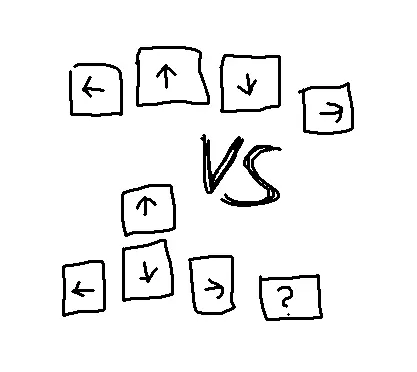
Here are two prevalent layouts, along with some initial thoughts:
Homerow
Binding them linearly to a homerow on some layer.
Pros
- Arrows directly underneath your fingertips
Cons
- Less intuitive
- Pinky may be weaker when going right repeatedly
Pyramid
Bind arrows in a traditional pyramid shape, likely based on a homerow as well.
Pros
- Familiar layout
- Extra key available for pinky, e.g. a tab might be handy
Cons
- Finger movement required for up arrow
- Takes space on the row above, which might matter if you’d like to have a full row of other things there
Post pic is original art by the author, public domain, commission queue is already full.
You must log in or register to comment.
I managed to quit vi once, I’m not recreating that experience again. IJKL all the way. Same hand and positions as the arrow keys, just without having to move your arm.
ASDW FTW
I’ve been using the right hand variant of this, but for no other reason than that just happening to be the case on the layout I started with. Becoming conscious of this was the reason for the making this post ^^
I prefer pyramid shape, and in order to not waste space around, I generally put Home and End around the Up arrow
Dang I can’t believe the commission queue is full already. Must be drowning in work.
Yes. It’s imperative that I micro optimise my arrow keys to make it through this.
Appreciate the optimization being open source at least, helping everyone out.
I have a split ergo and set a dedicated layer on one half as a “navigation layer”. There, I have pyramid on ESDF, skip word forward/back, start/end of line, … I placed these other movement-keys around the ESDF cluster “logically” as I don’t care to much on saving space on a dedicated layer.
ESDF! You don’t have to move your hand for gaming

I think it’s fairly common to have a gaming layer with wasd there already so this would indeed be a natural extension.
Is anyone using the linear style for mouse emulation? I find this to be way more difficult than just moving the caret around text.
Yeah, I am on my Ergodox EZ. One layer has hjkl for arrow keys, and another has them for mouse movement, with u for left-click and o for right-click.
Impressive, so it can be done ^^
I just wish wasd had never become the standard, esdf had been so much better for touch typers
Just move all the keys one column to the right …

I play stepmania and sometimes edit maps that are good but probably impossible on feetI’m pretty used to hjkl navigation from using vim. When I first started learning vim it felt weird but it’s natural now.
And HJKL doesn’t use the pinkie.
Pointer finger covers both H and J.
Yeah I get the feeling that this line of navigation originates from vim and friends.
The inverted T is god-damned masterpiece, regardless of where it’s placed. Your middle finger is already longer than the others and naturally rests closer to the top edge of the down arrow, requiring a minimal amount of movement to get to the up arrow. This is why it outlasted cross-nav and various godawful clusters or shift-pairs like on early 8-bit home computers, and why it never faced a serious challenge from layout-complicating diamond-nav or “does it exactly backwards” T-nav. It’s also more intuitive than 4-key linear nav, though fair play to you if your brain can make it work. I do tend to think that some folks make a commitment to staying on the home row that goes way beyond the strict needs of carpal tunnel health, but I’m a row-stagger heathen so take my thoughts for whatever they’re worth.
Excellent point about the middle finger lenght.