

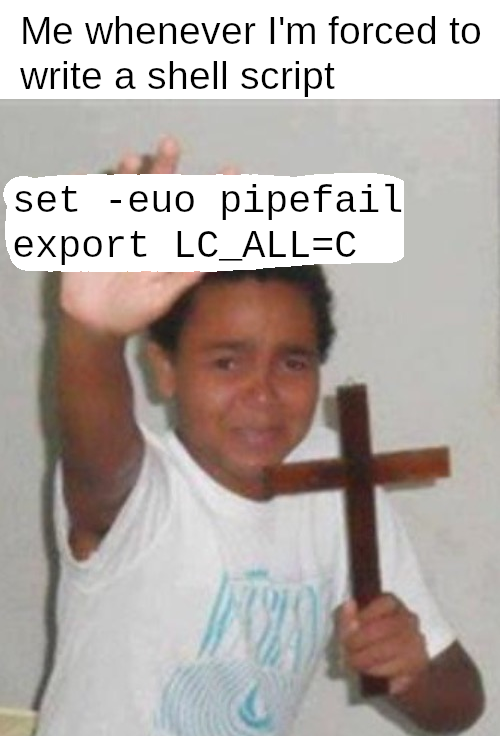
Explanation for newbies:
-
Shell is the programming language that you use when you open a terminal on linux or mac os. Well, actually “shell” is a family of languages with many different implementations (bash, dash, ash, zsh, ksh, fish, …)
-
Writing programs in shell (called “shell scripts”) is a harrowing experience because the language is optimized for interactive use at a terminal, not writing extensive applications
-
The two lines in the meme change the shell’s behavior to be slightly less headache-inducing for the programmer:
set -euo pipefailis the short form of the following three commands:set -e: exit on the first command that fails, rather than plowing through ignoring all errorsset -u: treat references to undefined variables as errorsset -o pipefail: If a command piped into another command fails, treat that as an error
export LC_ALL=Ctells other programs to not do weird things depending on locale. For example, it forcesseqto output numbers with a period as the decimal separator, even on systems where coma is the default decimal separator (russian, dutch, etc.).
-
The title text references “posix”, which is a document that standardizes, among other things, what features a shell must have. Posix does not require a shell to implement
pipefail, so if you want your script to run on as many different platforms as possible, then you cannot use that feature.
set -euo pipefailis, in my opinion, an antipattern. This page does a really good job of explaining why. pipefail is occasionally useful, but should be toggled on and off as needed, not left on. IMO, people should just write shell the way they write go, handling every command that could fail individually. it’s easy if you write adiefunction like this:die () { message="$1"; shift return_code="${1:-1}" printf '%s\n' "$message" 1>&2 exit "$return_code" } # we should exit if, say, cd fails cd /tmp || die "Failed to cd /tmp while attempting to scrozzle foo $foo" # downloading something? handle the error. Don't like ternary syntax? use if if ! wget https://someheinousbullshit.com/"$foo"; then die "failed to get unscrozzled foo $foo" fiIt only takes a little bit of extra effort to handle the errors individually, and you get much more reliable shell scripts. To replace -u, just use shellcheck with your editor when writing scripts. I’d also highly recommend https://mywiki.wooledge.org as a resource for all things POSIX shell or Bash.
I’ve been meaning to learn how to avoid using pipefail, thanks for the info!
After tens of thousands of bash lines written, I have to disagree. The article seems to argue against use of -e due to unpredictable behavior; while that might be true, I’ve found having it in my scripts is more helpful than not.
Bash is clunky. -euo pipefail is not a silver bullet but it does improve the reliability of most scripts. Expecting the writer to check the result of each command is both unrealistic and creates a lot of noise.
When using this error handling pattern, most lines aren’t even for handling them, they’re just there to bubble it up to the caller. That is a distraction when reading a piece of code, and a nuisense when writing it.
For the few times that I actually want to handle the error (not just pass it up), I’ll do the “or” check. But if the script should just fail, -e will do just fine.
Yeah, while
-ehas a lot of limitations, it shouldn’t be thrown out with the bathwater. The unofficial strict mode can still de-weird bash to an extent, and I’d rather drop bash altogether when they’re insufficient, rather than try increasingly hard to work around bash’s weirdness. (I.e. I’d throw out the bathwater, baby and the family that spawned it at that point.)Yup, and
set -ecan be used as a try/catch in a pinch (but your way is cleaner)I was tempted for years to use it as an occasional try/catch, but learning Go made me realize that exceptions are amazing and I miss them, but that it is possible (but occasionally hideously tedious) to write software without them. Like, I feel like anyone who has written Go competently (i.e. they handle every returned
erron an individual or aggregated basis) should be able to write relatively error-handled shell. There are still the billion other footguns built directly into bash that will destroy hopes and dreams, but handling errors isn’t too bad if you just have a littlediefunction and the determination to use it.That’s well put. I might put that at the start of all of my future comments about
bashin the future.Putting
or die “blah blah”after every line in your script seems much less elegant than op’s solutionThe issue with
set -eis that it’s hideously broken and inconsistent. Let me copy the examples from the wiki I linked.Or, “so you think set -e is OK, huh?”
Exercise 1: why doesn’t this example print anything?
#!/usr/bin/env bash
set -e
i=0
let i++
echo "i is $i"
Exercise 2: why does this one sometimes appear to work? In which versions of bash does it work, and in which versions does it fail?
#!/usr/bin/env bash
set -e
i=0
((i++))
echo "i is $i"
Exercise 3: why aren’t these two scripts identical?
#!/usr/bin/env bash
set -e
test -d nosuchdir && echo no dir
echo survived
#!/usr/bin/env bash set -e f() { test -d nosuchdir && echo no dir; } f echo survivedExercise 4: why aren’t these two scripts identical?
set -e
f() { test -d nosuchdir && echo no dir; }
f
echo survived
set -e f() { if test -d nosuchdir; then echo no dir; fi; } f echo survivedExercise 5: under what conditions will this fail?
set -e
read -r foo < configfile
And now, back to your regularly scheduled comment reply.
set -ewould absolutely be more elegant if it worked in a way that was easy to understand. I would be shouting its praises from my rooftop if it could make Bash into less of a pile of flaming plop. Unfortunately ,set -eis, by necessity, a labyrinthian mess of fucked up hacks.Let me leave you with a allegory about
set -ecopied directly from that same wiki page. It’s too long for me to post it in this comment, so I’ll respond to myself.From https://mywiki.wooledge.org/BashFAQ/105
This is great and thanks for taking the time to enlighten us 😄
No worries! Bash was my first language, and I still unaccountably love it after 15 years. I hate it and say mean things about it, but I’m usually pleased when I get to write some serious Bash.
Exercise 6:
That one was fun to learn.
Even with all the jank and unreliability, I think
set -edoes still have some value as a last resort for preventing unfortunate accidents. As long as you don’t use it for implicit control flow, it usually (exercise 6 notwithstanding) does what it needs to do and fails early when some command unexpectedly returns an error.