

In the US “sleet” is the term for a winter precipitation that occurs when snow falls through a layer of warm air and melts into water droplets, then re-freezes into ice pellets as it passes through colder air closer to the ground. In many other areas that were part of the British empire that precipitation is called “ice pellets” and “sleet” instead refers to a mix of snow and rain. In the US that’s called a “wintry mix.”
I didn’t know it required a freeze-thaw-freeze cycle either. I’d always been under the impression it was just rain that froze before hitting the ground.
It technically does, it just happens 2 or three more times than we thought. TIL
is when there is sudden downpour of slut (plural)
Heh!
Hah, have you ever noticed that the meaning of “quite” is quite different depending on whether the person saying it is from USA or from England? :) On one side of the pond it means the same as “somewhat”, while on the other side it means “very”.
Quite.
Who uses it to mean “somewhat”? I’ve only heard it used to mean very/indeed/enough/completely, consistently between both the US and UK.
Are you sure people were saying what you thought they were?
I’m quite certain
Don’t forget hominy snow in the south.
Sleet is like raining slush in the us too. That was the only definition I knew of.
Im here in the Midwest and sleet here is anything with a gas station slushy consistency as it’s falling. It’s slush on the ground, but sleet in the air.
I’m in Ontario and would agree. But I’d also call say it’s sleet if it’s little ice pellets that move like sand. Probably because when it happens (which us rare for us) it oscillates between the phases several times in the same storm.
Why are people out here calling graupel “sleet” or “ice pellets”? We’ve already got a perfectly good word for graupel. =D
What the hell is graupel?
It has no meaning to me.
I would call the frozen raindrop thing hail and the snowy watery thing sleet. I’m from the UK.
I would say the same and I’m from the southern US. Everyone I know would say the same. I’ve never heard anyone, IRL or the news or online, say hail is sleet.
Hail is formed through a completely different process and is a spring/summer precip type associated with thunderstorms. It forms as water gets lifted high into the atmosphere from updrafts in the thunderstorm then fall before getting lifted again. Hail often shows layers (like a jawbreaker) and can grow very large.
In the US, sleet/graupel is essentially just a frozen raindrop and is a winter precip type. Wintry mix is what the US National Weather Service uses for any mix of rain, snow, sleet, graupel, and freezing rain. The WMO and Europe use Ice Pellets for frozen raindrops and Sleet for mixed rain and snow. So both are official terms depending on where you are.
Yes! This is also my understanding. I’ve even experienced hail in hot tropical countries.
deleted by creator
To the layman: sleet=tiny ice. Hail=big ice.
I will NOT hail big ICE. They can go fuck themselves!
Yes, hail is from thunderstorms and is generally larger, ice pellets are winter precipitation and almost always smaller. Hail usually lasts only a few minutes, ice pellets can last many hours.
Sleet is basically crunchy snow. Very slightly larger, a bit harder, not really a danger to much of anything it falls on. You don’t get golf ball sized sleet, you get like, half-a-pea-sized sleet.
I’m in the US and I completely agree
I had to go looking to see if there was a distinction. There is!
Hail is a form of solid precipitation.[1] It is distinct from ice pellets (American English “sleet”), though the two are often confused.[2] It consists of balls or irregular lumps of ice, each of which is called a hailstone.[3] Ice pellets generally fall in cold weather, while hail growth is greatly inhibited during low surface temperatures.
Unlike other forms of water ice precipitation, such as graupel (which is made of rime ice), ice pellets (which are smaller and translucent), and snow (which consists of tiny, delicately crystalline flakes or needles), hailstones usually measure between 5 mm (0.2 in) and 15 cm (6 in) in diameter.[1] The METAR reporting code for hail 5 mm (0.20 in) or greater is GR, while smaller hailstones and graupel are coded GS.
Wild to assume the entire US agrees on much of anything.
As someone from the U.S. I have never heard of “wintry mix”. I currently live on the west coast, but I always grew up that wet mix of snow/rain/water on the ground as “slush”. Each country has its own regional dialects
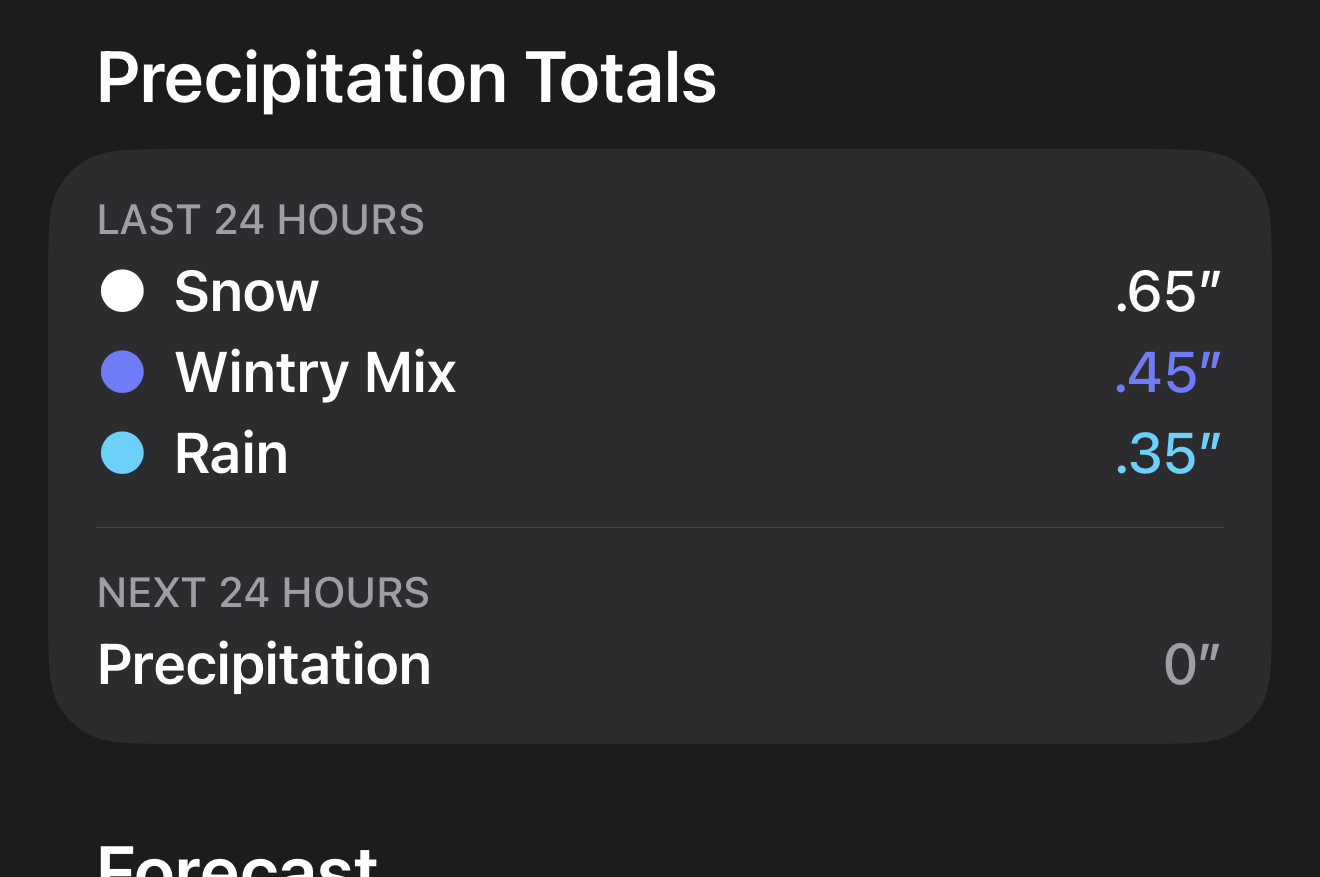
That’s the NOAA/NWS term I think (this is apple weather)
intresting. was looking and asking around, it seem, (agian as a person who lives in a west coast area where we get about 0 snow). “Wintry mox” seems like it might be used to mean a combo of rain/sleet/snow, so while the “ice pellets” are still called “sleet” you might say its “wintry mix” bcs there might be sleet/snow/rain on the ground or around.
Snow - snow Rain - rain Sleet - sleet Winters mix - any combination above
Sleet has always been the slushy stuff near me. Hail is the hard frozen ice pellets that can crack a windshield. I don’t know what OP is talking about.
deleted by creator
In some part because weather isn’t the same in all English speaking countries.
A lot of the world doesn’t get a significant amount of what Americans call “sleet”, it’s either mixed in with, or the brief transition between, rain and snow. The quirk of having the huge landmass of Canada up in the North, the warm waters of the Gulf of Mexico to the South, and no East-West mountains to keep them separated means we get huge masses of moist warm tropical air lifted high above dense cold yet dry polar air, that tropical moisture condenses and falls through that polar air and has enough time to freeze on the way down, completely and continuously for long periods of time.
Subjectively, sleet is snow’s dipshit loser brother. Snowfall is silent, in fact it’s silencing, it’s like it sucks the sound out of the world. Sleet hisses like rain on fast forward, it’s almost like pink noise. Sleet is denser than snow; an inch of sleet is more precipitation than an inch of snow; it has less surface area so it’s harder to melt and it’s heavier, so it’s harder to move.
Not to be confused with hail, which is frozen precipitation that occurs paradoxically in the summer in vicinity of severe thunderstorms. Convective activity catches precipitation and throws it very high into the atmosphere where the temperatures are cold, so it freezes. This happens over and over again until it is either too large to be lifted again or it gets thrown clear and lands some distance from the storm. The major threat from hail is impact damage.
If someone told me about ice pellets id persume they meant the fancy lil ice cubes, but also y’all say “pass me the fairy liquid” and be talking about soap.
Come to think of it, I’ve never really bothered thinking about what sleet is. I’ve always just put it in the “you know it when you see it” category.
If I pummel my brain for what I would describe it as, I’d say it’s wet, heavy snow in a wind. Like “really soft hail” I suppose.
But yeah…I never bothered. Interesting thought experiment for myself.
Where are you from? Based on your and OPs descriptions I’m guessing a Commonwealth country.
Being from the U.S. I’d have described it as frozen drops of rain.
Canada.
“Frozen drops of rain” makes sense too. I picture it as, “Imagine a raindrop hits your windshield, and instead of thunking like a raindrop, it’s kind of splats like a tiny tiny snowball.” That’s sleet.
In the U.S. sleet bounces off the windshield instead. I think we’d call Canadian sleet wet snow. OP said we’d call it “wintry mix” which maybe some of us would but I always thought “wintry mix” was when you were on the line between snow and rain and you just got a bit of everything; snow, sleet, slush, freezing rain, etc…
From Ohio, and to me sleet is several things
Wet snow/rain mix
Tiny frozen spheres that aren’t big enough to be called hail
Snow/tiny hail mix
Any combination of the three, really.
Mostly it boils down to “not snow or rain or hail”, and “wintry mix” is something I never heard until adulthood.
Soft hail is called graupel.
We called it hominy snow growing up. Always loved the sound it made.
If its winter, you walk outside and the precipitation is very loud and stings like hell when it hits you it’s sleet.
That’s hail.
It doesn’t hail in the winter, and hail is larger. Hail comes down in pellets due to the fact that it’s made by water droplets falling down, getting blown back up into a cold cloud, freezing, getting blown back up to freeze some more, and so on until it’s heavy enough to overcome the updraft and fall to the ground. Sleet is like rain that freezes as its falling, but doesn’t become the soft gentle snow, and the difference between sleet and freezing rain is that freezing rain is liquid until it hits a frozen surface.
Around here, we just call that freezing rain.
Freezing rain to me is water that freezes on impact, and it very quickly becomes a problem for trees and roofs and everything.
Yes, around here the difference between freezing rain and sleet is that freezing rain is liquid until it lands and it freezes on contact with a cold surface and sleet is solid as it comes down.