Small clarification. My understanding is that it’s 40% by weight of goods carried, not 40% of ships. So still massive chunk, but not quite the same metric. Also some of those ships would still presumably be needed to move batteries and solar panels, At least for a while until we have enough for a closed loop recycling system (we can recycle like 99% of the lithium from lithium batteries, no idea how emerging sodium batteries will affect things)
Once per installation per x years. While battery and solar replacement seem like a long time, the massive scale needed for a global buildout will require a continuous stream of shipping. It’s not free and will never be locally produced everywhere. Obviously a couple orders of magnitude less shipping, but energy related shipping is not disappearing entirely.
Actually I’d like to see someone do that math, out of curiosity. In a world with all renewables, does energy related shipping drop from 40% to 1%? 0.1%?
Sodium based battery companies are, unfortunately, crashing right now, since lithium production has jumped so significantly that lithium prices have seen a major crash. Since price was the main economic driver for sodium batteries over lithium ones, many companies making sodium batteries are in big trouble right now, since lithium is more energy dense and at price parity
Which is still all due to investors not looking longer than 2 years since all of the crashing companies except Northvolt are startups. Lithium prices will always rise again at a much much higher rate than sodium.
Sodium was always better for grid storage due to temperature charging and discharging and still plenty cheaper than Lithium Iron Phosphate that it is a replacement for.


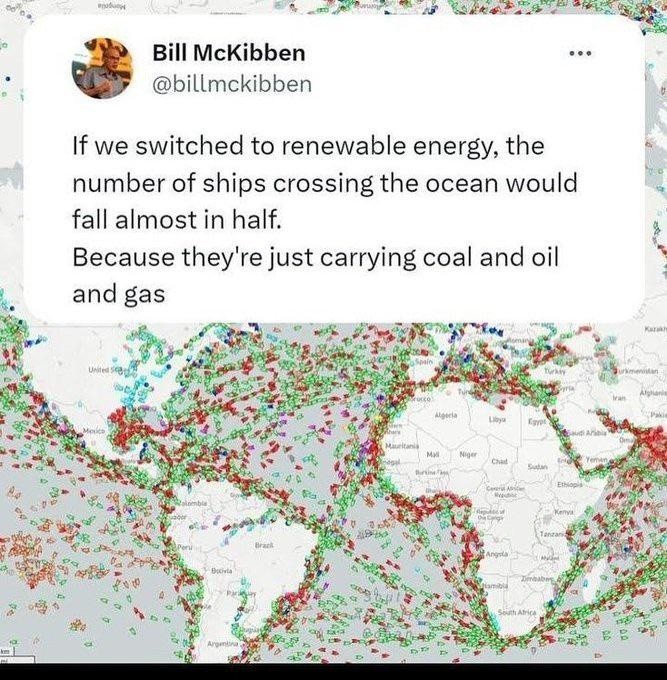
I don’t doubt that it’s a lot, but can anyone provide a source for the 40% of global ship traffic? I couldn’t find any statistics sadly
The data is from UNCTAD
Small clarification. My understanding is that it’s 40% by weight of goods carried, not 40% of ships. So still massive chunk, but not quite the same metric. Also some of those ships would still presumably be needed to move batteries and solar panels, At least for a while until we have enough for a closed loop recycling system (we can recycle like 99% of the lithium from lithium batteries, no idea how emerging sodium batteries will affect things)
That’s what the headline says: 40% of traffic, not 40% of ships.
deleted by creator
You need to move batteries and panels ONCE per installation, not every time you need energy.
Once per installation per x years. While battery and solar replacement seem like a long time, the massive scale needed for a global buildout will require a continuous stream of shipping. It’s not free and will never be locally produced everywhere. Obviously a couple orders of magnitude less shipping, but energy related shipping is not disappearing entirely.
Actually I’d like to see someone do that math, out of curiosity. In a world with all renewables, does energy related shipping drop from 40% to 1%? 0.1%?
So, for estimation purposes, that’s essentially no shipping compared to the present fossil-fuel situation.
Recycling systems will become absolutely necessary, preferably before the battery boom happens.
You have to show the math for an absolute statement like that.
Excellent explanation! Thank you :)
Sodium based battery companies are, unfortunately, crashing right now, since lithium production has jumped so significantly that lithium prices have seen a major crash. Since price was the main economic driver for sodium batteries over lithium ones, many companies making sodium batteries are in big trouble right now, since lithium is more energy dense and at price parity
CATL retooled to sodium and plans to produce both sodium/lithium hybrids and pure sodium packs.
Lithium is also very abundant. OK, not as much as sodium, but still common.
Which is still all due to investors not looking longer than 2 years since all of the crashing companies except Northvolt are startups. Lithium prices will always rise again at a much much higher rate than sodium.
Sodium was always better for grid storage due to temperature charging and discharging and still plenty cheaper than Lithium Iron Phosphate that it is a replacement for.
Also better performance in cold environments which is important to outperform ICE cars.