- cross-posted to:
- programmer_humor@programming.dev
- cross-posted to:
- programmer_humor@programming.dev
You must log in or register to comment.
I still remember when my 386 had 4MB of RAM, and I didn’t have a math coprocessor.
And I could still get online.
I was going to write that I’m old. But, no, I’m not that old.
How is centered div formed
It’s actually really easy though! Look up a Flex box generator and copy the code it gives you!
For #1 you can try KDE Connect. Send files and clipboards between your devices over wifi or bluetooth.
Sending stuff to another person’s device? 🤷
I’ve heard good things about LocalSend.
LocalSend is great.
Needed to send some stuff from my Linux server to my wife’s Window’s PC the other day, but I was at work and she couldn’t get her PC to see the folders I’m sharing over the network. So I used AnyDesk from my Mac at work, opened LocalSend on the server and sent the files over. 1GB sent over in about 10 seconds. Amazing stuff.
Some parts of living in the future are magic.
deleted by creator
deleted by creator
Many public wifi networks disable peer to peer connections over the network for security purposes, which breaks KDE Connect
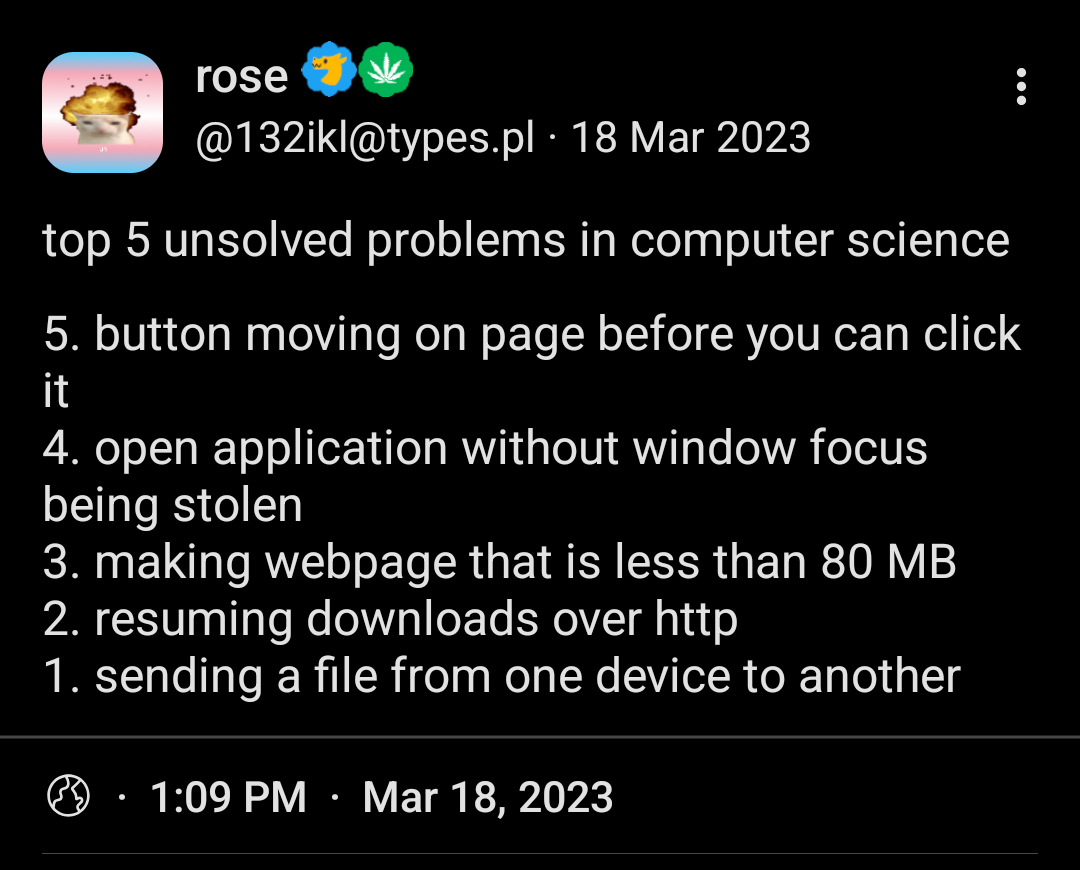
5 is infuriating, especially if the site engages in fuckery like putting an ad under where the desired click disappeared from, so the user ends up clicking the ad.
3 is intentional, too. A performant page requires paying a skilled web developer.
Web page too slow? Use our affiliate link for a new computer!
Dark patterns. All 5. Problem solved
- Any user input should take top priority over anything. I don’t want to wait for your 50 banner and ads to load to click the thing I already know I want. If I opened a program or clicked a link I don’t want, I want to be able to leave even before its wasted more time loading the thing I don’t want. And holy shit, those tutorial popups that explain features that you can’t click out of, and have to click through all the prompts to start using the fucking program, made way worse if you went there by accident and are now stuck.
I feel this.
I’ve visited websites of legitimate companies that I want to support, but as I’m looking to spend my money I get punched in the face with subscription popups.
If disrespecting me is the first thing you do when I visit your website, I can’t give you my money. It’s that simple.
And paid apps that beg you to review their app, no matter how many fucking goddamn times you’ve closed that popup, is a punch in the dick.
deleted by creator
Too many to count.
NaN
LoL
Just #3 by the looks of it
5 is intentional. Websites choose what size ads are displayed, they plan ad placement and page layout around that. If the page is jumping around as ads load they want it to. They want you to accidentally click, because that gets them more money than simply displaying the ad.
woosh 🤣😂
“Never attribute to malice that which is adequately explained by stupidity” - or laziness/incompetence/lack of care in this case.
This happens regularly even on sites with no ads.
You give these people far too much credit.No that was true 10-20 years ago, prior to the online advertising systems becoming so refined. They used to just send an ad with a general size, horizontal, vertical, etc.
It’s too common and stick website designs take advertising sizes and loading into account now, so despite constant complaints now it has to be intentional.
I would guess they’re a Windows user based on 2 and 1. wget -c works for continuing downloads, and transferring files is trivial with sftp.
Fun fact we download things with browsers and not always wget also not everyone has an open port.
You’re using all 65535 or so values for ports? Port forwarding is not necessary inside the same network.
Corporate networks which ban incoming connections 🤗🤗
#1 - kdeconnect. Plus several other cool features on it
OK. Now tell me how I do it when I want to send it between a phone and a laptop tethered to that phone via hotspot.
What I do is start a micro web server with Python on a termux terminal, if you don’t have root on said device you’ll be stuck in the /data/data/com.termux/files/ but its still enough to save files with Firefox to said directory on the files/home/ I believe? (export or share to termux and you’ll be taken to termux on the aforementioned directory, where you can always pwd to know where you are) however if you do have root you’ll be able to literally start the mini web server on the / or any folder you like. And then on your laptop you browse to the IP of the phone and the custom port, which if its hotspot you can also find via termux or tends to be 172.20.10.1 or something mundane depending on your carrier.
Usb cable much? Heh
Can’t do both at the same time through USB
Localsend, I mean kde connect will work this way but I find local send more reliable
Honestly? Hardwire is the only way I’ve found to always consistently transfer files like this, to this very day
But that kills the hotspot :(
Or sshfs between computers
the chaotic neutral for #1 is making a torrent and leeching off of youself
I usually use Pairdrop when on local network. Cross platform, P2P, quick, works on phone, and doesn’t need a download. The only third party software is a TURN server. Recently works over internet too.
autofellatio
But how do I send the torrent file to the other device?
uhhhhh
make it a torrent
i was going to say, your missing one finding a job in cs.
5 is worst on websites, but “adaptive UX” apps do this, too. It’s a crime.
4 is trivially fixed, for many Linux WMs. Here’s for KDE. It’s less trivial for xfce, but possible. Here’s how to do it in i3 (this is as simple as any configuration in i3).
3 is clearly satire, and a very real and valid condemnation about modern web page design. Use Hugo (or similar) and pick a lightweight theme: there are several nice looking ones that specifically exclude JavaScript, which is the main culprit.
1 is such. A. Pain. Sure, if you use KDE or mconnect and the KDE app on Android, it’s easy. The Device Connect app works really well. Apple to Apple is trivial. But arbitrary device to arbitrary device? The problem is that there’s no standard championed by anyone. Apple is not interested in pushing their protocol: they have a vested interest in making all other devices a PITA so people are encouraged to buy into the Apple ecosystem. Google has been oddly inactive about it. Samsung does the same thing Apple does. We have the Wormhole protocol which is fantastic, but not even the main Linux desktops have built-in support; c.f. KDE Connect.
I love magic wormhole. Still trying to get my bf on board with it. Before that, I used sftp.
Me too! It’s easy and reliable.
But I’d settle for any protocol that was standard and available on all platforms without an extra install.
Idk why you are reccomending Hugo for number 3. Any static site generator out there performs just as same tbh.
Of course. I recommend Hugo because it’s the best static site generator.
Or, maybe I’m just giving an example.
I’ve had downloads resume properly over http back in the 2000s at least 4 times.
I haven’t really had a problem with this, tbh.
I think I just never need it, so I have no idea how “solved” it is. It’s absolutely supported by most clients, and I’ve had downloads resume, but I rarely Downloads anything large enough, over a network unreliable enough, to notice that a resume is needed.
Yes the problem is solved, but it’s not well supported where it’s needed.
That’s probably due to all those sites putting their own authentication mechanism in front of the download instead of just letting the webserver handle it.
Built something like that myself a few years ago with PHP. And while it wasn’t super hard it wasn’t trivial either and not supported out of the box by the common libraries.
Back in the early 2000s I was a teen on a 56k dial-up modem. There would be frequent connection drops, or if not that, my dad would simply kick me off the Internet so he could make a phone call. Trying to download large files through the browser would only end in tears, so a download manager that supported resume was absolutely essential.
I used something called FlashGet (I was a Windows user back then) which looking it up now apparently turned into a malware-riddled mess towards the end of its life, as did so many things. But it was an absolute lifesaver at the time.
I used Get Right. That type of program was a life-saver.
turned into a malware-riddled mess towards the end of its life
This caused me to spontaneously remember RealPlayer.
I used one called Go!Zilla. I remember the UI being somewhat similar to Winamp, and that I liked to configure it to think that my connection speed was 14.4 kbps so the “speed graph” was always in the “high speed download” zone when I was downloading at 50 kbps 😅.
FlashGet brings me back haha.
I have memories of using a free dialup internet with ads and trying to download a Worms Armageddon demo of like 11-12MB and using FlashGet because my sister was kicking me off dialup.