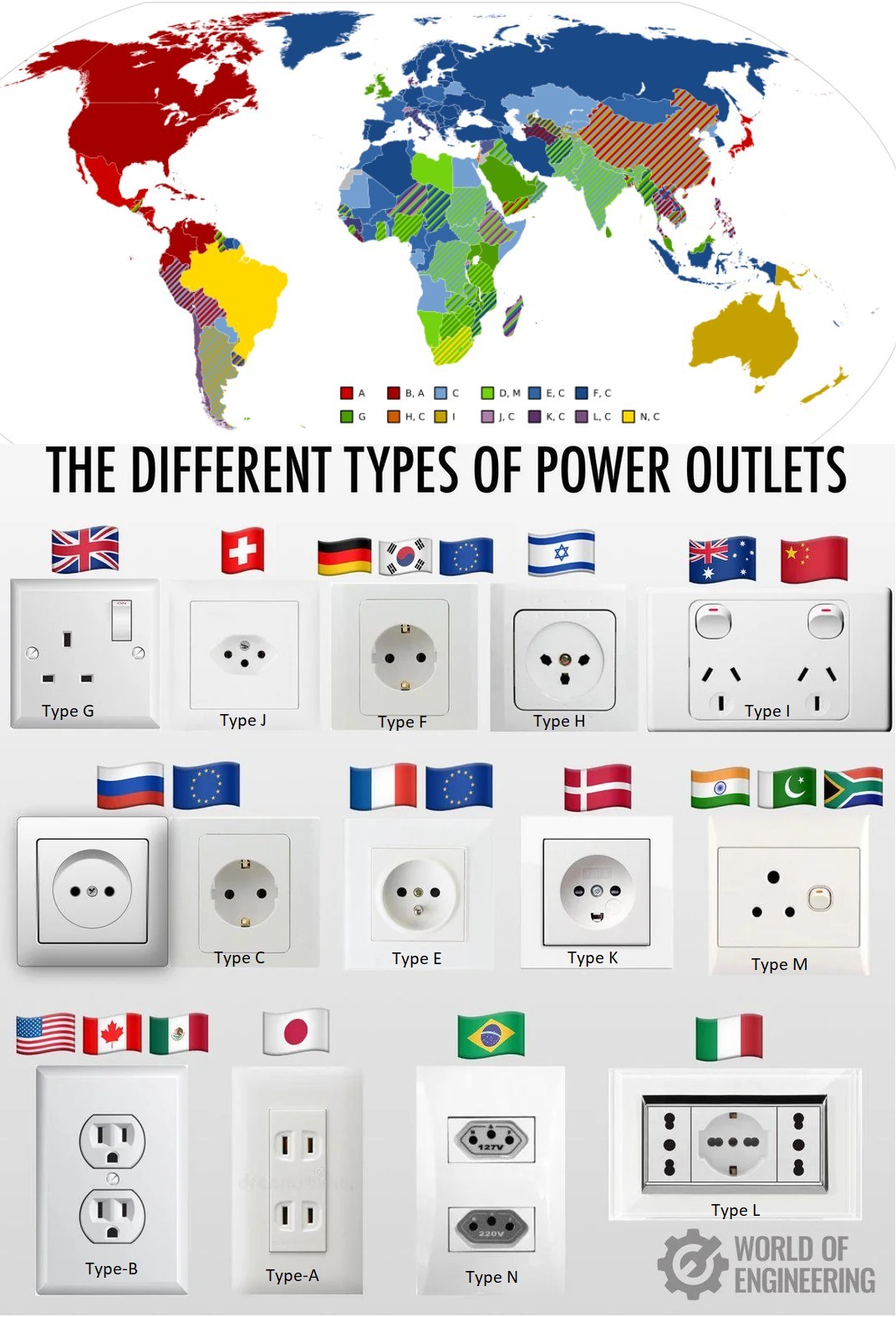

In my opinion it’s Type-F
Because:
- It’s bi-directional
- It’s grounded and ungrounded plugs use the same socket
- It’s already widespread (50+ countries) source
- Your fingers can’t touch the live wire as you’re plugging in a wire
- It’s recessed
- Low footprint
- Accepts Type-C
Bi-directional is a double-edged feature.
It means that there is no reliable way of identifying line and neutral wire, which requires more complex double switches downstream.
Also, F is unnecessarily clunky and big and hard to make a weather-proof version of because of the complex shape.
It’s bi-directional
That’s bad.
Every device produced in the past few decades doesn’t care which wire is live.
No it’s bi-winning
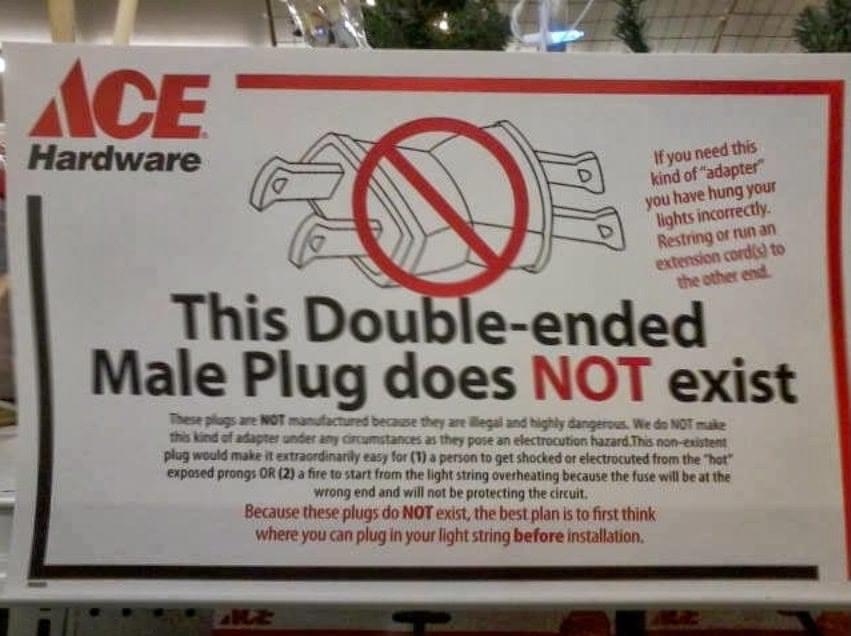
Damn homophobes…
Clear, informative and solution oriented. I wish all signs were this good.
Why?
Why?
Why? It doesn’t make any difference with AC
deleted by creator
In the particular case the sign is trying to prevent it’s to keep lazy idiots from electrocuting themselves stringing up Christmas lights.
The actual electrical device can be designed such that it depends on exactly which direction is live and which is neutral.
Imagine a circuit loop that, as you follow along the circuit, has an AC power source, then a switch, and then the electrical appliance, leading back to the AC source it started from.
If you design the circuit so that you know for sure that the live wire goes to the switch first before the actual load, then your design ensures that if there is a fault or a short somewhere in the appliance, it won’t let the live power leak anywhere (because the whole device is only connected to the neutral line, not the hot live voltage that alternates between positive and negative voltage). It’s safer, and is less likely to damage the internals of a device. Especially if someone is going to reach inside and forgets to unplug it or cut power at the circuit breaker.
Could you give an example of such a device? Seems like a bad design
A simple lamp can demonstrate.
You have both live and neutral lines in the cable, coming up to a switch, which can either open the circuit on the live line or the neutral line. Then, the lamp itself has a single light bulb as the load.
If you place the switch on the live line, then the energy of the live line stops at the switch, with only whatever lower voltage is in the neutral line to actually be connected to the light bulb and lamp assembly.
But if you place the switch on the neutral line, you’re leaving the entire lamp on the voltage of the live line, which gives the voltage more places to potentially short circuit. If you were to take a non-contact voltage detector, you’d be able to detect a live voltage in the line leading up to the bulb, even when it’s not turned on.
You generally do this with the in-wall wiring and switches, too, and make the wall switches break open the circuit on the live line, not the neutral line. It’s just a better practice overall.
And no, the neutral line is not totally grounded, so it can still pose a danger, too. But safety is exercised in layers, and putting the switch on the live line is the better practice.
If there’s electricity reaching the bulb it would be lit no? So if I place the contact upside down, I wouldn’t be able to turn off my light?
It’s not electricity, exactly, but it is a higher voltage that is different from the average of everything around it. Electricity needs a closed loop to flow, and breaking open the loop with a switch means that no electricity flows, but the voltage of the live line goes up and down, creating an electric potential with anything that might be at a different voltage, if a conductor touches both.
This is an entirely theoretical problem that just doesn’t exist in practice. Just to be clear, for it to short circuit, it’s needs to find a path to ground. It can’t just “go somewhere”. Just because the line is longer didn’t make it more dangerous for it to “just exist”. There are regulations for wires, which include frankly absurd safety margins, regulations for the electrical devices that are not optional either (CE compliance for example). It just complicates this for basically no reason to have keyd outlets.
That’s a lamp in theory, but do you know of any actual lamps being sold where this matters?
in the US it’s fairly common, so probably some American manufacturers would do it that way
In practice tons of outlets are wired the wrong way around.
F actually has a convention for the socket, which is probably ignored even more often, but I would never trust live and neutral not to have been swapped somewhere regardless of outlet.Just forcing plug designers to consider live/neutral being randomized in a very obvious manner might be safer in the long run than working on a partially broken system where someone manufacturer might be fooled into trusting it.
it’s a bad practice to design appliance in such a way to assume that neutral will have low voltage, because in case of neutral failure in three-phase circuit you can get full voltage there, and there can be a couple of volts difference (sometimes more) between neutral and ground even in normal circumstances
it’s better to cut off both live and neutral at the same time anyway, especially if there’s no standard which is which. also, as device designer you don’t know if it’ll be used on a circuit that has neutral and phase where you think it’ll go or not. (ie british appliance used on unpolarized circuit, like type F. adapters exist)
it’s a bad practice to design appliance in such a way to assume that neutral will have low voltage, because in case of neutral failure in three-phase circuit you can get full voltage there,
Who’s using three phase in a setting where these types of plugs are used? In the US, at least, three phase circuits use very different receptacles and plugs.
The fact of the matter is that the switch has to be placed somewhere. And it’s safer to place the switch between the load and the live wire, rather than between the load and the neutral wire. Designing a system where the live and neutral can easily be known makes it easier to do the safer thing.
you don’t have to have three phase circuit to be affected by floating neutral in three-phase substation upstream. in some places in us there are 208v interphase three-phase circuits, which give 120v phase to neutral, which is distributed as a pair of wires as single-phase circuit. this is also normal way to deliver single-phase power in europe, as it’s most efficient use of conductor. (from 400v three-phase circuits) in case more power is needed than single-phase circuit can deliver, three-phase circuit is installed
if there’s switch on device, it’s 2p1t meaning both phase and neutral are switched. if it’s permanent, non-pluggable circuit, like lightning, it’s okay if only phase is switched (neutral is connected permanently)
This is entirely an US problem created by the “center tap” nonsense. Nobody else I’m aware of uses that, let alone with that other. The outlet in question (type F) I’m only aware of being in use with one phase of a there phase supply plus the neutral, or just “the” phase and neutral. Note that in the second case, even if a house or apartment only has one phase wired to it, it’s still generally part of a three phase supply, but the other phases just aren’t wired to that particular place (incredibly rare these days, but might be the case for very old homes/installations).
Now the real reason for it being safe: The neutral is required to be wired to ground at the main breaker panel. With installations newer than 2000-something, every circuit has to be GFCI protected. With even newer installations having even more granular requirements (not sure on the specifics).
Yeah, you’re probably right. I’m in over my head on this discussion.
I am reminded of my first day in an electrical engineering circuit theory class, when the professor made very, very clear that he was teaching us theory and fundamentals, and that the real world of electricity required a lot more safety built into the procedures and designs, because not everything behaves the way the undergrad textbook describes.
So I’ve learned something new. Thanks.
Some people say it does with certain devices but I’ve never had anything I’ve run into. The American outlets have been used as bi-directional in most instances. (With 2 prong). If they had a ground then you can only go in one way. But that said… Obviously a cord without a ground can still plug into an outlet that has the ground set up. If the device wants the current to go in a certain direction they use one with a slightly larger prong on one side, but if you pick up any phone charger in America, you can plug it into any outlet any direction.
deleted by creator
If the device wants the current to go in a certain direction
That’s not how AC works
they use one with a slightly larger prong on one side,
That’s not Ground, it’s Neutral. Neutral is sometimes bonded to Ground, but they are fundamentally different things
- Yeah it’s just a potential difference, not a one directional flow really
- No one said it’s ground? The ground is on the third prong
And type-E. Most EU plugs are F-E compatible, because countries go about alternating them. Spain F, France E, Germany F, Poland E. You build a plug with a hole for the E ground bolt and a cutout for the F side contacts.
Agreed. The best.
As the least biased swiss person. Type J (or type N, Idk) is so much better. We put three plugs on the same surface as you have 1. I am always frustrated to see how impractical your plugs are when I go to the EU
Furthermore, appliances compatible with Type F are almost always compatible with Type E as well, it’s just a matter of including both grounding mechanisms which they all do to avoid designing multiple cords.
I haven’t yet visited the UK so the only time I’ve had trouble plugging in something in Europe is in shudders Italy.
Jawoll!
Hear me out, type L, the one in the middle, is the best socket, as it has all the things you talked about, but also accepts Italian plugs.
Type L bipasso (the one on the side) instead is the most space efficient, while retaining type C compatibility and grounding. Type L plugs also have plastic bits at the end to avoid contact with live wire (like UK one).
I see a lot of your comments about F being objectively same or better compared to G. The only thing I’d throw into the mix is the socket switch feels so logical, I’m really surprised it’s not more standard.
High frequency use case: I don’t need my microwave on all the time showing me the time, so I switch it off at the socket unless I’m using it
Low frequency use case: before going on holiday I switch all the electrics off at the sockets
I never understood why every appliance in the kitchen needs to display the time. lol
Why not switch off the fuse in the holiday case? More time efficient.
Socket switch isn’t really a feature of the socket itself. I’ve had schuko sockets with switches. It’s just not as common
What’s the difference of C and F type?
The type-C shown in the picture is also not the only form it has and maybe partly misleading, the plug usually is significantly smaller and flat, and power strips can feature multiple of those in less space.


C is mostly for low power devices
F is basically a heavy duty upgrade of C, it’s got grounding on the side and can handle 16A (ovens, heaters etc.)
Don’t you get numpties plugging F appliances into C sockets then complaining to customer service that the induction stovetop doesn’t boil water for tea fast enough?
no, because it’ll just trip fuse, and stoves are wired directly anyway
You cant the plug is thicker
Can you plug C into F?
Yeah. You cant plug f into c because f is thicker by a bit but c goes into f.
USB. Most things don’t need AC power. We can get rid of wall warts and create a universal standard by including USB C ports on AC plugs.
On my way to power my fridge and oven by usb-c!
Oh yeah let’s power my 2000W kettle from USB
Yeah it’s not like USB standard changes every few years or anything.
Type I
Earth pin doesn’t cause the plug to murder your feet like the UK plug.
Angled pins to prevent cross polarisation.
Localised power switch per socket so you can turn something on or off with your toe and not bend down to unplug it.
Looks like a ghost face and when in the double gang formation the switches when on looks like the plate is high.
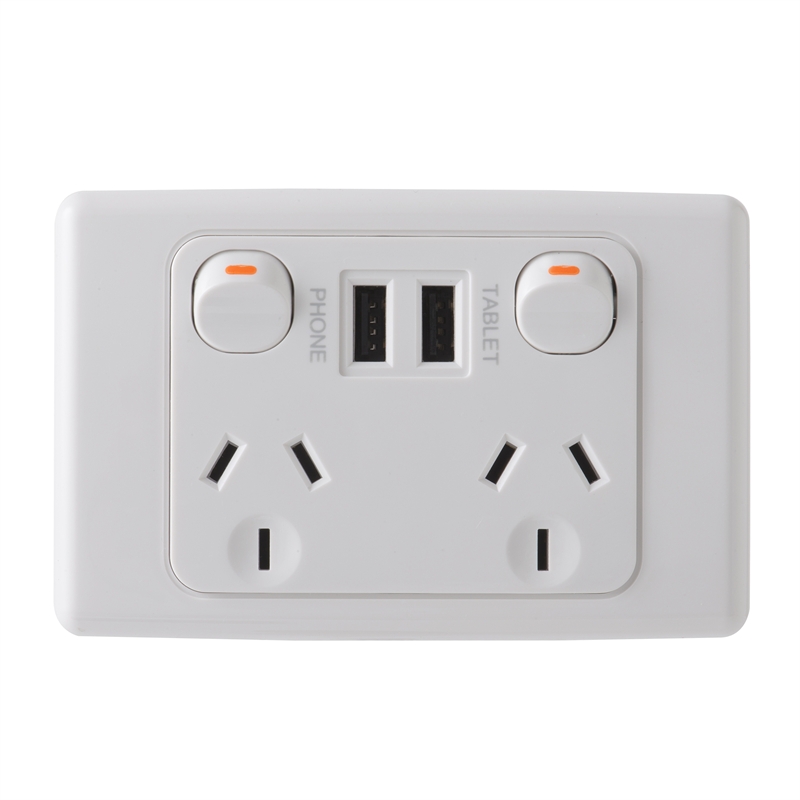
The main problem with type I (and a few others) is that it’s not recessed. If it comes loose a bit, you still have the problem of exposed live pins.
Pins are insulated since 2003.
And the thin pins means that with any weight (wall-wart, etc.), it starts to come out.
Doubly so if it’s set into thin plasterboard that already wobbles.
Removed by mod


Some images of the plugs, since I didn’t know what they looked like.
It was mentioned the pins started being insulated like that second image 20 years ago, but going by the images I found the older uninsulated style is still more common. This is ofc a major shock hazard when plugging in your stuff.
Even with the insulation, you can still reach under the half inserted plug, just less easily and maybe only if you have smaller hands (like children).
Fundamentally flat sockets are doomed to be shock hazards, compare it to the recessed sockets where the entire surface the contacts insert into is cut off from reach before the pin insertion starts, and on top of that the pins of say type F have been insulated for so long many don’t know there were uninsulated variants.
Another bonus of the recessed style is the plug doesn’t stick as far out of your walls. For extension cords it’s probably a bit bulkier, but when you sink the recession into the wallbox of the outlet you can get as flush as the width of the cable with an angled plug.

Also pretty sure you can step on angled type I plugs resting on their backs. The recessed plugs usually have grips on top so can’t rest on their back even when angled. Their pins are also ball-shaped on the end, type I looks quite angular and more painful.
Ironically, those are upside down.
Which usually indicates Chinese Type I - they don’t insulate pins but do put earth on top.
We insulate pins but live/neutral is on top.
Oof, I see.
Kinda a bad look for type I when some of the users follow a different spec and ruin all attempts at improving safety or even keeping standards like earth being down.In comparison the european plugs are moving closer together, for example F+E combo plugs are increasingly common.
I live in Australia and I just did an audit of the power board that was sitting next to my bed. All four devices and the power board itself all have the insulated pins. I can’t remember the last time I saw one that didn’t have insulated pins. I’m sure they exist, but they are not common.
We also have RCD on all our circuits so if someone is able to short the pins, it will trip within 20ms or less.
New world solutions. I agree.
I’m a G guy at heart but use I now. My main issue is how easily the pins can bend.
Also:
Thin stamped construction is cheap, but can still be fitted with sleeving on the live (active and neutral) pins like UK & europlug, but not US plugs. This prevents objects or fingers getting to live pins on a partially inserted plug.
Industry has agreed that leads exit either straight out, or down-and-right, so there is no conflict for horizontal or vertical sockets. Sockets are universally installed earth-down.
Reasonably compact.
All outlets should just be replaced with IEC C13. Robust and compact.
G - safest
Does this account for injuries from stepping on them?
Why would you step on them?
You can just turn them off at the socket. And if you need extra sockets, just buy an extension.
Literally zero reason to leave a plug lying on the ground.
Do you not live in a world where sometimes non-zero time elapses between realizing you need a thing and procuring that thing?
What makes them safer than the others?
Earth pin has a mechanism to prevent kids inserting shit essentially
C/E/F also have shutters, probably more types do that too
Don’t a bunch of them, like I, have an earth pin?
deleted by creator
The video explains it better than I could. But there is a cover mechanism that only opens when the longer earth pin is inserted
Oh that’s pretty cool. Closest thing I’ve seen to that in AU is a socket you have to twist from the ground port to access but it’s definitely not standard.
deleted by creator
I’d like to see a real world comparison between its safety and Type-F
Both are extremely safe
Do you have a similar breakdown video of the features? I’ve never seen a rundown of them.
No but I found this haha Why Tom Scott Is WRONG About The British Plug
I just found this one. https://youtu.be/tx5NzxJjT0Q
It seems like they’re mostly comparable but the schuko might be a bit safer. As someone in the US the lack of polarity would be an issue for us. But I still think our plug designs are the absolute worst.
Nice find, IMO the Type F plugs are near perfect. Type N might technically be better because it’s smaller, but it’s got poor adoption. Sadly the EU canceled their plans to adopt it.
Type D is listed but not visually shown. Am I missing something?
It looks the same as M, it’s essentially just a smaller version of M.
It’s hardly used anymore. It technically fits into M, but that’s dangerous.
Don’t worry, we will give you the D later
Heyo!
Type C has such a satisfying click when plugging something in.
As a Brazilian, that makes me so sad. We used to have a type that could fit European and American plugs, but they just changed it. Never gonna let it go hahaha
It’s obviously the one in the country I live in. All the others that I have had zero experience with are from Satan.
Tom Scott already answered this
Name a more painful thing to tread on than the British plug. Bonus points if it’s incorrectly wired to be live.
K is the happiest. I like that one. B is shocked (pun!) at what’s going on. H is encouraging me to see things in a racist light.
Type B, H, or I. They look unpleasantly surprised by what I’m shoving in their mouths. Definitely not K, because he looks like he likes it.
Schuko (Type F)
Wasn’t the best one the Type G one? Except that companies need to learn to make the head of the plugs round so they cannot land with the pins up.