
You must log in or register to comment.
Thanks, that’s going in my bookmarks!
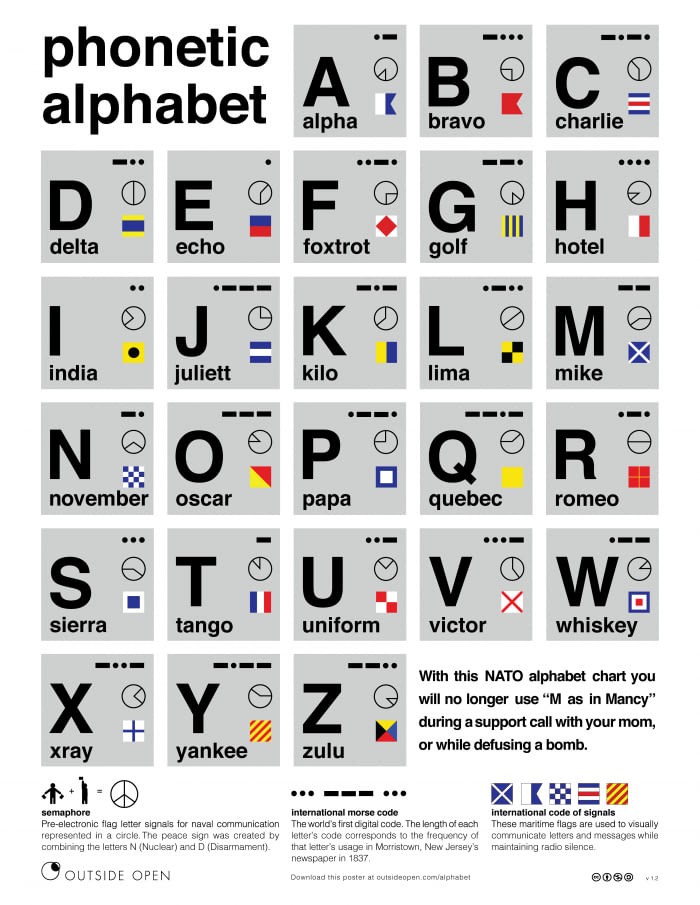
That Morse code tidbit is actually super interesting. I’m curious how systematically they went with it, like E-I-S-H were the most common, and are ascending in dit counts. And then A being one dit and dash being the next most frequent. Or some combination of “values” for a dit/dash
I always liked this chart for Morse code:

I’m curious how systematically they went with it
Allow me to introduce you to Alfred Vail.
one of my last jobs needed me to use this for reading inventory locations to a crane operator over a phone. he always seemed slightly bemused that I didn’t know the phonetic alphabet and had to make up my own phonetics for him
Tiajuana-Gringo-Water-Fiver-Zero
exactly. I KNOW that dude was clowning me as soon as I hung up the phone 😂
I can imagine the laughs at all the words you might have come up with. “It’s at uhh… Narwhal Sellotape Banana!”
A reminder though, to anyone who needs it - don’t be condescending to others for not knowing things. Everything we know, we had to learn.
For me, I learnt the phonetic alphabet after getting frustrated one too many times trying to give my postal code and car reg on a bad phone line.
For something so commonly used, it’s got some pretty glaring flaws. Most critically, ‘golf’ and ‘mike’ - single syllable, which over radio comms often doesn’t sound like shit. Compare to something like ‘oscar’, which even if either half of it gets all staticky you still hear “osc–” or “–car” which is enough to still receive an accurate exchange of info.
My more whiny complaints are that the number of syllables are inconsistent, F and X use compound words instead of one single complete word which feels… icky… x gets a pass cuz x is always janky and x-ray is perfect. Some of the entries rhyme with commonly used words that could confuse someone who’s either inexperienced or in a stressful situation like being shot at. For example, “echo” could be misheard as “gecko” and even though “gecko” isn’t on the list, our brains do stupid shit when they’re saturated with adrenaline, so something like this should be as absolutely idiot-proof as possible.
If I could magic that fucker into something new, I’d shoot for:
-
every entry is exactly three syllables.
-
no two of the same syllables in any entry can rhyme with those two syllables of another entry. I.E., “Uniform” and “Chloroform” are not compatible because syllables 2 and 3 are too similar.
-
Each entry should be as common a word as possible, in as low/unspecialized a reading level as possible. I.E., “November” is recognizable by nearly everyone; vs something like “Ganglia” which is gibberish to anyone without specialty knowledge requiring them to be familiar with ganglia.
-
No compound or multiple word entries.
-
X gets a pass cuz x is always janky and x-ray is perfect.
-
Prototype phonetic alphabet must be first scrutinized by a panel consisting of a linguist, a speech pathologist, an English teacher, a 7 year old, a highschooler, a geriatric with severe hearing loss, and a junior enlisted US Marine. Their job is to find any potential for confusion.
Having a 7 year old and a junior enlisted US Marine seems redundant
I mean… someone has to supervise the Marine…
That’s fair. I’ve got enough marines in the family to know what happens when they’re left alone and get bored. Always best to have a more mature playmate with them.
I’ve got enough marines in the family to know what happens when they’re left alone and get bored.
The good crayons always go missing and there’s waxy buildup around their mouth.
Oh you’re so lucky their mouth is the only place your marines have stuck the crayons…
In Amateur Radio, if our first calls are not received correctly, most experienced operators will switch up and use alternates for troublesome phonetics. America for Alpha, Germany for Golf, Kilowatt for Kilo. Some folks even use amusing ones. I once heard an American station using “Kentucky Fried Chicken” for their callsign ending in KFC.
I once heard an American station using “Kentucky Fried Chicken” for their callsign ending in KFC.
i mean that one is perfect
But with your new rules, x can be xylophone so you don’t need the special case rule for x anymore.
Ooh, good call!
-
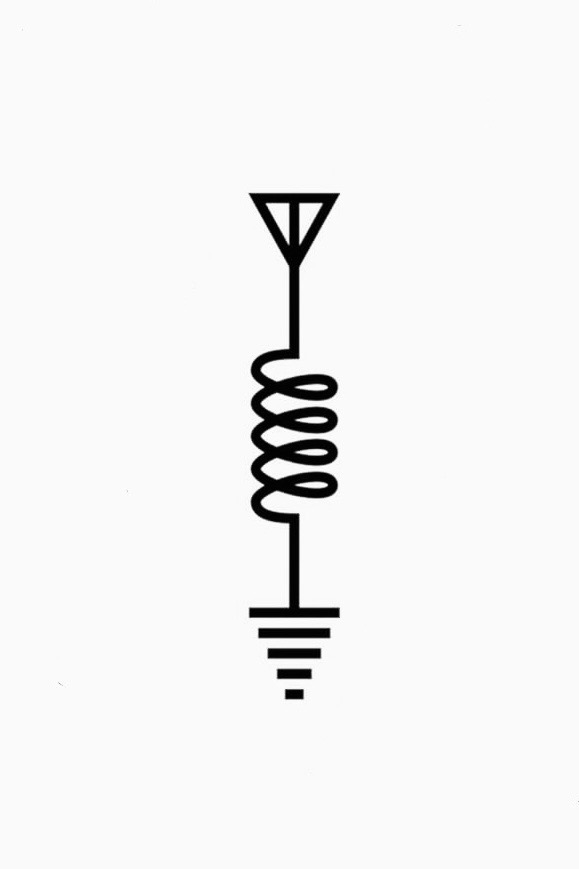
Pretty cool about the peace symbol
So the peace sign is GK?
ND, for nuclear disarmament.
it seems hard unless you use it a lot and then it’s second nature. I’ve had to actually stop myself from using it in places like for a drive-thru pickup code, as that never goes well.
I was using this to read put a gift card code to make a purchase over the phone with apple (don’t ask why, it was a shit show), and when I gave Sierra, the person thought it was C as in Ciara. Had to repeat the whole thing over again.
Sierra’s even the name of one of their OS versions.
“Ciara”. smh
Hahahaha! I had forgotten about that!
I appreciate the Archer reference
Adam Charlie Adam Boy
Doubly clever! For those that don’t know, that’s the code cops use. :)
I do because of this one.
Ended up not learning morse, but at least memorised the phonetic alphabet.
Spelt alfa wrong though
It’s correct
Incorrect. Alpha is the Greek letter.
Alfa is spelt this way in the phonetic alphabet to help with pronunciation in all countries, as ‘ph’ often makes a different sound.
Ok
deleted by creator
What???
Look at the post again… it’s misspelt as Alpha. When in the phonetic alphabet it is spelt Alfa.
Where’s the confusion in anything I said?
No. You’re right. Apologies.
I’m remove my comment.
Papa and Mike
I know about this. I still choose my own rules. Once I said “X for xylophone”. It makes things fun.
One time my roommate (who worked at Amazon) did that and people were giggling over the words he chose, most of them were Pokemon iirc.
X as in Xanax Y as in Yggdrasil Z as in Zed
Z is pronounced as “zed” in the UK.
Same here in Canada. And that is why it is funny.
Haha I just got that, I think I’ll be using that too thanks.
B as in Bee is also funny as when they go “what?” you can say “you know, Bzzz Bzzz”
I think the civvie version is easier for the average person. The military phonetics are just ‘odd’ enough that it is more of a chore to remember.
They really missed an opportunity to get the semaphore to look like the letters they represent. At least get the I, K, and T to line up (V gets a pass because at least that pattern goes to the U).