

I’m sad that I missed posting this on the 4th
That’s not big enough.
It should be the 2 gallon Costco-sized jug to truly be 'Merican.
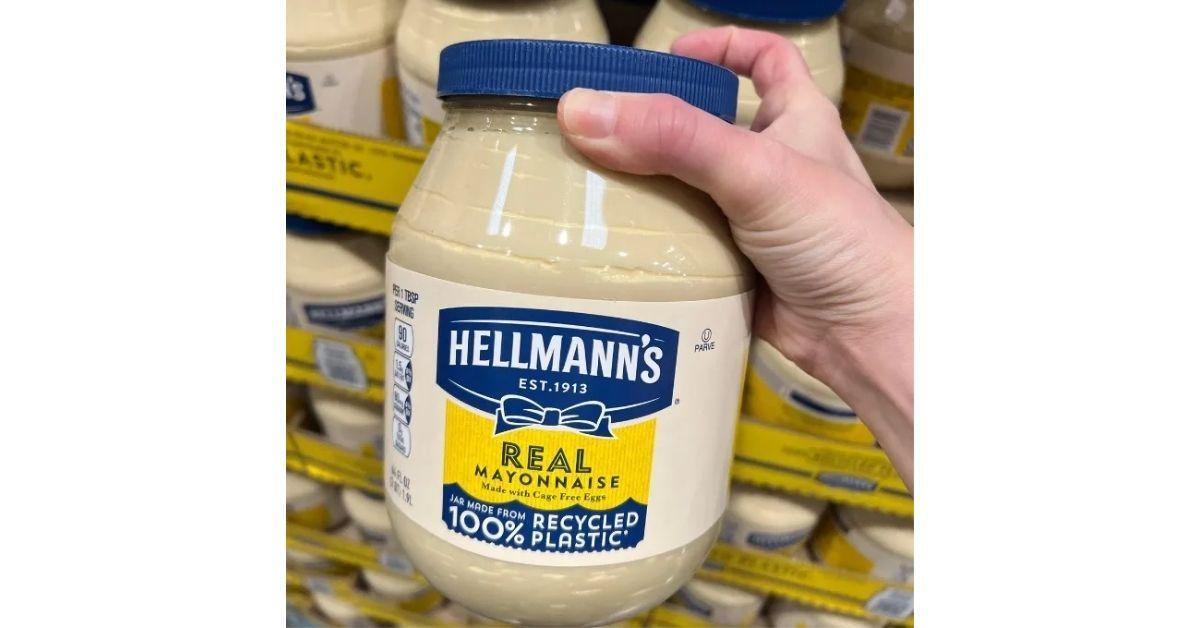
Are all your jars made from plastic?
The cheap stuff is. If you get the avocado mayo, it generally comes in a glass jar and is about the size of the OP.
90%
Nearly. The exceptions would be for pasta sauce, pickled or fermented things. An even some of those are plastic.
For most things where dropping it is likely and would definitely break it. It also lines up with the cost change for glass going up as the container gets bigger.
I figure part of it is people having a preference for the lighter jar for big quantities, and liking the rigidity of glass for the smaller ones.
Maybe American ant size. Costco sells a lovely 1.9L jar.
That’s nothing compared to Slavic-sized!

Even the jar looks like it needs to be on a diet


64 fluid ounces = 128 servings of 1 Tablespoon = 11,520 total calories, if you use a child-cheater to scrape out every drop.
A what??
Oh sorry, family word maybe? A child cheater is a flexible spatula (rubber or silicone) rounded on one side, that scrapes all the yummy cake batter out of the bowl and into the baking pan, leaving not enough to lick.
Kinda dumb that these two are called the same thing. They’re for very different use cases.


The “child cheater” is sometimes referred to as a rubber spatula to differentiate it.
Agreed, although I prefer silicone rather than rubber these days, it holds up better with heat.
Yep, silicone spatulas are also a thing.
Definitely a local thing, I’ve never heard of it, and I’m a born and raised bowl licker.
That makes sense!
Almost enough for a regular Midwestern salad.
I found a 128 ounce (3.758 litre) jar at Walmart.
For anyone unaware, the gallon size of condiments (mayo, ranch dressing, hot sauce, etc) is typically for food service. IOW, restaurants and the like.
That said, there’s nothing stopping individuals from getting it, so the point is still valid.
I worked prep at a buffet, and there was a salad that we made in bulk that used exactly one full gallon of mayo. i got really good at scooping it all out with a spatula in one fluid spiral.
just one of many otherwise completely useless skills i developed in foodservice lmao
Worked at a seafood restaurant and we made coleslaw in basically a 40 gallon trashcan. Even had this auger that you attacked to the top to make it a huge food processor. It would use multiple gallons of mayo.
I worked at a pizza buffet when I was in high school. The ranch dressing, made in 5 gallon buckets, called for multiple gallons of mayo and buttermilk. I too got far too skilled at getting it all out in one go.
Mayo and sour cream are like 80% of the sauces in most restaurants.
The 10 gallon size is for food service. The gallon size is for large families. I knew a couple with ten kids who would kill a gallon of mayo quickly.
That seems kind of expensive. The Costco 64oz variety is often on sale for <$10.

It’s called a tub of mayonnaise thank you very much.


Wow, only 100 calories!
Psh! Nobody could take a bath in a tub that small.
Hell yeah, save by buying a 4-pack.
those are for “restaurants”
In the way a family size is for a “family”
Hell yeah.
I saw this several times when in Finland. I thought it was hilarious (I’m American).
600g? Those are rookie numbers. You call that American size? Our smallest jars are 390 (15 oz) grams. Regular and large jars are 780 (30 oz) and 1248 grams (48 oz). And they do have ridiculously big jars too, 1 gallon jars, i.e. 128 oz and 3328 grams, for, like, restaurants and doomsday preppers… or dudes that just really love mayonnaise, I guess.
Restaurants use a 10 gallon bucket (37.8 liters).
So does my homemade mayo shower.
Why did you DIY? I thought those came standard…
There’s also the family that uses mayo and only goes shopping once a month or whatever. Some of those bigger jars are something like two normal sandwiches a day for a month, which is totally possible if you’re packing lunch for two kids.
Some of our preposterous containers of food are because some people decide to live unreasonably far from a grocery store, or just go shopping infrequently and buy huge amounts of food.
(This has the side effect of making them buy bigger cars to hold the groceries and family that now has to come along because it’s such a long trip, and that makes it miserable so they try to do it as infrequently as possible, so they need to buy a lot of groceries to hold them over. )I haven’t seen anything under 20oz in my supermarket, but I’m not buying the fancy “organic” stuff, just the squeeze things for picnics and the larger jars for home.
They’re not lieing…
 this is literally the first thing that comes up if you search mayonaise in the US.
or dudes that just really love mayonnaise, I guess.
You know it’s nice to be seen
Out of curiosity, I just checked my pantry. I have two 30 ounce jars (1400+ grams), sitting in reserve.
This genuinely represents a failure to comprehend the scale of American food products.
Rookie numbers. We get the 64oz Costco size.
Maybe don’t eat the mayo in the doomsday prepper bunker.
You leave me and my gallons of bunker mayo alone.
That sounds like how the zombie apocalypse starts.
Zombie or no zombie, it’s how I’m going out.
This is smaller than a medium size jar in Canada (890 mL). Large is 1.4 L.
Mayo tanker truck waiting patiently for the BBQ sauce and Pepto Bismol tanker trucks to depart…

As someone who lives in Utah, there better be a ketchup truck pulling up soon because I have a hankering for fry sauce!
That’s like a week’s worth at best.
For a baby maybe
Woah woah, it’s American size, not Wisconsin sized. I based my estimate on the usage of average Americans, not outlier groups.
deleted by creator
As an American I approve this image
I mean, isn’t that just shelf-stabilized 'Murican pulmonary fluid?
Wow, this made me realize I haven’t seen mayo in a glass jar in years.
Same.
I’ve been loving Kewpie squeeze bottles and Truff mayo.
Avocado mayo comes in a glass jar in my area.
I picked up one last month. Organic. Hated it…
There is a lot of truth to the big in America stereotype. Big country, big cities, big roads, big cars, big buildings, etc.
And a lot of those are related. Big country means that our cities can sprawl. Big (low-density) cities mean that our roads can be wide. Big roads mean that our cars can be big.
Big country also means that there are a lot of people, and sooner or later a good percentage of them want to live close together, so they build big (dense) cities, which means big buildings.
And the sprawl leads to the part about big containers of unhealthy food, too. If you live more than an hour away from the nearest grocery store, you’re unlikely to get groceries more than every other week or so, which means you need to buy larger, more shelf-stable containers of food.
I believe (based on nothing but a whim) that us shopping culture is based on buying supplies (shopping for a week or more) while the European shopping culture evolved more from daily supplies from the market. Rural Europe would be the same i guess, but old cities was made for daily commerce
I lived in a couple of countries on Europe and the daily and bi-daily shopping is only really for people who live in big cities and commute by public transport and will pass by a small grocery shop on their way home from work.
As far as I can tell most people do a single weekly shopping generally by driving to a supermarket or even hypermarket either on the weekend or at the end of a working day, hence the popularity of such large surfaces.
Even in places like The Netherlands people have side bags on their bicycles and can just cycle to a supermarket once or twice a week if they don’t feel like driving there and bring the shopping on the side bags.
From my own experience with my grandparents (farmers in Portugal), rural food planing timeframes are even longer than a week, as people relied (at least 50+ years ago) on preserved meats and longer duration things like dried pulses, certain fruits, and staples like potatoes for months or even a whole year and then add in season fruits and vegetables and even just go outside and pick up whatever was ripe then from a plot next to their home (so, for example, make soup with some salted pork bellies and chipeas from their food stores and some spinach and carrots picked up from from a farming plot near the house).
Anyways, even in Europe doing a weekly shopping is generally more convenient.
Mind you, it’s great when you live inside a big enough city and you can just hop out of the tram a stop or two early on your way home and go by a mini-market to buy, say, some milk and fresh vegetables, but that’s not how it generally works for most people, mainly because even in a big city, unless you live right by the store it’s more time efficient to do one big grocery shopping a week were you can go to bigger places with more selection.
gotta fit all these big fat people…
That’s not American enough, should be a bucket of Duke’s.
600 grams?
You could make maybe two sandwiches with that.
To be fair you could make three grilled cheese sammiches with that
Found the american!