- cross-posted to:
- fuckcars@lemmy.world
- cross-posted to:
- fuckcars@lemmy.world
You must log in or register to comment.
Toronto in 1990 was approximately the same map.
Orange vs Apple! Who will win!
That being said I do wish every country would have a better public infrastructure.
Just out of curiosity if you do have recent research in economy on the impact of subway, tram, bus, bike lanes, etc on both productivity AND happiness, please do share. I’m already convinced but I’d love to learn more on how and why.
Apples every day of the week.
Very recent, non-peer reviewed research, n=1. It makes me very happy to be able to nap on a subway/night bus or safely ride a bicycle or somewhat less safely ride a motorbike. My productivity is the same because I work remotely.
Public transport policy in Toronto is a disaster. It is a complete disappointment of a city and an ugly blight on the landscape that serves only captialism and vapid mediocrity
its sad im over here in Dallas and im envious of Toronto.
Here in San Antonio we have zero rail so…
It’s a disaster until you compare it to most other North American cities. Like what is better? NYC and Montreal? I’m sure there are a few other cities that I can’t think of.
But its true that it has been neglected for decades. Thankfully that has changed a bit recently with 2 new lines being in construction. However the maintenance budget is continually insufficient to keep everything in good repair. Only new projects make your government look good I guess. (But we need both new projects and maintenance)
I agree that North America is appalling. I grew up in Europe, so that is my main comparison.
The two new lines would be helpful, but as someone that lived in Toronto for 15 years until very recently, I believe they were horribly mismanaged. Like most of the city is…
And still WAY ahead of a ton of similarly sized cities on the continent
We also have non labour’s camps
Toronto is more bound to US economics than Chinese economics. You could make the same map for every major city and probably tell which they were more influenced by.
deleted by creator
While your comment is very amusing, accessibility and congestion are pretty high up on the list of things that make a place “nice.” A deep Investment into public transit is very likely to have a positive impact on an inhabitant’s happiness.
(Incidentally, it’s ironic that you have leapt to the conclusion that one of these cities is “winning” while nothing of the sort is stated in the post, only then to take objection to people drawing such conclusions.)
deleted by creator
Yep, developing country is developing? Holy crap, imagine that!
Add to that, Toronto’s transit system includes light rail that pulls together a much wider geographical area, outside its subway system. It’s a pretty good system, actually
I think the average construction worker in Chengdu made around $3 to $4 per hour building this. Not sure of the safety conditions.
You can think whatever you like I suppose, but it helps if you provide a source.
According to https://www.statista.com/statistics/278351/average-wage-of-employed-persons-in-urban-units-in-china/ it’s about $6 USD per hour. Note that the cost of living for a single person is ~$495.3 per month excluding rent, which costs ~$181.54 per month according to https://www.numbeo.com/cost-of-living/in/Chengdu, which seems about right. I only found 4 deaths and if there are any more they haven’t been reported, though anecdotally I’ve never heard screaming around construction sites.
$6 now. What about 15 years ago? Rent in the city is $181/mo? That would be for a 1 bedroom outside the city. Double that for room for a family and you might be able to just get by paycheck to paycheck. While living in a polluted city(another money saving tactic)
Edit: I believe migrant workers played a large role in building this. Where did they live? Likely in employer provided housing. Yes. Proper sanitation? Likely no. Imagine the outcry using this cheap technique to build in Toronto.
outside the city
i swear i included that it was outside the centre… apparently i didn’t, sorry
Double that for room for a family
the source includes prices for 3-bedroom flats
While living in a polluted city
fair but that’s not exactly a construction safety condition
and it’s not much either. the AQI there is squarely in the 50s, which is moderate, which means
Unusually sensitive people: Consider reducing prolonged or heavy exertion. Watch for symptoms such as coughing or shortness of breath. These are signs to take it easier. Everyone else: It’s a good day to be active outside.
i can’t believe this is the official fed AQI language ngl it reads as if it was translated copy
What about 15 years ago?
if you really think it would change that much i think you should prove it
Imagine the outcry using this cheap technique to build in Toronto.
a lot more people everywhere live paycheck to paycheck as migrant workers than you probably think
“a lot more people everywhere live paycheck to paycheck as migrant workers than you probably think”
The percentage of Americans living paycheck to paycheck is insanity. I haven’t seen Canada’s numbers, but the US is barely surviving.
Easy when all the equipment and materials needed are made by the same people that will build it
Doesn’t Toronto have the tram lines east west or trolley busses and buses with cheap flat price through ticketing for each journey?
The cables over and underground run from the cheap, green hydroelectric power?
If it’s cheap, regular, reliable with through ticketing, it’s good public transport, not bad.
They just started the Ontario line. W are still waiting for he Eglinton Street car. i get your frustration! I think it’s a financial issue mainly, because the last CEO did a post about that, and said there is no money for expansion, and they had to ask government.
There is not even enough money for proper maintenance let alone new construction! Of course new construction looks good politically so it will get separate budgets while the existing infrastructure slowly crumbles. Look at the “reduced speed zones” that have lasted for years because the rails can’t properly be maintained.
Talking about China’s human rights issues right away is very strange. Nobody does this if someone mentions a US project.
I wonder why
Because the US has no human rights violations?
/s
deleted by creator
Berlin has 1.4 times the population of Toronto and a train system comparable to Chengdu.
Our tram network is proportionally bigger than Toronto. It could be a lot better but all trams in west Berlin where removed while the city was divided.
What’s up with all the China hype on Lemmy? These projects are impressive, no doubt, but their cost in terms of human rights violations are pretty high. I’m speaking generally, I don’t have the specifics with regards to this subway system. Either way it’s not really comparable to a project like this in a country like Canada imo.
The speed and size is impressive, yes.
But I doubt the quality.
“Tofu-dreg project” (Chinese: 豆腐渣工程) is a phrase used in the Chinese-speaking world to describe a very poorly constructed building, sometimes called just “Tofu buildings”. The phrase is notably used referring to buildings that collapsed in the 2008 Sichuan earthquake disaster,[1][2][3][4][5][6] and the Bangkok Audit Office skyscraper collapse initiated by aftershocks from the March 2025 Myanmar earthquake over 1000km away, which was constructed with poor construction techniques and materials
!meanwhileongrad@sh.itjust.works
Lemmy has tankie problem.
you are the problem
We don’t have to agree with China’s politics to appreciate that they did a positive thing. And we shouldn’t have to emulate their politics to get a thing done. We should be able to do it
Something about a street being made that leads into hades.
Lemmy is more international than Reddit, so you’ll see more diverse perspectives
Pentagon wasted tax money on facebook bots to convince people in East Asia that the chinese covid vaccine was poison, so no one is really buying the “China human rights abuses are what allow China to succeed” idea anymore.
Especially since you can just as easily point to Japan’s infrastructure projects which achieved the same thing under US supervision post WWII, meaning said human rights violations aren’t even a supposed cost if there’s less evidence of it that of UAE literally pirating in immigrants to build their lavish towers and stadiums.
Of which the US fully supports, so this just goes back to the blame game of who is worse.
Yes, China has some shady ideas of what is considered acceptable behavior and work output from citizens, but the point is that they are using it to rapidly grow their infrastructure, unlike NA which take a decade for a single transit system to get approved all while car OEMs are pumping out dumpsterfire vehicles of whose parts are overwhelmingly made in China.
What helps is that the aumomotive/gas industry lobby there isnt so effective.
I don’t know about Canada but the USA has been pro-child factory work lately. China’s wages have been rising faster than expected so they have gone all-in on automation. So when I see people claim their stuff is cheap because of “slavery” or human rights, it reads like projection.
I’m from neither the US nor Canada, and in my case it certainly isn’t a matter of projection. I’m sure things have been getting a lot better for many people in China. However, it is still the case that China has a lot of human rights issues which are simply not as widespread in a lot of Western countries, the US included. And due to nation wide systems, such as hukou, it is very difficult for the population in poorer, rural areas to work legally in more affluent areas where the pay is higher. My understanding is that this has led to large scale “illegal migration” within the country’s borders, where workers are paid far less (sometimes not getting paid at all), work under poor conditions, and suffer abuses at the hands of their employers with little to no legal recourse due to their illegal status. China is a very inequitable society, and a lot of the misery that its less rich and powerful citizens have to deal with goes unnoticed by the rest of the world (and indeed the rest of its population), because we see stuff like this and are impressed by China’s progress. And no doubt that there’s actually been progress in a lot of areas, but the somewhat tired “at what cost?” question is still as pertinent as ever.
None of this is a defense of the US or Canada. Just saying that for the average person, China is probably a worse place to live and to work in.
Hukuo in modern China could be perceived as prioritizing the right to have a home over choosing to have none. “At what cost” includes homelessness and higher unemployment rates. We are quick to highlight where there is a lack of right in China but not how it reflects on our own lack of rights. That is to say, they aren’t trading their rights for economic progress, which is how the west often frames progress (our foreign sweat shops are good actually because it helps them in the long run). They are trading one set of rights for another.

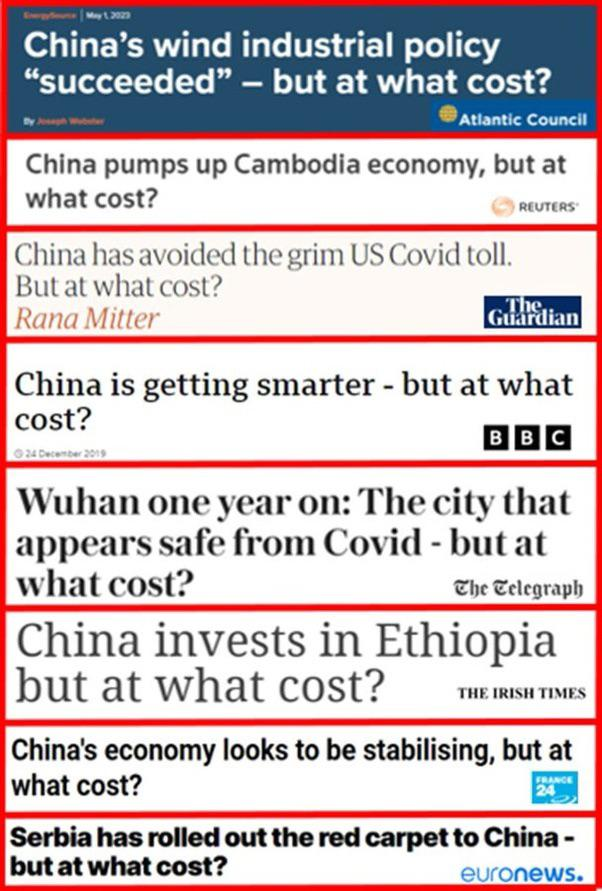

Some countries want to sell the image of “China is the absolute evil”, thus from this logic everything “good” must equal something very evil.
Some of those are valid, some are stupid as hell.
For the covid ones - the cost was complete lockdown, with some people’s doors being welded shut (not official government policy, but common enough to make news, as lower level authorities get some decision making power in these cases). Imagine having an emergency and your door being welded shut. And of course we later found out that even multi-dose vaccines don’t stop covid 100%, so instead of stopping the pandemic forever, nothing of value was actually achieved. Covid is the new seasonal flu. For a while we didn’t even get vaccines for Covid here in Estonia anymore, though now they’re back on the table, free if you’re in a high risk group.
Electric cars - the cost is mass government subsidies for BYD and a couple of others. BYD doesn’t make money if they sell you a car I believe, they make money from the Chinese government if they sell you a car. Even if you’re in another country. China wants their EVs to dominate the market and that’s a strategy. This is why the EU had to raise tariffs on Chinese cars. Otherwise the European auto industry would simply die.
Electric cars - the cost is mass government subsidies for BYD and a couple of others. BYD doesn’t make money if they sell you a car I believe, they make money from the Chinese government if they sell you a car. Even if you’re in another country. China wants their EVs to dominate the market and that’s a strategy. This is why the EU had to raise tariffs on Chinese cars. Otherwise the European auto industry would simply die.
Why doesn’t the EU simply also subsidize their EVs?
They’re for-profit companies and so far pretty successful without direct subsidies. EU countries usually have subsidies for purchasing EVs (regardless of manufacturer) rather than subsidizing the manufacturers directly - this leaves the consumers more choice and has a similar or maybe even better effect on EV adoption. On the climate side of things as well as public health and equal opportunities for people, transit investments would be better than outright paying BMW and Mercedes to make their EVs cheaper. China, however, doesn’t just want EV adoption on their own roads, China wants THEIR EVs specifically to dominate the world. Usually this is seen as unfair, regardless of industry, and is one of the few valid reasons for tariffs in an otherwise free global market.
The funny thing is, if the Chinese subsidize their EVs and the EU tariffs them, the tariff money could then be spent on EV subsidies - bringing all the different manufacturers to equal ground again.
yeah this makes sense to me
i guess there is a lot of ways to subsidize something. for example, if you want your local EV company to produce cheaper EVs, you could also subsidize public housing sothat rent is cheaper, sothat workers have cheaper rent and don’t need to ask for such high wages to cover the cost of living.
Lots of things, yeah. Many countries have set up energy efficiency loans too - for home renovations, or for business purposes. The idea is that you give out low interest loans so people (or companies) can achieve what they need earlier. I don’t know if anything like that is in place in Germany, France or Sweden (or Italy, I suppose they still have a bit of their car industry left), but if I was in a relevant position in one of those companies and there was a need to, say, build a battery manufacturing plant locally so that EVs could be built for cheaper and less dependence on existing battery manufacturers, I’d definitely go ask the relevant nation’s government, parliament and/or business development department, for a loan, tax break, or subsidies. Worst that could happen is they say no.
But yeah, an already successful car manufacturer getting straight on subsidies for selling cars they’re already making and selling anyway - extremely unlikely in most countries I’d think. Now if one or two of the German big 3 were on the verge of bankruptcy because of Chinese competition, that might change. Still sounds unlikely though. China’s GDP is 4x that of Germany’s, they can afford to keep subsidizing their shit for longer.
Yeah but how much of that is up to code?
Probably most if not all. Despite some well publisized failures these big government transit projects tend to be pretty good. It’s amazing how fast you can get things done if you don’t care about zoning, the environment, money, worker conditions or safety.
(American) zoning (besides industrial/residential) is bullshit anyway.
Just give me the three major industrial, mixed residential/commercial and some small purely residential zones and be done with it.
No need to basically outlaw a business in a residential area.
deleted by creator
That’s what federal directive and funding will do.
That’s what a single-party government, where NIMBYs and minorities have no power, can do.
I dont think that it requires a single party system to do this. Just much more coordinated public industries and infrastructure projects where public development is prioritized.