

- cross-posted to:
- upliftingnews@lemmy.world
- cross-posted to:
- upliftingnews@lemmy.world
cross-posted from: https://lemmy.world/post/34272214
A California-based biotechnology startup has officially launched the world’s first commercially available butter made entirely from carbon dioxide, hydrogen, and oxygen, eliminating the need for traditional agriculture or animal farming. Savor, backed by Microsoft co-founder Bill Gates through his Breakthrough Energy Ventures fund, announced the commercial release of its animal- and plant-free butter after three years of development.
The revolutionary product uses a proprietary thermochemical process that transforms carbon dioxide captured from the air, hydrogen from water, and methane into fat molecules chemically identical to those found in dairy butter. According to the company, the process creates fatty acids by heating these gases under controlled temperature and pressure conditions, then combining them with glycerol to form triglycerides.
You must log in or register to comment.
Didnt the Nazis also make something similar using coal?
You’re probably thinking of the Fischer-Tropsch process for making gasoline.
How much carbon is emitted to run the factory to make it though? Are we talking a net negative here?
You mean how much butter is emitted
Some, as prepping the carbon and hydrogen will take energy. But it wouldn’t be hard to be way better than the emissions associated with dairy farming for butter. Cost could still be higher, though depending on how much material is needed for the process.
I wonder where they source the methane from. Because I pictured a comicbook flip book of a balloon blowing up behind a cow
Methane is just the primary compound in natural gas.
I mean they can get it from the ground, but it can also come from things kind of fermenting in cows/our stomachs.
Methane is easy to produce. Basically, anything that rots produces methane.
They didn’t go into details, and I never took chemistry, but they may not even need methane. From my very basic understanding of chemical chains, triglycerides are made from carbon, hydrogen, and oxygen, and methane is hydrogen and carbon. So you could theoretically convert methane to triglycerides by combining w/ oxygen, but you could also do the same by extracting carbon and oxygen from CO2 and oxygen and hydrogen from water.
Fertilizers are typically generated from natural gas (methane), but green ammonia exists and is produced from air and water and can replace the fossil fuels in fertilizer production. The same could absolutely make sense here.
“Savor says they take carbon dioxide from the air and hydrogen from water”
I’m no expert but direct air capture of Co2 and water electrolysis both use a lot of power. So using them for this purpose is likely just a marketing gimmick that doesn’t make any sense either economically or for the climate.
Perhaps. But if we really go hard on green energy, we’ll likely have a lot of excess energy in the daytime, so it makes sense to look into alternatives to land and water intensive products (like dairy and beef) that are heavy on electricity. If it’s a more efficient use of land to have solar panels instead of cows eating grass (and solar panels work just as well on farmland as they do in the desert, unlike grass), then it makes a ton of sense even if it spikes electricity consumption.
Butter is rather low volume, so maybe it’s doable. But it’s very hard to compete with self-replicating organisms that have evolved specifically to use the energy sources, materials and conditions that are abundant on this planet. I’d be more more interested if someone had made a plant make butter.
Having a bunch of machinery sit idle waiting for power to be cheap isn’t particularly good use of resources either. We’d be better off trying to store the power.
Storing power is expensive and many energy storage techniques require a lot of resources to produce. The more we move toward solar generation, the more we should plan on being opportunistic with energy when it is plentiful
For example, electrolysis isn’t the most efficient way to store power, but if energy is cheap, it may be better on net to do it opportunistically when there’s excess energy and use that hydrogen for things like producing artificial butter (and perhaps fuel mobile equipment like forklifts and delivery trucks).
Cows aren’t particularly efficient at turning biomass into human food. There’s a ton of waste in the process, and they need a lot of space. A factory doesn’t need to sustain life of an organism, it just needs to turn one set of compounds into another. Maybe it’s not there now, but getting it there will be a lot easier than genetically engineering a much better cow.
That depends entirely on the method used to generate the power. In fact carbon capture only works if you use renewable energy to capture the carbon, otherwise there’s literally no point.
How it is made in the lab may or may not be sustainable, but it’s a proof of concept so it doesn’t really matter. If this were commercialised then you would use renewable energy, perhaps solar panels on top of the factory building, although you could just connect to a green grid. Clearly the facility will be constructed somewhere other than the United States.
While I think this is pretty amazing science stuff, the writing is terrible. Here is the progression of the story as written:
They made butter from carbon…
Well, it’s actually made from carbon dioxide, hydrogen, and oxygen…
OK, it’s actually made from carbon dioxide, hydrogen, oxygen, and methane…
Well, no, it’s actually made from carbon dioxide, hydrogen, oxygen, methane, and glycerol…
Wait, hang on, it’s actually made from carbon dioxide, hydrogen, oxygen, methane, glycerol, natural flavor, and lecithin…
Now, the source of glycerol is in question, because they say this butter is both animal and plant-free. Glycerol can be made synthetically, but it’s WAY more expensive to do it. Also, I’m not seeing any way to create lecithin without plants. They never say what the “natural flavor” is.
It kind of sounds like the beginnings of star trek’s replicators…
But that aside, somehow I doubt those are the exact only “ingredients” they use.
And it wouldn’t surprise me at all if the end product contains all kinds of trace elements of various not so healthy chemicals used to get the parts to combine into the actual butter.
Like the process to get the glycerol or lecithin in a state they can use.Ofcourse a lot of our dietary ingredients are contaminated in various levels anyway.
It makes me think of Enterprise, where they don’t have replicators but they do have protein resequencers, which can take waste matter and convert it into useful things, but they can’t do energy to matter conversion yet.
They add just a little butter for that real butter flavor
They never say what the “natural flavor” is.
A reminder that “natural flavor” doesn’t mean healthier or even something you might want over the artificially created flavors. It just means it comes from a natural source and is not lab created.
Castoreum, sometimes used for vanilla and raspberry flavoring, comes from beaver anal secretions. That would be labelled under a “natural flavor” and you’d never be told more than that.
I’ll take the artificial stuff any day just on principle there.
Fuck man I had no idea, I’ve missed out on my prime years of eating beaver anal secretions 😭
They can still be your prime years in terms of quantity of beaver ass eaten, if not in quality. But I think you sell yourself short. They’re gonna love you!
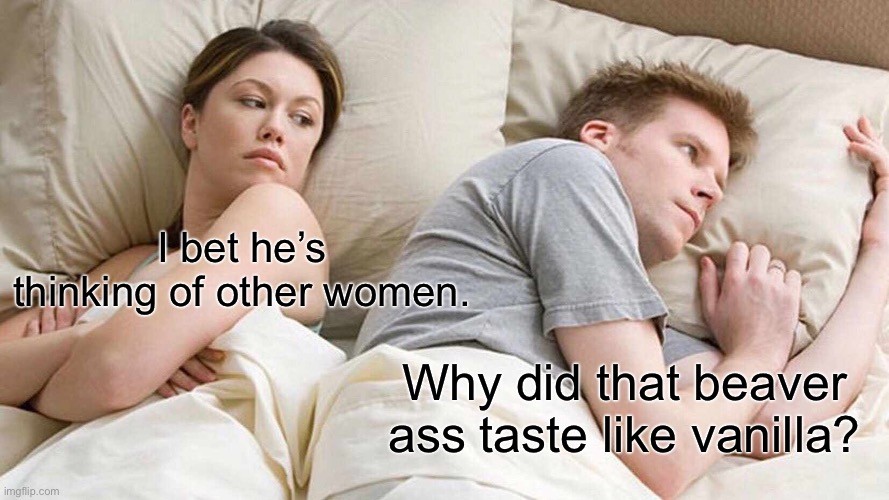
Mmmm, I like licking beaver butt. 😉
My ex wife’s uncle was the director of the south American division of the arm that made coloring and flavorings of one of the big Food/Chem groups, Procter & Gamble, or unilever, or one of those. Can’t remember.
No one in his household ate any processed/ultra processed foods.
Do the math.
Also, poop has natural flavour. Natural flavour also doesn’t mean it tastes good.
Get your Synthetic poop flavour here!
Spoken like someone who’s never ate shit.
You’re not going to catch me out with this one again!
Billions of flies can’t be wrong!!
I think it’s worth pointing out that vanilla extract is from vanilla beans and artificial vanilla is whatever the fuck they feel like that tastes like vanilla. Also, modern artificial vanilla extremely rarely, if ever, is derived from Castoreum because it’s hard as hell to farm beavers and expensive as all fuck. The “artificial vanilla comes from beaver anal glands” is basically a prevalent internet myth that gets passed around like the, “You eat 7 spiders a year in your sleep.” myth.
Incorrect, vanillin is the primary component of real vanilla beans and responsible for like 90% of the flavor.
I don’t understand what this would be correcting in what I said above. Can you show me what part this is correcting? Cause I’m legitimately confused.
You said artificial vanilla is whatever the fuck. It’s not, artificial vanilla is the main ingredient of natural vanilla, but without the other flavors
Ah gotcha! I for sure was not following what you were saying. I don’t know if that’s he real thrust of the point in my above comment, but I was more referring to the fact that artificial vanilla doesn’t necessarily come from vanilla beans. I should’ve been more precise with my language, but it’s worth noting that artificial vanilla is largely synthesized and comes from a variety of sources, not just vanilla beans (see below for the source/pertinent excerpt).
It also gets weird as to how the FDA regulates the term. I believe the key term is actually “Pure” in the “Pure Vanilla Extract” but don’t quote me on that. Not sure how it’s done by other regulatory agencies but it’s probably equally convoluted in a lot of places.
Pertinent excerpt:
However, many alternate routes to vanillin are well documented, including vanillin derived from spruce tree lignin, corn sugar, rice or wheat bran, clove oil, curcumin, or guaiacol.
Yes, that’s true, but the vanillin in the artificial stuff is chemically identical to the real thing
Myth. Vanilla extracts either come from low grade vanilla pods or cloves. It may have been but not today.
It would have cost you nothing to not write this.
Maybe he wouldn’t have lost anything, but I wouldn’t have been able to enjoy his comment.
They never say what the “natural flavor” is
…it’s people?
Where do you think Trump is sending all the homeless? A big old wooden screw press…
There’s something unpleasantly psychopathic in emotion about BtVS, but this one moment was funny.
I was thinking Soylent Green, but if Buffy provided a reference point for Charlton Heston, all the better.
Why not just make a fuel that can power cars if you’re gonna go this far.
@MuskyMelon @Gsus4 hydrogen probably… just need further development, I think we are in a technologic race, battery is still winning but it can change…
hydrogen probably… just need further development
You can get a hydrogen car today. Just that if you’re outside a few places like Japan and California, finding a fueling station might be a bit difficult.
https://en.wikipedia.org/wiki/Toyota_Mirai
Sales in Japan began on 15 December 2014 at ¥6.7 million (~US$57,400) at Toyota Store and Toyopet Store locations. The Japanese government plans to support the commercialization of fuel-cell vehicles with a subsidy of ¥2 million (~US$19,600).[12] Retail sales in the U.S. began in August 2015 at a price of US$57,500 before any government incentives. Deliveries to retail customers began in California in October 2015.[13] Toyota scheduled to release the Mirai in the Northeastern United States in the first half of 2016.[14] As of June 2016, the Mirai was available for retail sales in the UK, Denmark, Germany, Belgium, and Norway.[15] Pricing in Germany started at €60,000 (~US$75,140) plus VAT (€78,540).[16]
2025 Mirai
Starting MSRP $ 51,795
https://afdc.energy.gov/fuels/hydrogen-locations#%2Ffind%2Fnearest%3Ffuel=HY
They do fuel up a lot faster than BEVs do, but the fuel cost is considerably higher than for BEVs.
cost :/ and low energy conversion efficiency. Whereas expensive novelty edibles may have a high price, fuels, not so much.
Honestly, I’m mostly wondering about the nutrition factor. Not that you expect much from butter, but we all know this will be slipped into other things, just like hfcs.
We focus too much on efficiency and cost sometimes. Sometimes efficiency is only a “nice to have” while being outweighed by practicality, convenience, safety, and any of the other factors we choose to make a priority.
It is expensive and inefficient for an airplane to have two engines instead of just one. We do it anyway because it’s required for safety and redundancy. We made that the priority, and that was an active choice. We need to start making more active choices about what the priority is when it comes to our energy futures. All priorities have tradeoffs. Cost and efficiency have their own tradeoffs. Question it when people tell you that things can’t be done because of “cost” or “efficiency”. When they do that they’re presupposing what the priority is, but often it’s billionaires trying to cut corners to make themselves richer at our expense, our safety, our futures. We can do inefficient things. Sometimes it’s even the right choice.
I think you’re missing that there are better ways to produce fuels for cars than to chemically synthesize petroleum. It’s all about cost and efficiency if you’re just looking for portable energy. Or we could burn more coal so we can generate the energy needed for synthetic gasoline…
Or we could burn more coal so we can generate the energy needed for synthetic gasoline…
The problem is, people can, do, and will use that exact same argument to say we don’t need any more solar panels or wind turbines, because we don’t need and can’t use or store the excess power for anything and that’s why we need to keep thermal plants as backup for base load generation. Look, when we produce too much electricity, the electricity cost goes to zero and negative! It’s “wasteful and inefficient”! But these two problems can solve each other. Synthetic fuels (doesn’t have to be gasoline, hydrogen is step 1, methane/LNG is a bit more manageable as a chemical fuel. As long as the carbon source is atmospheric, then it and other synthetic hydrocarbons are carbon neutral to burn) provide an on-demand energy sink/storage method that can support and drive more electrification and renewable power, it just has to be part of a consistent and systemic approach with strict regulation and a clear view of the big picture (something sorely lacking these days).
Nailed it.
We need a solar grid that can meet our demand during a 9-hour, overcast, low-angle winter day. That same grid will be producing more than 4 times as much power as we need during a 15-hour, high-angle summer day, even after we include air conditioning loads.
We need massive, seasonal loads to soak up that excess power and keep solar profitable.
Fake butter isn’t going to do it, but things like desalination, hydrogen electrolysis, and Fischer-Tropsch hydrocarbon production are all likely candidates.
I’m glad someone understands.
deleted by creator
To put it in simple terms, Savor says they take carbon dioxide from the air and hydrogen from water, heat them up, oxidize them and get a final result that looks like candle wax but is in fact fat molecules like those in beef, cheese or vegetable oils.
So their process sounds like it creates synthetic lard, not butter. This can still be a good thing as the extra ingredients to make it “butter” aren’t really the hard/impactful part of butter.
No, the fat they create is butter fat
Cyberpunk shit getting real
From the description I cannot in a million years assume that it tastes anywhere near butter. And where’s the buttery taste going
“Fat molecules chemically identical to those in butter”. I’ll wait until I hear more third party people try it or I do myself.
Of course not. They’ve made artificial fat, not butter. BIG difference
water, lecithin as an emulsifier, flavor and color
Idiotic
My #1 fear of this… I’m sure they’ll fix it:

(Yes, I used AI to make that. “Black Butter” is also apparently real and actually looks super tasty!)

So as a block it’s your #1 feer, but in a jar it looks super delicious?
Carbon butter - ick.
Black apple butter looks amazing!
Of all things…butter! I’m sure it’ll be more expensive than real butter with the way things work nowadays.
Should be a nice change from that silicon based butter I usually get.
I must be losing my mind because I thought I saw this post 2 days ago except it said beer.
I don’t eat carbon-based foods. Exotic silicon lifeforms, fresh from Titan’s methane seas.
Oh look; AI has gotten so advanced that computers now have haut-quisine.
How do you know when someone is a non-carbon eater? Don’t worry they will tell you.

So, in essence, this, but with added marketing steps.
There’s a term for that high-carbon butter-like substance. Migraine or something…