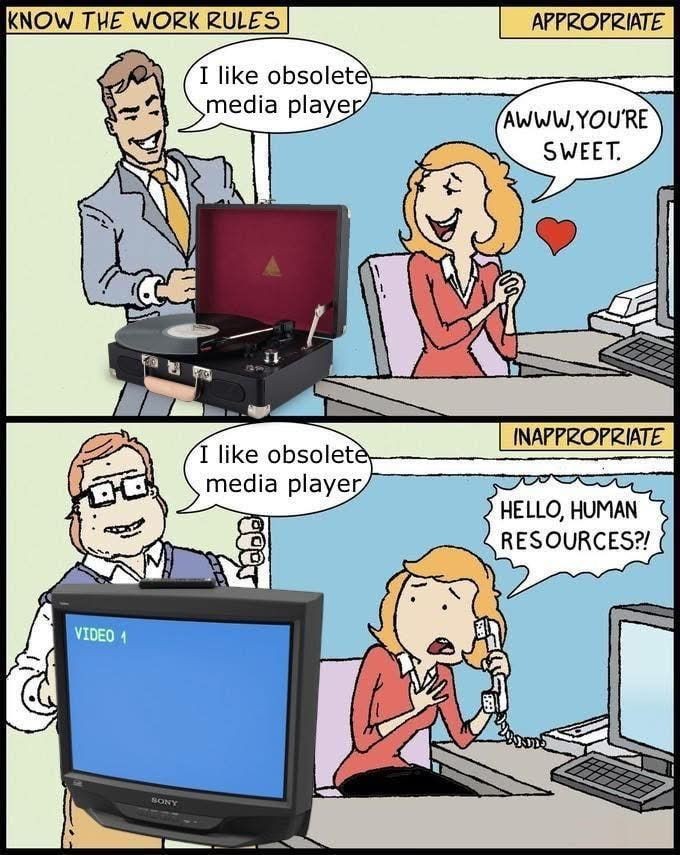

man i shouldve kept my box tv
VHS next to DVD on a CRT is why lol.
Good sound fidelity is easier to reach on a vinyl record than good video fidelity on magnetic tape. Hence why even old TV shows that were shot on film look great on modern TVs, but their tape counterparts look dated.
That all being said, VHS has inherently more sentimental value due to its widespread use for personal and home video. Anyone still using vinyl is either a hobbyist, collector, or moronic audiophile who can’t cope with stuff like opus or even flac/wav.


Okay fair but do you know anyone who actually used D-VHS lol.
Sony digi beta was the industry standard for quite a while
Well maybe I do! Or maybe I don’t! I’ll never tell!
VHS or dvd? That things main use is video games lol
I was always taught to be a bit scared about potential burn-in if playing games on our projection TV…never seemed to actually have it happen though. 🤔
Another point is that the one on the top is a premium model, whereas the one on the bottom is meant for us plebeian masses.
the one on the top is the cheapest, worst turntable you can possibly buy. they’re so cheaply made they don’t even play records reliably
don’t even play records reliably
As compared to the one on the bottom, that might look like a junk plastic box from outside, but will most probably do what it does after swapping a few capacitors.
And still, said cheapest model is not significantly cheaper than the thing on the bottom.
So yes, I’m going with premium.
But of course, considering that you are the second person to refute my claim, I feel the need to state that I am going by the meaning of the marketing word, “premium” and not the original meaning.
You really think portable vinyl player is the premium model? Oh you sweet summer child…
Premium ⇒ functionally worth less than what you are paying for, in turn for form.
Yes.
Because they weren’t made as stylish. If you had that exact same tv, but with wood-style paneling and the occasional velvet lining, it would be exactly as charming. Nice style has been phased out over time, being reserved for extremely expensive versions of appliances instead of being the standard.
And like, that’s not to say there’s literally no nice style in anything these days, but the average product tends to look… bland and cheap.
I don’t really think that is true, those big wood TVs mostly aren’t especially stylish, and neither are recorded players.
Although style is obviously subjective so I suppose our miles varyThey have nice styling today. You just can’t afford it. To be clear, I can’t either
Wanna come by my place later and check out my… Sony Trinitron?
Yes. I really do.
Don’t expect anything sexy or nothin’, I’m genuinely in this for the Trinitron. Do you have retro consoles or should I bring mine?

those large Mitsubishi tv’s that killed their tv side.
To be fair, most CRT TVs are the equivalent of like a cheap not-classy record player. A nice big 1200p CRT computer monitor is a lot more classy
people would love crt tvs. i have hounding me for crts
It’s gotto be real analogue vintage

Nope. Too vintage! Those are old enough to be haunted now. O_O
(Well, dang, so are N64 cartridges so…)
Try playing Control with all the settings maxed out on 540p and have it be the most amazing looking game you’ve ever seen
Metal Gear Solid ruined me.
I can’t see the VIDEO text of the OSD without thinking of the HIDEO fourth wall break during the Psycho Mantis scrap.
Not old enough.
I mean I think CRTs are going back into vogue as a nifty thing in many indie circles, including on YouTube where you see a lot of smaller creators embracing the aesthetic nowadays.
Meanwhile the hardcore smash community never left crt because latency.
Although Melee was the first big ‘hardcore’ Smash community I was aware of, there are quite a few of its contemporaries in the Counter Strike community that also stuck with CRTs…
I’m so torn. On one hand, cool! These things are still seeing use and stay out of landfills!
On the other hand, always a bit frustrating, this cycle of things no longer produced suddenly coming back into style with enthusiasts, and everyone trying to hustle it to get rich quick on eBay.
I have 5 computer CRTs, but even I find that a bit much. Commodore 1702, 1080, 1902, 1950, and the green screen in a PET.
Don’t fret. In 20 years’ time future hipsters will romanticize bleeding colors, dogshit resolution and subpar color space and call it “so much nicer to watch”.
Video games have been doing that for over a decade at this point
I even saw mainstream ads on TV that deliberately have this look (and in 4/3 ratio !)
There’s a weird debate about the audio quality on VHS. Under the right conditions (right tape, right player, right source) it could be shockingly good – perhaps even better than CD audio, despite not being remembered terribly fondly.
If you really want to wow the ladies, be the one guy with a music collection on VHS.
Well this is going to be an interesting rabbit hole…
In I go!
Better than CD is a pretty bold claim. That format is near perfect for listening quality.
Agreed. Main issue is “better” is subjective and doesn’t always mean the same thing to different people.
I have dabbled in other tape formats, and one thing stands out to me about the compact cassette (not VHS): most people used them in the car, where conditions were bad for cassette storage. Car cassette players also tended to have poorer quality mechanisms and heads. As a result, many people remember the format being bad, when in fact, it was more about their use case. A quality home cassette deck with a quality cassette (e.g. type II or chrome) stored in the right conditions is capable of extremely good results.
Not sure if there is something similar with VHS audio, though. Very different format. I just know there is a debate, but it could be entirely bogus.
The debate is basically bogus. There are very few analog audio formats that can reproduce an audio signal more accurately than a CD, and even then, that’s only because CDs use a 44.1KHz sampling rate and 16bit encoding. There is no analog audio format that can rival a 32bit 96KHz PCM recording, and that’s not even the best digital recording available. CD chose 44.1KHz and 16bit because it’s nearly perfect for the range and sensitivity of human hearing. It’s only when you need to record ultrasound or extremely low amplitude sound that you would use something better.
Fun fact: if you add some hisses and pops and a little bit of compression to CD audio before playing it, some people (me included) will say it sounds better.
Fun fact: if you add some hisses and pops and a little bit of compression to CD audio before playing it, some people (me included) will say it sounds better.
This sounds fun. I wonder if there’s an explanation for why that is?
Lo-Fi ALL THE THINGS!!!
This is why the debate still exists:
There is no analog audio format that can rival a 32bit 96KHz PWM recording, and that’s not even the best digital recording available
Analog audio is not sampled. By definition, it includes more data than any sampled version.
Now, the benefits of the sampling in terms of reducing format noise or similar are (subjectively) up for debate.
Totally agree with things sounding better if you introduce noise. I suspect it has to do with sampling, and maybe is not well understood.
Fun fact: if you add some hisses and pops and a little bit of compression to CD audio before playing it, some people (me included) will say it sounds better.
Exactly. It is subjective. It’s not about right or wrong.
I think there are things (like above) where the measurements are misguided. But at the end of the day, even that doesn’t matter.
Analog audio not being sampled doesn’t really matter. It’s like film, it can’t have infinite “resolution”. It’s the size of the granules on the tape and the speed the tape is moving that determines how good audio can sound. Grain size is kind of equivalent to floating point resolution, and tape speed is kind of equivalent to sampling rate. In order to get as true-to-life audio reproduction as 32-bit 96KHz PCM, you’d need absolutely wildly expensive tape and equipment. I’m not even sure if it’s physically possible.
When you say by definition it includes “more data”, you have to think about what that data is. There’s signal, the stuff you want to record, and there’s noise, the stuff that gets on there that you didn’t want. The higher precision a digital recording is, the higher the signal-to-noise ratio. Unlike analog tape, there’s not really a theoretical upper limit (just the limits of your recording hardware). If you record with a high enough precision, you can record incredibly quiet or incredibly loud sounds, way out of the range of the best audio tape. Same with frequencies. The faster your sampling rate, the higher the frequencies you can record. And unlike tape, it’s not going to shred itself to pieces if you go really really high.
Things sound “better” when you introduce noise because people like analog recordings. Not actual analog recordings, mind you, just the appearance of analog recordings. It has nothing to do with audio quality, it’s just vibes. It gives good vibes.
You’re definitely correct on the 32-bit dynamic range side of things, as that’s more dynamic range than a human can perceive.
However I feel like I read a little while ago, that a standard record industry 15 IPS reel-to-reel master tape (on some high quality tape formulation, I imagine) sits somewhere between 96khz and 192khz equivalent sample rate. Though there is every chance it was from Reddit or something. Do you happen to know if that stacks up?
That doesn’t sound right unless you’re running the tape at faster than usual speed. Even high quality reel to reel tape is usually running at a speed that tops out around 20KHz. There’s also no reason to record frequencies much higher than that unless you’re trying to record ultrasound. A 96KHz sampling rate can record sound up to 48KHz. Considering even the best human hearing can’t hear above about 24KHz, there’s no reason to use that for music. It’s only if you’re recording something not meant for human hearing, like stress fractures, electric noise, or bird song, that you’d use a recording with that sampling rate.
I totally agree it’s just vibes. I’m sorry if I suggested otherwise, but most of my point is about audio being subjective.
If everything is subjective, then some people will like tape.
Ok, yeah. I get you. It definitely is subjective, and I like tape. :) I have a huge tape and vinyl collection. And I have an all-analog setup to listen to it. Tube pre-amp and tube amp. For me, I know it’s less accurate audio, but I want that less accurate audio.
Brb. Recording all my records into my vcr.
A VHS physically can’t be better than CD audio. The tape would have to move faster than the VHS equipment is designed for. The Hi-Fi VHS audio system can come close to CD’s frequency range, but there is still about 70 dB signal-to-noise (compared to CD’s 98 dB), and there is always loss when writing to and reading from analog tape. CD is not destructively read, so any signal up to 22KHz will be reproducible the exact same way every time.
Hi-Fi VHS audio is nearly as good as CD audio (the best consumer analog audio format, in fact), but it’s not as good. The simple fact is that an appropriately comparably sampled digital PCM recording will always beat an analog recording. You can read about the Nyquist-Shannon theorem for an actual proof, but basically CD audio is near-perfect for almost every human’s hearing range (most people can’t hear above 20KHz).
I’d like to gloat that I can still hear above 20kHz, but I can’t be sure if it’s just my audio consumer-grade equipment creating undertones. Although my Headphone says it can do 28, I have no idea about the stock sound drivers on the devices.
I totally agree that CD should be better.
I really wasn’t trying to make a point, except that a simple search shows that the debate about VHS vs CD exists.
I don’t think it comes down to either one being objectively better.
Records and their players are tangible. You don’t need any electricity to play a record. It is a kind of magic the human mind can comprehend.
VHS tapes and cathode ray tubes on the other hand work with magnets and quantum physics and shit. Nobody knows how they fucking work.
You don’t need any electricity to play a record
Are we talking about the hand-cranked players from the olden days?
Yes, but you can also spin a modern player and just listen closely to the needle.
Yeah, there’s something about the physicality of a record player and records that changes the experience. At least for me it encourages more focus on the listening. Even if you just put something on while you do something else, you’re going to be interacting with again before super long.
The record, the part you interact with, has size and weight. It’s definitively a “thing”. And choosing a record is a choice. You can’t just press some buttons on a remote and change to whatever else (unless it’s a full music system setup).
Plus the beautiful art on the sleeves, and the time it takes to get the record out forces you to spend at least a little time with that art.
With a CRT TV, you’re using a remote and there’s a lot more abstraction and layers between the physical object holding the content and your actual consumption of it.
VHS tapes are physical, but the moving parts that make it all work are hidden away in the VCR and the magnetic tape isn’t really touchable. Playing one on most TVs required another device plugged into the TV and pressing some buttons on one or two remotes that could just as easily bring you other content without ever leaving your seat.
There is art on the VHS case, but it’s not like it takes time to get the tape in and out, so you’re not as likely to look at it for long.
Most importantly, people are still making new record players and records. There was a long while where it was a very niche thing, and there weren’t a lot of new records coming out, but there were still new players coming out. And the technology is simple enough that the average person could at least keep a player in working order or fix the most common issues themselves. Enthusiasts could even “fix” an old machine with modern parts that are readily available, as long as they function the same. It’s not like people are going to stop making electric motors anytime in the next century.
CRTs simply aren’t manufactured anymore. Depending on the issue they aren’t end user servicable for the average person, or even most enthusiasts. Maintenance is potentially dangerous to the person doing the work. The parts have limited lifespans with no replacements available for the main bits. If the electron guns start to go, you can potentially rejuvanate them with special equipment, or you can end up breaking a damaged one entirely (see 10:32 of this video about restoring an old arcade cabinet).
It’s the same (sans danger to the person doing the repair) for VCRs. No new stock, specialized parts that can’t be swapped for more readily availble modern components, you get the picture.
And that’s also not considering the fucking weight of a good size CRT compared to a record player.
Don’t get me wrong. I love CRTs. Pretty sure I still have my childhood one in my basement, complete with some discoloration from when my 8 year old self had some fun with magnets.
I was legitimately distraught when my wife talked me into only keeping one of the three CRT TVs we had gathering dust, and I think I still have one or two CRT monitors stashed away somewhere.
I spent multiple weekends years ago looking up and configuring the best CRT shader for emulators so it looked like an idealized version of that childhood TV.
But I entirely get why records and record players are such strong and well thought of “nostalgia bait” and CRTs and VHS tapes are not.