I would think Steam is big enough to make deals with local card vendors in individual countries.
I bet that would also be a lot cheaper than PayPal.No need for Steam to make their own as some suggest, it would be insane to have a system just for one business.
And it would be a serious limitation for Steam, because many won’t bother signing up for it.They could, but in Europe each country has at least one local payment systems. It was just more convenient to provide a few global players instead of dozens local ones. Many online shops here too is just local player + visa/Mastercard. That might change now that the global players get too controlling. (Not speaking for entire EU, just the part I visited.)
They could, but in Europe each country has at least one local payment systems.
Huh? https://www.ecb.europa.eu/paym/integration/retail/sepa/html/index.en.html
That works for account to account transfers and in shop payment with your card. The online payment world is still a lot more fragmented.
That works for account to account transfers
Yeah, so? https://www.europeanpaymentscouncil.eu/what-we-do/sepa-instant-credit-transfer
The online payment world is still a lot more fragmented.
Valve literally only needs an EU bank account. Doesn’t help the rest of the world but the outlandish claim was that within Europe Valve would need to support “at least one local payment system” per country and that’s just wrong.
I believe Valve already supports all the local payment systems in Europe, though they’ll only show it to you if you’re in one of those countries (the payment processing flow asks you which country are you paying from upfront and then uses that to display the various payment systems available for that country).
Same for GOG, by the way.
The problem is mainly that to sell to anywhere in Europe a seller has to integrate with the many local payment systems out there, which is a lot of work for a small seller.
Um, no? They can provide an IBAN and then you can pay almost instantly with most banks, with the worst ones taking a business day or two.
That’s for bank transfers, not for payments.
Mind you, you often can pay stuff online in Europe via bank transfer if it’s within the Eurozone (and the fact that it works from anywhere to anywhere in the Eurozone for the same cost as a local transfer, rather than just locally in each country is exactly because SEPA has been standardized and the regulator has forced banks to charge the same for transfers between different countries in the Eurozone as they do for transfers within their own country), but it’s not reliably available in sellers and is a bit more convoluted than pure payment systems (basically you have to use your bank’s online site or app to transfer money to the account the seller provides you).
No actual payment systems are standardized across Europe yet, though various country-specific ones have been getting together and setting up cross-compatibility, but none of those covers more than a handful of countries.
That’s for bank transfers, not for payments.
Let be blow your mind: Transfer money to Valve’s EU bank account, get the game in return.
As I wrote elsewhere, Steam already supports all the European national payment systems, which are all more convenient than bank transfers.
(I actually tested it when writing another post and the Steam payment processing flow first asks you the country you’re paying for and then lists the payment systems for that country, and there I could see the standard national one of the country I gave)
GOG too also supports all the European national payment systems (I know because I switched to using those after the whole VISA/MasterCard/PayPal censorship crap happened).
Mind you, a lot of sellers in Europe do actually support paying by bank transfer (which goes via SEPA) but a lot don’t, plus it’s a bit less convenient than a dedicate payment system (though if you do the bank transfer from a banking app in your smartphone it’s reasonably simple plus some of those payment systems are really just a convenience layer - say an app scanning a QR-code for automated payment - over the whole “open the transfer screen and manually enter 20-something digits and an euro amount”).
Mind you, a lot of sellers in Europe do actually support paying by bank transfer (which goes via SEPA) but a lot don’t
This is not about what “a lot of sellers” do, it’s what Valve could do as an easy alternative in one big region of the world.
though if you do the bank transfer from a banking app in your smartphone it’s reasonably simple plus some of those payment systems are really just a convenience layer - say an app scanning a QR-code for automated payment - over the whole “open the transfer screen and manually enter 20-something digits and an euro amount”
Making SEPA money transfer by scanning a Qr code from the bank’s app is literally a thing. That’s how I paid the dentist a couple of months ago.
Well, as I said, Steam already supports all the national payment systems in Europe and yeah, since I’ve switched away from PayPal in GOG, my game payments have also been done by scanning a QR code from the banking app (which goes via an intermediary but ultimately gets turned into a SEPA transfer).
Sure, Steam could add bank transfer payments. They don’t need to as in Europe they already have the VISA/MasterCard/PayPal mafia problem solved, but it would be nice if they did (actually the whole split between payment-system and bank-transfer disappearing and it becoming a single mechanism is probably a good idea).
The lack of a pan-European payment system that’s accepted anywhere in the World isn’t a problem for Steam, it’s a general problem for Europeans wanting to avoid using VISA/MasterCard/PayPal in all their payments no matter where the seller is located (plus even in Europe a bunch of things such as car rental often require a Credit Card). It’s solved for the likes of Steam, but not for other sellers (for example I buy eBooks books from a US based seller who doesn’t support anything but PayPal, VISA and MasterCard and the same when I buy stuff from AliExpress),
When it comes to Steam, the problem of them being dependent for payments on VISA/MasterCard/PayPal is outside Europe, not in Europe.
That is true, I am also in EU, and I use Visa for purchases outside Denmark and also for Steam.
We also have local payment systems that are mostly exclusive to Denmark. Many have Visa but not all, so only accepting Visa may lose Steam some business.
To cover Denmark 100% they will need to accept Dankort or MobilePay by Danske Bank. Everybody here have both of those, and they are both cheap and excellent to use.
I personally don’t have PayPal because I despise the company for their high rates.Many online shops here too is just local player + visa/Mastercard.
In principle that would be the same for Steam, local player is the local service for the country the customer is in.
Steam is multinational, and has business enough in each country to support the local players. It’s extra work to set up, but also cheaper prices for Steam than Paypal and also cheaper than Visa in most cases.
So I think they’d make money on it over using PayPal.
For all the people saying Valve should become their own payment processor. PayPal employs 24,000 people. Visa employs 31,000. Mastercard employs 35,000. Valve employs 400. They’re not going to 60x their employee count anytime soon.
PayPal/Visa/MasterCard do way more than just payment processing for one company.
Valve wouldn’t need 25,000 employees just to process payments for their own platform.
They could do it with significantly fewer people, for themselves and even for GOG, Itch and potentially others. Their use-case is digital payments for games, which is limited in scope and risk. PCI and compliance is a PITA, but manageable.
The hard part isn’t processing payment… They already basically do that for themselves with the steam wallet.
The problem is getting the ability to withdraw funds from your customers’ bank accounts. That requires a commercial relationship with your customer’s bank and going through an insane amount of red tape. And there is no standard worldwide protocol for this, you’ll be starting from zero in every market by cold-calling major banks.
The only viable approach is to have an army of salespeople, accountants, and project managers to do all those individual negotiations.
The EU has been trying for years to have an indigenous continent-wide payment processor. The first attempt failed, now Wero is poised to succeed in the next few years but that’s building off negotiations that started a few years ago with pressure from the EU and buy-in from the financial sector, and still only a handful of European markets have been integrated at this point.
Now imagine all this difficulty but you have to also get active buy-in from every market worldwide. There’s a reason Visa/MC have a near monopoly on international payments in the western world, and it’s not that no-one else thought to get a piece of that very juicy pie that’s making them literally billions in profit every year.
Hmm. You are right, but they might not need it for every region. Steam is probably big enough that existing regional companies would come to it and be eager to form partnerships. They could become more of a payment processor aggregator, focused on a low risk market segment. And of course they can do CCs directly too - that’s the easy part.
The challenge will be to get consumers on board. I know that I groan every time I need to enter my CC details online these days.
They would face anti-competitive behaviour from Peepal though. So it’s a risk.
Internally, they are probably already working on ways to appropriately segment their catalog based on payment provider. “Sorry User, you cannot purchase title X using Paypal. We recommend $Competitor instead.”
Is it a payment processor problem, or a card issuer problem though?
It sounds like some payment processors are treating mastercard’s contractual requirements as a hard risk in this case - maybe it’s justified, maybe not. Try getting corporate lawyers to be risk averse in the finance world. Mastercard doesn’t seem to want to soften their wording but talks platitudes in public statements. Shrug.
Quantity is not quality.
The funny thing is that because Master Card is too afraid to actually accept any responsibility, using Master Card directly is still an option:

That means Master Card-powered PayPal Card should work.
Removed by mod
Meh. Paypal deserves everything bad that happens to it. Barely used it in the last few years. Definitely do NOT keep funds on there unless you’re okay with just losing them.
Long ago, I used to work for a small business that did most of its sales through eBay using PayPal. They were the single biggest impediment to our business, yoinking money away at the slightest excuse. It seemed like they just lived to screw us over.
I mean, I don’t want to keep funds in PayPal, but they make a good proxy for a credit card.
Credit card POS systems permit for me to do (reasonably, lack a trusted display or input mechanism) secure transactions. But I can’t do that with my computer — I don’t have a way to use a smartcard reader and purchase things online. I have to send my actual credentials to a vendor and trust that they’re treating them securely.
But if you use PayPal to pay at a vendor and then send that payment to a credit card, you avoid the security problems inherent to direct personal use of credit cards.
I’m not comfortable sending credit card data to sketchy-looking sites. With PayPal, worst case they don’t send me whatever I paid for.
Look into the Privacy app (kind of a terrible name honestly). It’s effectively a Paypal type system but one that issues CC numbers for each vendor or transaction and allows you to easily audit and manage them. It’s not perfect, but it’s a hell of a lot better than Paypal.
Use a virtual card like the ones from privacy. You can select if it’s a one time payment or a monthly payment and set limits.
It saved me many times from companies charging me way more than I agreed to. (Bought a phone and never activated it, they tried to charge me $150 the next year, but I used a virtual card!)
deleted by creator
It’s not a credit card, but I use Revolut and they have temporary virtual debit cards on their free plan even. They work a single time per generated card only. Great also if you want a 1 month subscription of something and don’t trust yourself to cancel it.
Btw this feature is exactly why certain companies are also banning Revolut cards; turns out authorizes for payments on a card that is about to disappear is a great way to not have to pay for anything (the Dutch OVPay had fraud issues with these cards for example).
deleted by creator
My provider unfortunately doesn’t, so I have to rely on PayPal as the proxy. I use USD, so I guess I won’t be too affected, but it is a bummer that I can’t seem to ditch them.
I don’t know if they do, but I’ve used a service before that provides similar functionality, a “temporary proxy credit card”, which also permits one to not even provide one’s real name and address to a vendor.
But it’s more work to set one up than it is to do a PayPal transaction. Like, I could do it if a vendor doesn’t permit for PayPal payments and I really really want what the vendor is selling, but PayPal does the big “the vendor doesn’t get your credentials” security fix and avoids creating extra hurdles for a purchaser to jump through.
Some Citi cards and privacy.com let you do this. Privacy.com takes a business day or two to verify you though
Revolut literally has this as a feature, single-use cards.
Additionally at least in Europe 3Dsecure is very common. It’s opt-in which makes it kinda weird, but still widely used.
If valve had the power to enter the payment processing industry, I would support.
They most likely already have half the knowledge, mainframe infrastructure is a different beast than servers but not a huge gap if you are Valve, they were responsible for half an EXABYTE of data traffic per month… IN 2015!!! Haven’t seen any new reports from them or Level 3 Communications (unaware if they still partner with them), to know current levels but its for sure at least 10 exabytes annually.
Edit: Getting some downvotes but unless proven other wise the data is there, I can understand not everyone in c/technology works in the industry like some of us but unless your source is this fucking idiot mainframes are still peak efficiency and peak speed and peak space efficiency and peak… you get the point. Ask IBM, at this point they own half the mainframes in the world and they still release enterprise Linux distros.
Anyway, clearly I was still under the impression L3C was still a thing, now they are part of lumen and while no longer in the S&P500 they still move around a fucking gazillion of exabytes everywhere.
Still regarding Vajve, turns out my predictions were very moderate, I was 33.3% of the way there, turns out in '18 they broke the 30 exabytes mark. With a very conservative trend analysis we can bet on Steam being responsible of 40% of Asia’s bandwidth by the end of the decade and 30% of North America’s. All in all they are on track to break the 50 exabyte mark this year alone.
Perhaps it’s time Valve get into its own payment business.
The problem is that if you make a PayPal equivalent, you’re still beholdent to MasterCard and Visa since you need them for people to actually add money to their account, and if you want to make a direct competitor to MasterCard and Visa, that’s basically impossible without government support because they’re way too entrenched, why would a business support a random new payment method that nobody is using yet.
I had heard that Steam used to accept crypto but the volatility of the currency was a major issue. Maybe try cryptocurrency again.
Perhaps they could set up a system where they could make a sale in bitcoin or something then immediately convert to USD. They could add a processing fee to the sale to cover any conversion fees.
I know nothing about actually doing any of this beyond having bought and sold BTC in the past. I was just wondering if it would be possible.
It was the support cost as far as I remember. Way too many people were too confused about how Bitcoin works.
Volatility was not the concern, at least for Valve. They’ve utilized a payment gateway that just swapped the BTC to USD right away. Which was still a single point of failure, but in case of bitcoin, the company switching a payment gateway does not affect the UX for the customer as much.
The problem was the artificially congested network causing unreliable transactions that would take too long which would make the price too volatile. Additionally fees were getting ridiculous when they stopped accepting them due to this congestion
That led to too many refunds or failed payments or payments that were no longer sufficient.
That resulted In a customer service nightmare.
All of those problems can be avoided today using a stable coin not on the bitcoin network.
The fundamental flaw with all current crypto is that it’s far too volatile to use as a currency. The only reasonable use for it at the moment is as a high risk commodity which is the vast overwhelming majority of what we see. Any so called “currency” that regularly sees price swings of multiple percentage points in a day isn’t actually a currency and is unsuitable to be used as one.
Adding to this is the problem of transaction times. Actual payment systems typically have transaction times of less than a second, occasionally a second or two. Bitcoin in contrast can take multiple minutes, sometimes hours or even days to confirm a transaction. There’s no way for Valve to accept and then immediately convert Crypto to USD. The process would inherently involve at least two transactions, one to transfer the crypto to Valves wallet, then a second to transfer from Valves wallet to the exchanges wallet, and only then could Valve attempt to sell that crypto. The financial uncertainty involved in all of that is entirely unacceptable for a business.
At this moment there is only one potentially viable way of approaching this and it’s government regulation of some kind. Either government needs to regulate that payment processors get no say in the contents of customers business, or else they need to regulate the adoption of a neutral digital payment system. One possible example of what that could look like would be the GNU Taler system which might eventually become a payment system in Switzerland but isn’t yet.
Your debit card transaction does not happen in seconds, it actually takes days to complete.
Yes, but actually no. In the strictest sense that is true in that it isn’t “officially” settled typically for a day or two. However, the reason why businesses are willing to accept credit card transactions is that there’s a soft approval that happens pretty much instantly and weeds out nearly every non-fraud instance of non-payment. Once that soft approval comes back (which remember happens within a second or two) the retailer can be confident that the card is tied to a valid account, that has a large enough balance to cover the transaction, and barring fraud dispute it will go through and they’ll get paid. If something were to go wrong in that process there’s also banks and the CC processor that the business could go after in court to get their money.
In contrast crypto takes several minutes to go through if not significantly longer, and if something goes wrong in that process there’s no legal recourse of any kind. If a business were to allow product to leave their store prior to that minute+ approval process and it fails, they’re screwed, they just have to eat that cost.
Yes. That’s why cryptocurrencies won’t work in a physical store because the customer would have to stay in store for several minutes until the merchant can release the product.
But this is not an issue for online marketplaces like Steam. Customers should be willing to wait 10-20 minutes to get their video game key, or for Amazon to start processing a delivery. Faster cryptocurrencies like Litecoin actually take around 3 minutes to confirm transactions. Mullvad’s model is pretty good, where your account doesn’t get updated until the transaction is confirmed.
It sounds like a good compromise, unless dealing with payment processor policies is not as bad as they make it sound.
Bitpay allows companies to accept crypto payments and receive it as real currency automatically.
Wait. Bitpay is still around? That was the company Valve has used before. It was the de-facto standard for every eshop accepting bitcoin. Until they decided to implement identity checks, and only support payment from wallets implementing certain protobuf-based payment protocol. Which made them slide into obscurity pretty fast.
It’s still around. Last time I used it, it only required identity verification for amounts over $100 or so. That was a few years ago. I didn’t hear that they’d changed. That’s too bad.
Genuine question, but what about stable coins?
There’s no way for Valve to accept and then immediately convert Crypto to USD.
I didn’t realize that. It does seem an insurmountable problem.
What about the so called ‘stablecoins’?
(Although those sound dodgy AF to me?, not backed 1-1 anymore?)
Afaik no current stablecoin is proven via audit to be 1-1 backed, not sure if any are still claiming it.
Algorithmic stablecoins on the other hand are only stableish; see the terra/luna fiasco
Stable coins… Aka gold? I heard gold is pretty stable.
Yes sir, I’d like to buy this game with this bar of gold. At Steam’s headquarters.
Cryptocurrency that is pegged 1-1 against a normal currency. I think they have some limitations though.
It was a joke. Mocking stable coins for how they never compare to golds stability.
deleted by creator
At this moment there is only one potentially viable way of approaching this and it’s government regulation of some kind. Either government needs to regulate that payment processors get no say in the contents of customers business, or else they need to regulate the adoption of a neutral digital payment system.
I think it’s more likely for me to win the mega jackpot, and I don’t even buy lottery tickets.
I expect the established banking/credit card industry is not likely to let Valve into their systems just to circumvent their restrictions. Valve would need to be able to validate Visa/Mastercard/Discover etc cards issued by any bank and be able to credit/debit them.
Monero works for anonymous payments for cocaine and fent across international boundaries, it can more than handle the illicit video game trade
Why don’t they implement crypto already? Nano would be perfect
because me and many others hear “<coin you never heard about> would be perfect” and cant help but to immediately think scam
Don’t get me wrong, i like the idea, crypto just generally has a super bad track record
Though nowadays most places that accept cryptocurrency payments only do so through the most well-known stable coins. Generally, just Bitcoin, Monero, USDC (fixed to the dollar), and maybe Ether or such. Random coins like DOGE or [insert strange acronym] aren’t really accepted for payments most anywhere. And this is just as a payment option, so it’s not like you need to use it. Like paying on Amazon through Klarna or whatever. Anyone who prefers payment through a bank account or bank card would continue to be able to do so.
fair point
Hello-ooo Klarna!
deleted by creator
Asking as an ignorant person, what’s wrong with PayPal?
They quite often steal your money.
deleted by creator
Isn’t that like all credit card payment processors? Maybe we should just use Monero
deleted by creator
Their policies, verification systems, KYC/AML processes, risk aversion, and customer support leave many PayPal users with unmet expectations, especially when there is an issue with the transaction and PayPal is asked to assist.
The company has found ways to avoid some of the regulations that banks are held to which is partly the reason for the issues.
If you search the web for PayPal experiences, you’ll find concerns such as their 1.3 star rating with almost 35,000 reviews on Trustpilot.
The company has found ways to avoid some of the regulations that banks are held to
If you look at all the unicorns of the past few decades, a surprisingly large number of them did it with software that wasn’t in any way technologically advanced, but exploited technology to find loopholes in the kind of industry regulations that were there to stop companies from screwing people over.
PayPal was a way to do banking without registering as a bank. Uber, Doordash and other gig economy apps are exercises in sidestepping employment law. Airbnb, despite its origins as a couchsurfing app, didn’t get huge until professional “hosts” started using it as a way to run apartment hotels without having to meet the expectations or obligations of one.
If you want to build a tech unicorn, all you need to ask yourself is, “how can I make something 5% more convenient and 200% more shit?”.
It’s also ridiculously difficult if not impossible to process a legal name change on your account, unlike a real bank. This means that married women, people who changed their name to avoid unsafe family members, and trans people are basically just not able to have accounts under their new legal names unless they’re willing to just make a new account if they can’t get anywhere with support. Supposedly, all you need is your legal documents, but I’ve heard a lot of horror stories about how convoluted they make it in practice.
A non exhaustive list of what makes them awful: https://expertbeacon.com/why-is-paypal-so-bad/
Afaik, the issue that was making the most victims, was that they were facilitating scammers that targeted sellers:
5. Good Luck Recouping Losses as a Seller in Disputes.
89% of sellers experienced dispute resolution problems with PayPal in 2021 surveys. Despite providing evidence the item shipped or service rendered, they lost cases and sums averaging $622.
This is driven by PayPal‘s buyer-favored review round taking 1-2 weeks. This favors scamming buyers at the expense of legitimate businesses.Iirc, there was a time when Paypal always sided with the buyer, irregardless of evidence or past track record, the review process was useless. Once scammers picked up on this and began scamming sellers en masse, Paypal still kept their policy unchanged for years and sellers started to raise their prices on platforms that forced them to accept Paypal (ebay used to do this). Ebay has since tossed Paypal off their platform. I don’t know if Paypal ever improved.
If you sell things on eBay and the like, PayPal likes to fuck you over
A few matters - About 5-6 years ago - PayPal was going to make telemarketing your phone number a requirement in order to have an account - If you had an account, they were going to FORCE you to allow their 3rd party marketing calls. No opt-out available whatsoever.
PayPal is also an owner of the extension Honey - an extension that promoted they would try every online coupon code to see if you could save money on a deal. Recently (within the last year) it was discovered that even if they didn’t provide you with any discount at all - they were still hijacking the referral links that brought you to the shop site in the first place. They were also striking deals to those same vendors about kickbacks to NOT keep the best coupons in their system. Essentially they were taking money from three sides, promoters, vendors, and the purchasers - all while NOT providing the best possible coupon codes - which was the whole advertised point of their service. Lawsuits on this are pending.
It’s got all the worst parts of extreme anti-fraud measures, like freezing your account and holding onto your money just because you did something suspicious like receive money, but without actually protecting anyone from fraud.
All the authority of a bank.
None of the responsibility.
Plus Peter Thiel and Elon Musk had a hand in it, and made their fortunes. It’s right up there with Hitler and Reagan in the “reasons to invent a time machine and go back and destroy something”.
It was founded and continues to be run by some real shitbags.
It’s pretty easy for a scammer to get your money from you via paypal with no recourse. Person claiming to be selling an item for x dollars. You purchase item. They get money. They disappear. No item. Paypal: “oh well!”
Well that’s how money transaction works. The only way for you to have any recourse in this situation is something that can enforce laws. Or avoiding the situation all together through a reputable escrow.
C’mon Valve… Make me a credit card pretty please.
Based on the screenshot someone else posted, they do have some kind of payment/currency system of their own, Steam Wallet.
I guess you could buy a physical Steam gift card in a store via any mechanism the store accepts, including cash, and then transfer it to that.
Yeah, that seems to be the best option for people w/o credit cards. It was useful for me before I got mine.
Maybe it’s possible that they can make some sort of pre-paid card esque solution, rather than fixed amounts?
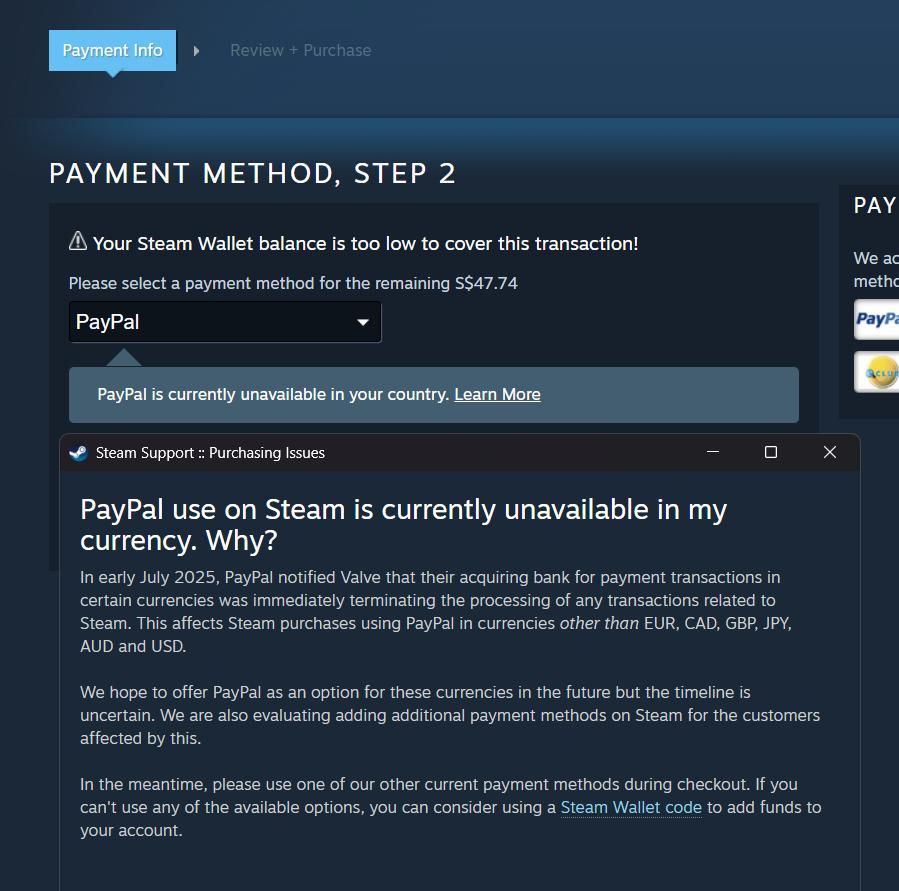
What happened to paypal?
Paypal changed banks and cannot accept currencies from most countries, resulting in the failures Steam is seeing. Source:
https://cdn.mos.cms.futurecdn.net/bpXXUDhPvYgsNn4SsrcdwD-1200-80.jpg
you can no longer
♫ pay your own waaaaaaaay ♫
It’s written in the article, related to the currency used.
I wouldn’t mind seeing a ValvePay system. 1% transaction fee, available to anyone who wants to use it, including OnlyFans, Itch, Kagura, DLSite, and others. Valve can team up with Japan, the EU, and Brazil to handle their respective ends of the business, so that Valve can focus on the United States.
or just use Wero which they are gonna use anyway
When will that happen though?
Depends a bit on the country since they are all transforming their national payment system to Wero, some of them already have it like Germany and Belgium will be getting it in October this year. The Netherands will get it 2026-01-01.
Will they? That would be awesome but I haven’t found any information on that.
Who Steam? Yeah they will be using Wero since they are currently supporting iDeal and the like which are changing to become Wero.
Based off what? The option are credit cards or crypto.
They don’t need a valve pay for crypto. They could easily accept something like USDC to accept crypto and not deal with volatility.
For credit cards all that would do is bypass the intermediaries if they directly integrated to a credit card company, and then they’d still be subject to their rules that the intermediaries claim they violate to protect MC etc from having to say it themselves. It’d solve absolutely nothing.
Also a direct integration like that is a multi billion dollar business and all the effort and expenses that would come with that without even solving the root problem.
This kind of problem is the exact reason crypto exists and is really the only solution even if it’s not perfect yet.
Edit: sorry, they could do a bank integration through ACH / EFT / Wires etc, but that’s slow and realistically not an option. If people want to buy something they won’t want to wait days for it.
Are you aware you can just transfer money between bank accounts, usually for free?
Much like with a credit card, you could just transfer money to Valve, which would be credited to your account, and you can then use it to buy stuff.
There’s no need for crypto anything.
You have completely missed the entire point of the number one cryptocurrency in the world. You’ll wish you had done some research. If you don’t believe me or don’t get it, I don’t have time to try to convince you, sorry.
👍
That takes time (days) that people don’t want to wait to make a purchase, nor do people want to leave a balance with companies or have to worry about topping it up so they have enough to buy the next game they happen to want without waiting.
Edit: Not to mention the risk of sharing bank account information.
For me it takes barely even a minute. What stone age banking systems are you using?
Bank to bank transfers typically show up in under an hour in my country, and you would obviously be able to credit your account ahead of time.
Even having to wait an hour is a fantastic way to lose a sale.
This is to top up your account, not make a purchase.
And that’s back to my point of people not wanting to leave money places in case they want to buy a game in the future.
Valve could extend a limited credit for the first two hours of play time. If after downloading and playing for two hours there’s still no confirmation from the bank, they’d then block your access to the game.
That’s actually a pretty realistic option given the 2 hour refund window.
Maybe allow it only after 1 successful deposit, and revoke it after 1 failure for a long period and X successful payments.
Also maybe only 1 game is playable if you happen to buy more than 1 in that time
Hours?? Lost of places (see EU, India, Japan) have instant transfers.
Ours is hourly for some reason, and it’s only recently they started doing that.
We need a lemmy instance for your country. sh.itdoesnt.work
but that’s slow and realistically not an option.
Neither are cryptocurrencies for most people.
I think the point is that Valve has the reach to start their own credit card network. It might be far fetched, but I’m old enough to remember when Sears launched the Discover card. It’s totally doable for a company that already has the technical capabilities of Valve.
I wonder if it would be simpler to launch a digital only credit card, IE no physical card exists? If you can load the card onto a device that supports tap to pay, that would be a very useful card.
I mean…I wouldn’t mind a physical card if it looked cool and shit.
That is such a monumental task and valve only has between 350-400 employees.
Stripe has around 8500 employees, and they only integrate with
credit cardbanks who integrate to the credit card companies. But they finally got a license to directly integrate so we might finally see that in the near future.When sears made the discover card, they had hundreds of thousands of employees, and they didn’t need to deal with all the digital shit we gotta deal with now.
they had hundreds of thousands of employees, and they didn’t need to deal with all the digital shit we gotta deal with now.
They needed hundreds of thousands of employees because they didn’t have “digital shit”. Today, the entirety of Discover Financial Services is around 21k, and probably falling.
If Valve did it, it wouldn’t be under the Valve organization anyways. It would be a subsidiary, and Valve has plenty of cash-flow to build it out.
The digital shit is so complicated it takes a huge amount of employees. Integrations with hardware (payment terminals), banks, setting up infrastructure so others can accept your payments, automated fraud detection, digital compliance in every country they want to target, it’s huuuuuuge. Thousands of employees.
It used to be do a carbon copy of the card and send us the receipt.
Valves internal structure wouldn’t scale to that size either, and they have no experience running a company of the size that would be required in a different structure.
What payment terminals? They could go years just being an online credit card. Hell, initially it wouldn’t be very different from any company that bills their customers. Start it as a Steam only thing, then add select partners one at a time. It doesn’t have to be in your grocery store on day one, or ever really. Fraud detection is easy when you can just yank the game back. Sears couldn’t do that when you bought a washing machine. I worked in banking infosec and I have no idea what “digital compliance” means in this context. The hardest compliance standards in this space are PCI, and those are defined and enforced on clients by the payment card industry itself.
Valves internal structure wouldn’t scale to that size either
Which is why I specifically said it would be run as a subsidiary.
and they have no experience running a company of the size that would be required in a different structure.
Gosh, where on Earth could they find people with experience running a company that would look like 99% of the companies in existence?
You’re just throwing shit on the wall and hoping something sticks. You could neigh say anything, and nothing in the world would ever be accomplished.
Fuck credit cards they are terrible for your finances.
Good riddance. Shady company from none other than the Muskrat.
No actually! Musks entire involvement with PayPal was being fired by the company he founded which then later down the road was bought out by PayPal when the people who fired him for incompetence turned it around and made it valuable enough PayPal wanted it
I think thiel is worse, also involved.
If digital payments are becoming a service problem, Steam might develop their own.
I actually think ramping up their gift card distribution to more countries might be more effective imo, since people have access to cash or payment systems at physical stores.
Gift cards are an obvious way to bypass regional pricing, so a low-income country like mine could get more harm than good (as in fraud increases and the storefront gives up ın regional pricing from that point on).
Also, when convenience of online shopping is lost, why would I bother wearing my shoes and get out to sun to purchase a gift card, while I can buy a physical copy of the game instead?
For a lot of games, especially games with low budgets that don’t make physical distribution possible (most indies on PC), they’re reliant on digital distribution, and Steam is the place for the majority of PC gamers to obtain their library. Also generally speaking for PC, physical distribution (apart from pirated files and niche scenarios), is basically already dead.
As for the regional pricing issue, Steam/Valve already looks at IP and regional activity (say a NA user temporarily VPN’s into Ukraine for a cheap price and then kills the VPN and plays from an NA ip afterwards) to flag accounts and restrict them from purchasing games in the future or gifting them to others. Because of that, I don’t think an increased volume of gift cards would be the issue (stolen credit cards are far more of a headache for Valve).
do they still make physical copies? if so, I’m pretty sure most indie developers cannot afford that…
Tbh I could not be arsed to go somewhere to buy a gift card to then use it. I’m more likely to use another platform to buy a game.
It’s not that I don’t have values. I just don’t feel strongly enough about using Steam to make that trip just for a gift card.
Digital gift cards would be okay though.
Digital gift cards would be okay though.
They already exist
That’s fair. The ball is in Paypal’s court anyway, but I guess digital/prepaid gift cards could also be on the table as well.
you don’t have to make a trip just for that. you can just visit the shop next time you’re nearby.
Of course, but that would mean delaying a purchase by a day or more
Not if you buy a gift card before you find a game you want
I wonder if this will just make them return bitcoin as an option to pay. It’s been 8 years since they dropped it and it has fewer large fluctuations now, it seems.
It still fluctuates a lot. If they were going to accept bitcoin I as a game developer would want them to get it into something a bit harder almost instantly. I don’t want it staying in bitcoin here it can lose its value, for no reason at all, at the drop of a hat. Under the current system steam tend to hold on to money until the end of the month and then pay you, that wouldn’t work with bitcoin.
Bitcoin cash maybe as it’s not limited to a small block size, but as others have said, there are probably better options out there now.
BCH has been dead for years (even if it doesn’t know if yet)